Multiple Chinese humanoid robot firms race to perform at 2026 Spring Festival Gala, signaling a move from stage to home, industry experts say
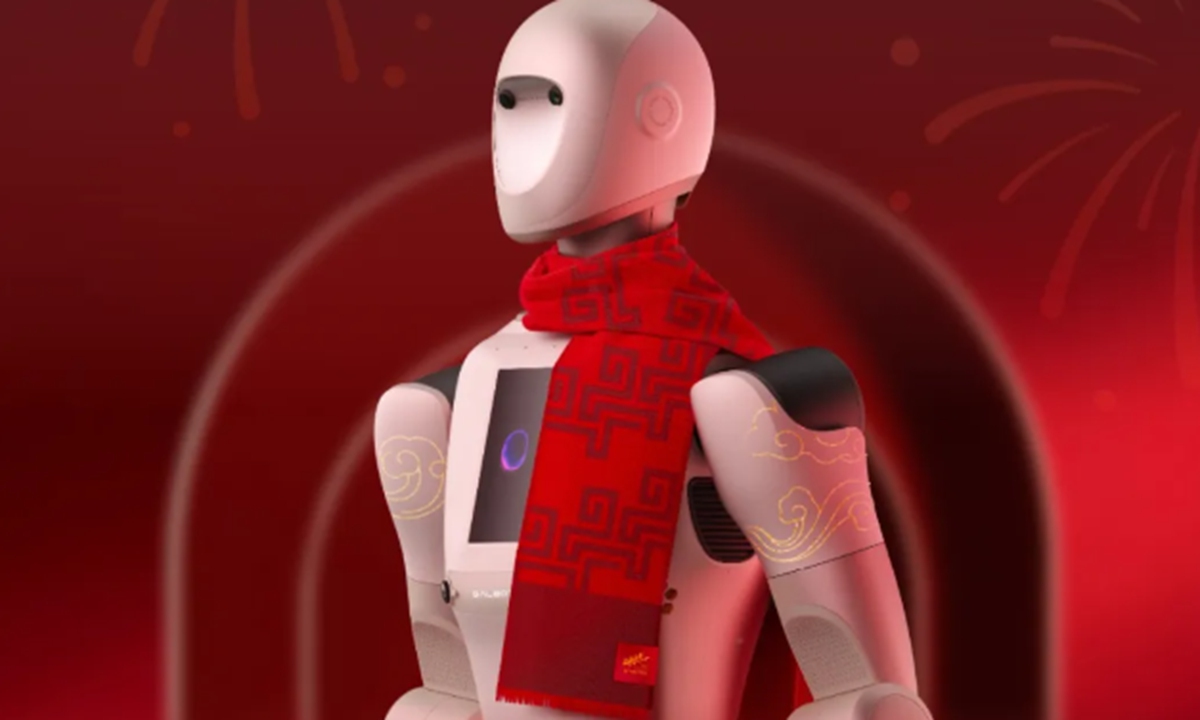
Photo: file
China's Spring Festival Gala has completed its second round of rehearsals, with humanoid robots once again emerging as one of the most closely watched highlights. So far, four robotics companies have officially announced their participation in the gala.
Sources familiar with the matter told the Global Times that competition among robotics firms for a gala appearance has been intense, with the final lineup undergoing several rounds of discussion and revision before the partnerships were confirmed.
Unitree Robotics, MagicLab, Galbot and Noetix Robotics have all announced themselves as official partners of the 2026 Spring Festival Gala on their WeChat accounts. A representative surnamed Huang from Unitree told the Global Times that while details of the performance cannot yet be disclosed, this time the stage will be linked to acrobatic maneuvers beyond the well-known backflip, he said.
Observers who have followed the humanoid robot industry may recall a time when robots still struggled with basic locomotion. Today, however, humanoid robots are increasingly capable of executing complex martial arts-style movements, including backflips and side-flips, underscoring the rapid pace of technological progress.
In a video released by MagicLab in November 2025, its humanoid robot Z1 demonstrated further upgrades in athletic ability, performing cartwheels and high kicks, while also identifying and dodging incoming arrows, illustrating advances in both motion control and perception.
Participation in the Spring Festival Gala serves not only as a way to build public awareness of humanoid robots but also as a "soft platform" for companies to demonstrate their technological capabilities, Zhao Mingguo, director of Tsinghua University's Robotics Control Laboratory, told the Global Times.
Using the three participating companies as examples, Zhao said Unitree's core strength lies in motion control technology, with industry-leading algorithms for high-dynamic movement optimization in both quadruped and humanoid robots. MagicLab, by contrast, has achieved over 90 percent in-house development of key hardware components such as joint modules, dexterous hands and reducers, while adopting a "brain + cerebellum" dual-mode architecture that balances complex task planning with real-time motion control. Galbot has pioneered a training pipeline that combines synthetic simulation data with smaller amounts of real-world data.
Earlier, when asked whether Unitree's humanoid robot that had excelled in track events could be adapted for broader use, Unitree founder and CEO Wang Xingxing told the Global Times that the company has long explored diverse application scenarios, ranging from industrial use and scientific research to AI development and certain service sectors.
"The Spring Festival Gala is a showcase," Zhao said. "The real goal for these robots and the companies behind them is to enter people's daily production and living scenarios."
At a press conference on January 21, the State Council Information Office announced that by 2025, more than 140 domestic manufacturers had released more than 330 humanoid robot models. Chinese humanoid robots are now able to "stand firmly, walk steadily and run quickly," accelerating the transition from "moving on stage" and "running on the track" to "working in factories" and "serving in households," according to CCTV News.
By the end of 2025, several entry-level home-use humanoid robots had entered the market. These included the Booster K1 designed for education and research, Unitree's R1 which is capable of voice and vision-based multimodal interaction for simple household tasks, and Noetix's Bumi, a family companion and programming education robot priced at 9,998 yuan ($1,400).
What now bridges the gap between stage performances and real-world household or industrial applications lies in technology and data, Jiang Zheyuan, founder of Noetix, previously told the Global Times. He said that humanoid robots had not entered the consumer market earlier because the technology was not mature enough and model generalization capabilities were insufficient for tasks such as elderly care and domestic services.
"Now we are seeing many companies making serious efforts to improve model generalization," Zhao said.
In terms of market rollout, Li Qingdu, executive dean of the Institute of Intelligent Machines at the University of Shanghai for Science and Technology and founder of DroidUp Robotics, told the Global Times that most current orders still come from business clients. As a result, the company plans to first deploy humanoid robots in public service venues.
Meanwhile, policy guidelines released on Thursday by the Ministry of Civil Affairs to advance technological innovation in civil affairs call for the broad application of humanoid robots, brain-computer interfaces and artificial intelligence. The document emphasizes addressing the full life-cycle needs of elder adults, including daily care, rehabilitation, psychological support and emotional companionship, according to CCTV News.
"When real-world interaction data across the embodied intelligence sector increases to a sufficient level, the overall intelligence of robots will rise significantly," Li said. "That is when humanoid robots will truly be ready to move from the stage into the home."
RELATED ARTICLES