Expert highlights challenges facing rescue operations after mudslide hits border port in SW.China's Xizang
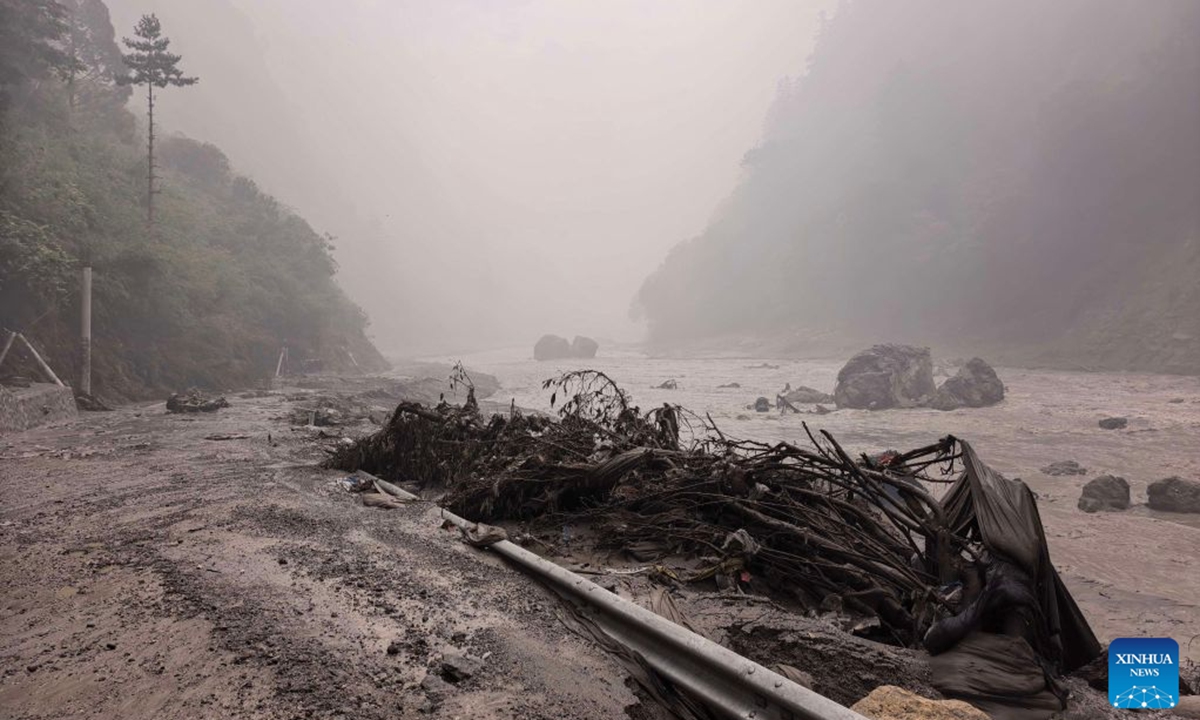
An area near Gyirong Port in southwest China's Xizang Autonomous Region on August 26, 2026. A mudslide struck near Gyirong Port in Xizang on Wednesday. Photo: the Xinhua News Agency
After a mudslide caused significant casualties along the China-Nepal border, a Chinese expert said that the current rescue efforts are facing great challenges, including the uncertainty over the stability of the landslide source area and the narrow terrain, according to CCTV News on Wednesday.The mudslide occurred on Wednesday morning in Nepal, resulting in three people dead and 265 missing at Gyirong Port in Gyirong County of Southwest China's Xizang Autonomous Region as of 8 pm, according to initial estimates, the Xinhua News Agency reported.
Xizang has activated its highest-level relief and emergency response for natural disasters. The local People's Liberation Army and armed police have also sent rescue and relief teams to the scene, according to Xinhua.
Chen Hongqi, a senior-level engineer at the geological disaster technical guidance center under the Ministry of Natural Resources, said that the rescue efforts are facing significant difficulties, which can be summarized into four aspects, per the CCTV News report.
First, the stability of the damaged area at the source of the landslide remains unclear, posing challenges to the prevention of secondary disasters, Chen said. The water conditions in the tributary channels and the upper reaches of the main channel are uncertain, and their stability has yet to be determined, he added.
In addition, the area is characterized by high mountains, deep valleys, and concentrated water collection, making rainfall a key factor influencing rescue operations. The narrow terrain also poses challenges, requiring strict precautions against mountain collapses, landslides, and falling rocks along access routes, the expert noted, according to CCTV News.
The local meteorological observatory forecasts continued rainfall across Gyirong County from Wednesday evening through Sunday, warning of possible floods, landslides and other secondary disasters in low-lying areas, per Xinhua.
Global Times
RELATED ARTICLES