Targeting Chinese-funded steel plant, Manila is nothing more than a puppet: Global Times editorial

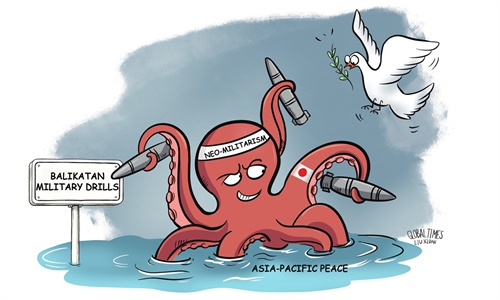
Illustration: Liu Rui/GT
US military power is penetrating ever deeper into the Philippines' economic sphere, and US intelligence agencies make no secret of viewing the country as a forward node in the US' strategic competition with China. Under this logic, any Chinese-affiliated company, infrastructure project or personnel could be assigned a particular "security risk" or "influence" designation. Once this logic becomes normalized, Sanjia Steel plant will not be the only entity to be affected.
Who exactly has been behind the continued attacks on Chinese-invested steel plants in the Philippines? The answer is becoming increasingly clear. On August 19, US and Philippine military personnel attempted to access a steel plant belonging to Sanjia Steel Corp, a Chinese-invested company in Misamis Oriental province, under the pretext of "scoping" the site, triggering an uproar after the incident came to light. The US Embassy in Manila quickly issued a statement, claiming that the visit was part of routine site-planning work to assess its potential for the upcoming 2027 Balikatan military exercises between the US and the Philippines.
The "coincidence" is that on May 15, the Philippines raided the Sanjia Steel Corp plant and arbitrarily detained dozens of Chinese workers. The operation was led by Philippine Defense Secretary Gilbert Teodoro, who maintains close ties with the Pentagon. The Philippine authorities have mobilized substantial forces to raid steel plants with Chinese investment, deploying multiple branches of the armed forces, including the army, air force and coast guard, rather than administrative or law-enforcement agencies responsible for product inspections or environmental checks. This raised questions in the international community: Why were the armed forces leading the operations? The appearance of US troops at the Sanjia Steel Corp plant has provided an answer.
An even more "coincidental" discovery emerged when we reviewed an open-source report from a US intelligence agency published not long ago. The report, which purportedly examined "[China's] influence at the US-Philippine Enhanced Defense Cooperation Agreement (EDCA) sites," acknowledged that the nine US military bases in the Philippines had provoked "ongoing domestic resistance" among Filipinos, while negative views of the US "contrasts with [China's] approach" in the country.
The report also put forward policy recommendations, including one explicitly suggesting that the US government can "support the Philippines in investigating illegal [China]-linked activity within its territory," particularly "properties, businesses, and labor recruitment activities near EDCA sites." The Sanjia Steel Corp plant is less than 30 kilometers in a straight line from one of the EDCA air bases.
This report is not an academic discussion. It was produced by the National Geospatial-Intelligence Agency (NGA), a combat support agency under the US Department of Defense and one of the principal members of the US intelligence community. Against the backdrop of Chinese companies being welcomed by local communities as they invest and establish businesses, while US military bases continue to fuel security anxiety, it is not difficult to see that Washington makes no secret of its desire to use the Philippine government to drive Chinese-invested companies out, laying the groundwork for turning the Philippines into a US "military forward position." If a public report can be this brazen, it is not hard to imagine how many underhanded tactics targeting China may be contained in materials that have not been made public.
Given the enormous scale of the industrial park where the Sanjia Steel Corp plant is located, with multiple functions including industrial production, port operations and logistics - and especially given its proximity to an EDCA site - it is hardly accidental that it has drawn the attention of the US as Washington seeks to expand its military presence in the Philippines. The US military's "scoping" of the Sanjia Steel Corp plant could have at least three implications. First, the US military may be assessing the area's potential military utility. Second, it may be conducting a closer assessment of the presence of Chinese-invested companies within the Philippines' strategic space. Third, US attention to Chinese-invested companies may be expanding from the economic sphere into the military sphere.
US military activities in the Philippines have already expanded beyond traditional military bases into a wider range of areas, and US intelligence agencies make no secret of viewing these locations as forward nodes in the US' strategic competition with China. Under this logic, any Chinese-affiliated company, infrastructure project or personnel could be assigned a particular "security risk" or "influence" designation.
Once this logic becomes normalized, Sanjia Steel will not be the only entity to be affected - particularly in areas deemed militarily valuable by the Pentagon. They may already have been viewed by the US as "low-hanging fruit." Today, the US may assess whether a steel plant is suitable for military exercises; tomorrow, it could assess a Chinese-invested port, industrial park or energy facility. Today, it may scrutinize the activities of employees of Chinese-funded companies; tomorrow, more Chinese investment projects could be brought under so-called "national security" reviews.
Teodoro, who has invariably done the Pentagon's bidding, is little more than a puppet on the Pentagon's strings. The Marcos administration has long accepted a posture of deference toward the US and "subordination" to its own armed forces. Behind this political manipulation lies the ugly reality of Philippine politicians surrendering their sovereignty to Washington and sacrificing the country's future development. If US military power penetrates ever deeper into the Philippine economic sphere, it will be anything but beneficial for the Philippines. Filipinos need foreign investment, industrialization, jobs and infrastructure, as well as a stable external environment. If an increasing number of normal economic activities are placed under the shadow of great-power competition, the damage will ultimately extend beyond the legitimate interests of Chinese-invested companies to the Philippines' own investment climate and development interests.
RELATED ARTICLES