Illustration: Liu Xidan/GT
Editor's Note:
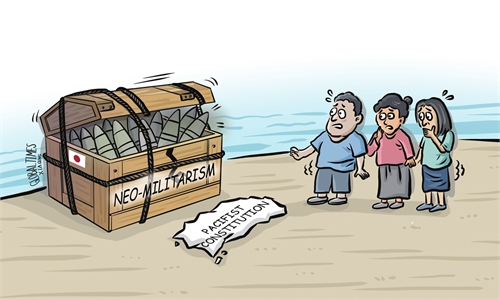
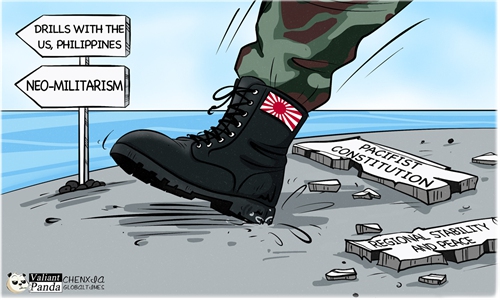
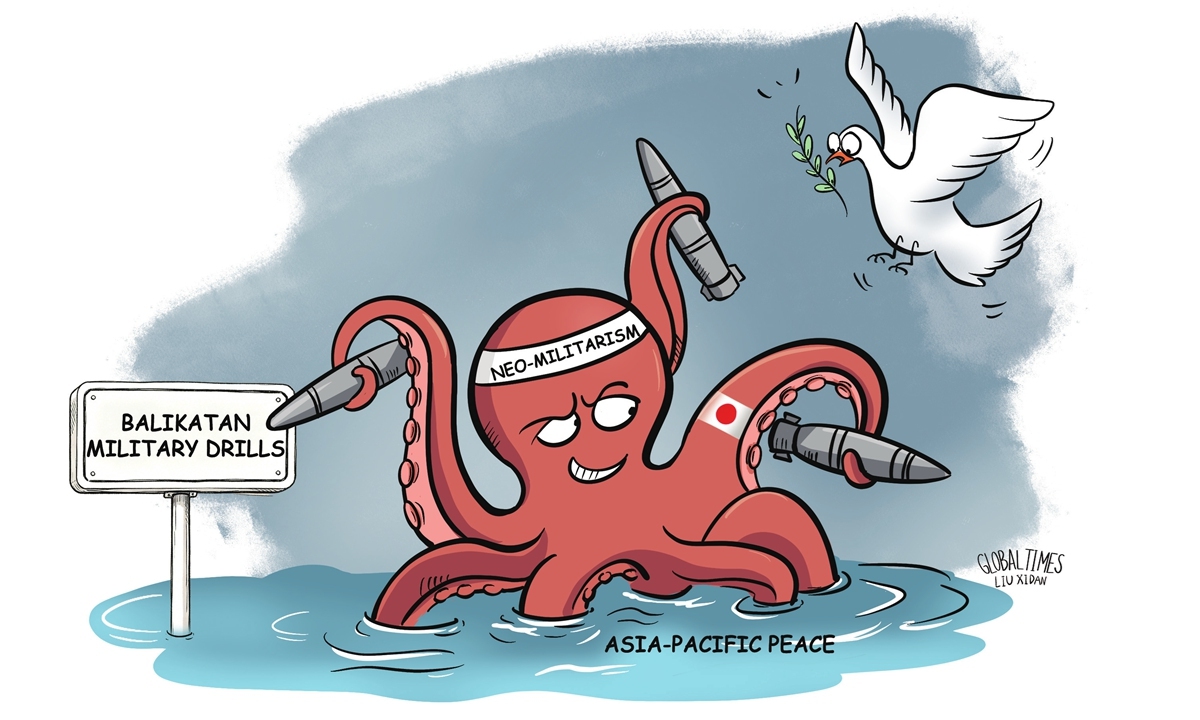
As Japan accelerates its military buildup, inks major new arms export deals and joins the annual Balikatan, or "shoulder-to-shoulder," drills as a full participant for the first time alongside the US and Philippines, history casts a long shadow. The Japanese combat-capable troops that once invaded the Philippines as aggressors are now returning as so-called close partners. How do Filipinos see this return? And how does Southeast Asia feel about Japan's rapid remilitarization? Anna Rosario Malindog-Uy (Malindog-Uy), director and vice president for external affairs of the Asian Century Philippines Strategic Studies Institute, shared her views with Global Times (GT) reporter Li Aixin.
GT: Japan's recent series of military moves, including expanding long-range strike capabilities, approving record-high defense budgets and scraping restrictions on lethal arms exports, has drawn significant attention. From the perspective of the Philippines and Southeast Asia, are you concerned about these developments?
Malindog-Uy: Japan's recent military trajectory signals a decisive but calibrated transformation in its national security posture. Japan wants to expand networked security partnerships by engaging in minilateral groupings, with, for example, the Philippines, Australia and Europe, and participating in joint exercises and access agreements.
Yes, there is legitimate concern about strategic, historical and institutional risks. The concerns are real, though they vary in intensity across ASEAN. Historical memory remains sensitive. Japan's military expansion may trigger security competition. It weakens the ASEAN's centrality as security cooperation is shifting toward minilateral alliances, sidelining ASEAN.
GT: Japan's Ministry of Foreign Affairs recently released the results of its 2025 fiscal year public opinion survey on Japan in Southeast Asia. The survey indicates that for the first time since its inception in 2021, Japan has fallen behind China in terms of being perceived as a reliable country. How do you interpret this outcome?
Malindog-Uy: The shift reflects China's rising influence, driven by deep economic ties and regional integration. ASEAN ranking China above Japan signals a growing desire for regional autonomy and self-reliance.
Japan's expanding security role may be creating mixed perceptions and adding a slight caution. Overall, attitudes in Southeast Asia are fluid and pragmatic rather than fixed.
GT: Looking back at postwar Japan-Southeast Asia relations, what has been the dominant tone over the long term? What do you see as the root causes behind the recent changes in Southeast Asian attitudes toward Japan?
Malindog-Uy: Japan-Southeast Asia relations have been built on economic development, aid and Japan's pacifist, non-threatening posture. Japan was seen as a reliable partner without military ambition, reinforced by decades of cooperation and the Fukuda Doctrine.
The drivers of recent changes in perception of Japan include, first, China's economic rise, and strong trade and investment ties that are reshaping regional perceptions. Second, Japan's security shift by expanding its military role introduces mixed feelings. Third, great-power competition: Trust is becoming more strategic and interest-based, rather than historical. Fourth, ASEAN identity: growing desire for regional autonomy over reliance on external powers.
GT: Japan is dispatching combat troops to participate in the ongoing Balikatan joint military exercises with the US and the Philippines. In the context of recent military discipline issues in Japan and the rise of right-wing sentiments, do you think pushing forward with overseas military engagements will heighten regional concerns?
Malindog-Uy: Japan's overseas military engagement will heighten regional sensitivity, especially when paired with incidents of military misconduct and rising nationalist perceptions. These issues, while isolated, can shape a broader negative narrative when combined with Japan's expanding military role.
GT: The Japanese combat-capable troops, which once invaded the Philippines as aggressors, are now returning to Philippine soil as "close partners" and participating in the multinational Balikatan exercises. How do you view this transformation from history to reality?
Malindog-Uy: Filipinos today hold layered views: Older generations remember wartime trauma, but younger generations see Japan as a reliable economic and strategic partner. Trust in Japan is conditional, grounded in continued acknowledgment of history. Revisiting WWII history is still important, not to reopen wounds, but to preserve accountability and sustain trust, especially as Japan expands its military role.
RELATED ARTICLES