Japan’s military transformation is generating growing unease across Southeast Asia
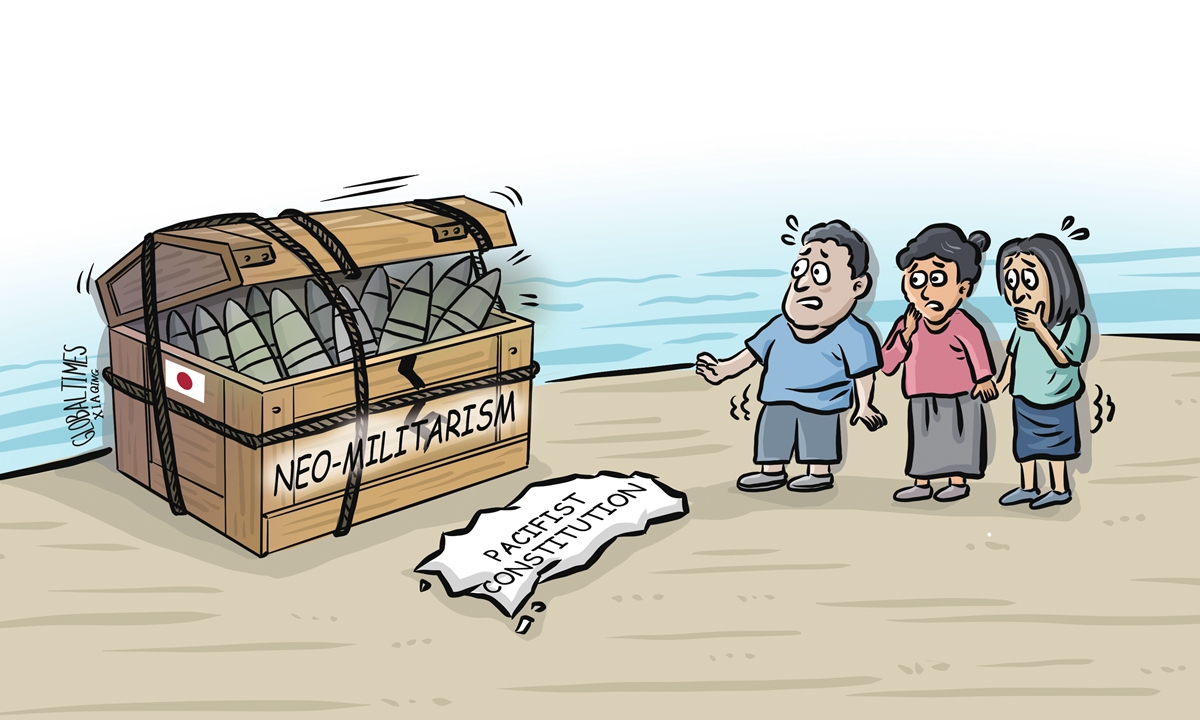
Illustration: Xia Qing/GT
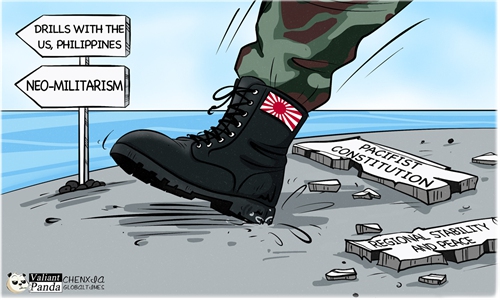
Editor's Note:Japan's accelerating military transformation is eroding trust among Southeast Asian countries. In recent months, from Tokyo's push to promote arms exports in the Asia-Pacific, the first post-World War II deployment of Japanese Self-Defense Forces to the Philippines for the "Balikatan" military exercises, to its explicit attempt to amend its pacifist constitution, concerns over Japan's expanding military role have continued to grow. Against this backdrop, the Global Times invited three scholars from Southeast Asian countries to examine how Tokyo's evolving security posture is perceived across the region. Their analyses highlight a central tension: Japan's military transformation is increasingly fueling unease among Southeast Asian societies.
Peter T.C. Chang, former deputy director of the Institute of China Studies at the University of Malaya and a research associate at the China-Malaysia Friendship Association
A troubling move was taken by Japan when it announced it would deploy its domestically developed long-range missiles in Kyushu. With a range of approximately 620 miles [1,000 kilometers], these weapons are capable of reaching parts of China's coastline, marking the latest step in Tokyo's most significant military shift since WWII.
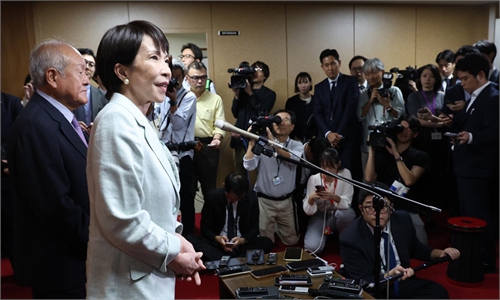
For decades, Japan's security posture was anchored in the 1977 "Fukuda Doctrine," which explicitly pledged that Tokyo would never become a military power. That era is now ending. Under Prime Minister Sanae Takaichi, Japan has accelerated its defense spending to 2 percent of GDP - two years ahead of schedule.
Southeast Asia's anxieties stem from two interrelated concerns.
First, history casts a long shadow. The legacy of Japanese militarism and its brutal occupation of Southeast Asia during WWII remains alive in the memories of many families. Recent actions by Japanese leaders have, at times, risked reopening these wounds. For instance, Takaichi's visit to a war memorial in Kuala Lumpur during an ASEAN meeting in 2025 - without explicit acknowledgment of wartime atrocities - drew criticism and revived historical sensitivities.
Second, there is growing concern that Japan is being drawn into a more confrontational posture toward China, one that could destabilize the region. The missile deployment, coupled with deepening trilateral security cooperation with the US and the Philippines, is viewed by some as heightening strategic tensions and pressuring Southeast Asian countries toward an unwelcome choice between Beijing and Washington.
These anxieties point to a broader shift: Whereas Japan once built its regional influence primarily through economic cooperation and development assistance, its current trajectory places greater emphasis on security alignment and military capability. For ASEAN countries that have long prioritized strategic autonomy, this evolution is deeply unsettling.
Japan maintains that these moves are purely defensive, aimed at deterring unilateral changes to the regional status quo. Yet perceptions matter immensely in international relations. As Japan arms itself and actively seeks to shape the military capabilities of its Southeast Asian partners, it risks being seen not as a stabilizing force, but as a catalyst for an arms race it claims to oppose.
Rommel Banlaoi, director of the Philippines-China Studies Center at Diliman College and president of the Philippine Society for International Security Studies
Japan's accelerated defense transformation is redefining Asia's current security architecture. Once defined by its pacifist constitution, Japan is now pursuing neo-militarism, displaying an unprecedented rise in defense spending, wider acquisition of counterstrike capabilities, and deeper integration with US military strategy.
While Japan frames these moves as necessary responses to China's growing regional security influence, they stir unease and exacerbate security anxiety in Southeast Asia, where the principle of amity and cooperation is central to regional stability.
From a security studies perspective, Japan's neo-militarism is not simply defense modernization - it is a highly strategic identity shift. Japan is signaling to its neighbors that it will assume greater "responsibility" for its own defense and regional order.
Yet, Southeast Asian countries regard this problematic military recalibration with utter suspicion. The Philippines, Indonesia, Malaysia and Singapore, for example, all endured Japanese brutal occupation during WWII. Those painful experiences continue to shape perceptions of Japan's military resurgence.
In the Philippines, memories of massacres, such as the Manila Massacre of 1945, which involved atrocities committed against Filipino civilians by Japanese troops, and the suffering of "comfort women," remain vivid reminders of the dangers of unchecked militarism. Survivors continue to demand justice and reparations, highlighting the enduring trauma of these atrocities that remain in the memories of Filipinos.
Japan's neo-militarism also stands in stark contrast to China's principle of peaceful coexistence. Japan's military resurgence, by contrast, signals confrontation and deterrence. This divergence places Southeast Asia in a difficult position: caught between China's call for coexistence and Japan's embrace of militarized deterrence.
Japan's neo-militarism, therefore, risks destabilizing ASEAN's delicate balance of neutrality. While Southeast Asia undeniably values Japan as an economic partner and development ally, its military resurgence threatens to undermine these contributions. Without transparency and restraint, Japan's military actions may be perceived as hegemonic rather than defensive. In effect, Japan's neo-militarism runs counter to ASEAN's principle of amity and cooperation.
Japan's neo-militarism risks reviving the very fears that Southeast Asia has sought to overcome since the end of WWII. For China and ASEAN, the imperative is to insist that regional security be built on dialogue, trust and cooperation - not on militarization. Japan must decide whether its future role will reinforce these principles or undermine them.
Only by rejecting neo-militarism and embracing peace-oriented engagements can Japan hope to transform Southeast Asia's security anxiety into a genuine regional partnership.
Muhammad Abdurrohim, a research coordinator of the ASEAN-China Research Center of Universitas Indonesia
On the question of Japan's remilitarization, Indonesia's concerns quietly align closer to Beijing's than Western narratives typically acknowledge.
Indonesia's foreign policy community understands that Japan's rearmament trajectory is structurally inseparable from Washington's strategic design. Japan's defense budget expansion, its acquisition of counterstrike capabilities and its aggressive push to export lethal defense equipment are deeply embedded within the US' Indo-Pacific containment architecture, which is explicitly engineered to counterbalance China's regional influence. This is what transforms Japan's remilitarization from a bilateral historical concern into a systemic regional destabilizer. A rearmed Japan operating as Washington's forward security partner fundamentally threatens the strategic equilibrium that ASEAN's collective framework depends upon.
From Indonesia's perspective, this US-Japan security convergence produces a deeply uncomfortable regional asymmetry. Southeast Asian countries risk becoming passive objects of great power competition rather than autonomous shapers of regional order. Japan's incremental bilateral defense engagements across the region quietly erode the collective institutional frameworks through which ASEAN has historically managed external pressures. This bilateralization strategy, enthusiastically supported by Washington, functionally marginalizes ASEAN centrality, the very principle Indonesia considers non-negotiable.
China's regional engagement, by contrast, has predominantly operated through multilateral economic frameworks, infrastructure investment and institutional partnerships that nominally respect ASEAN's collective agency. Jakarta's strategic instinct recognizes that it is the US-Japan security architecture that most aggressively seeks to redraw Southeast Asia's geopolitical alignment with US interest in the region, an approach Indonesia opposes, as it could bring instability to the region.
Indonesia's most urgent challenge remains developing the strategic coherence to prevent Japan's accelerating remilitarization, backed by Washington, from fragmenting ASEAN's collective agency entirely. The region does not need a rearmed Japan as its security guarantor. It needs great powers that respect the region's right to determine its own strategic future, which is a principle that, on the current trajectory, Beijing articulates far more consistently than Tokyo or Washington.
RELATED ARTICLES