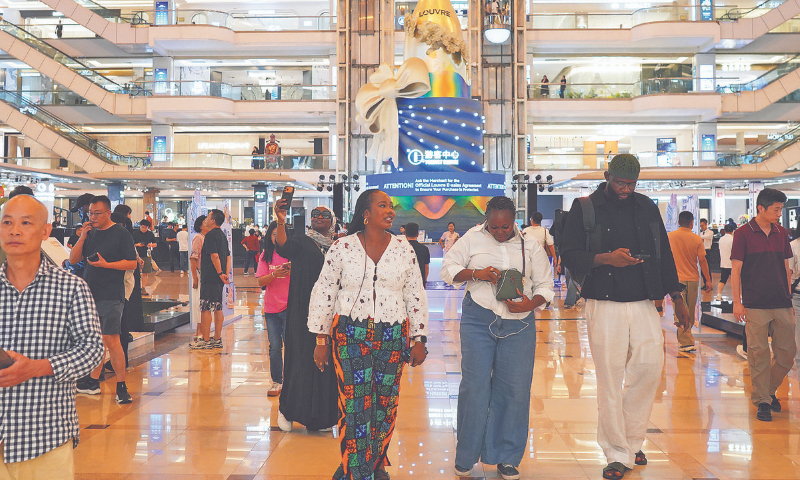
International buyers are selecting furniture at a home furnishing exhibition center in Foshan, South China's Guangdong Province. Photo: Courtesy of Foshan
Located in the heart of the Pearl River Delta, Foshan in Guangdong province is a national renowned historical and cultural city whose name dates back to the Tang Dynasty (618-907).
As a key birthplace of Lingnan culture, Foshan has long served as a vibrant hub of commerce and industry. Today, it continues to embody a pioneering spirit of reform and innovation, having grown into a national recognized innovative city.
Home to two trillion-yuan ($297.6 billion) industrial clusters in equipment manufacturing and pan-home furnishing, Foshan is globally renowned for its time-honored reputation - "Where there is a home, there are Foshan-made products." The city perfectly blends the elegance of Lingnan cultural heritage with the modern vitality of a world-class manufacturing hub.
A fertile ground for industry and entrepreneurship
Foshan's strong industrial foundation has turned countless entrepreneurial dreams into reality.
More than a decade ago, Tajikistani entrepreneur Alimov Jahongir first visited Lecong township in Foshan while studying in China. He was stunned by the sight of more than 180 furniture malls stretching for more than 10 kilometers along a national highway. Today, the furniture industry is one of the main reasons he has chosen to stay in Foshan.
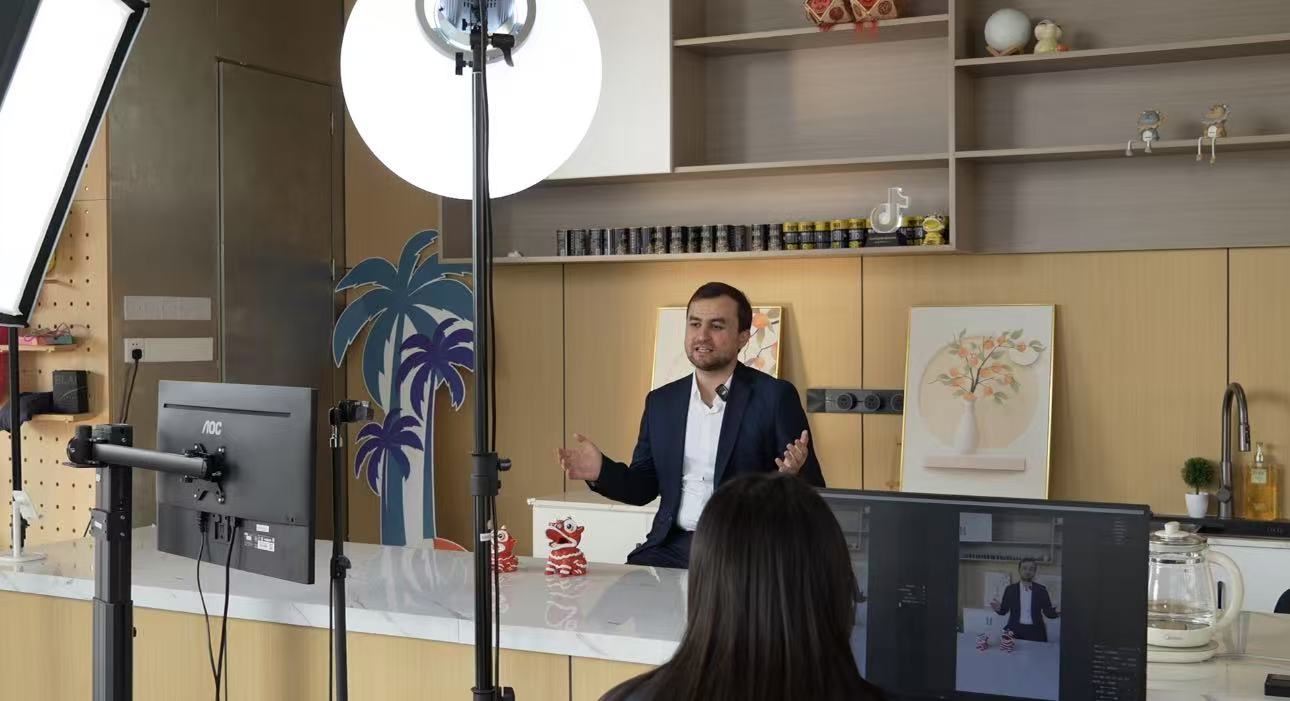
Alimov Jahongir promotes Foshan's furniture during a livestream session. (Photo/Lu Yuehui)
In 2024, he founded the Laowai Shuo Jiaju (Foreign Insights on Furniture) brand, providing overseas buyers with one‑stop solutions from material selection and logistics to cross-border marketing. He does not own a factory, but by tapping into Foshan's decades-old industrial foundation and extensive network of suppliers and manufacturers, he has built a thriving business.Today, Foshan has developed a highly integrated industrial ecosystem covering everything from raw materials, design and manufacturing to warehousing and logistics. Lecong alone is home to more than 10,000 furniture businesses and more than 2,600 manufacturing enterprises, facilitating annual transactions worth more than 80 billion yuan.
For Jahongir, finding the right business partners is all it takes to quickly connect his business with the local industrial chain.
To foster a first-class business environment, Foshan has introduced 123 targeted reforms over the past five years, based on the needs of businesses throughout their life cycles. The city has shifted from providing businesses with "whatever services are available" to providing "whatever services businesses need."
In the first half of 2026, Foshan's furniture exports reached 10.21 billion yuan, up 11.8 percent year on year. Digital technologies and intelligent manufacturing are breathing new life into traditional industries, while "Made in Foshan" is expanding beyond products to encompass comprehensive solutions.
Jahongir has opened a showroom in Dushanbe, capital of Tajikistan, determined to build a bridge connecting Foshan with markets around the world.
A hub of innovation where an ancient city looks to the future
If Jahongir has witnessed how traditional industries can create new value, Mathias Uller Rothmann has discovered Foshan's potential as a hub of cutting-edge innovation.
A postdoctoral researcher at the University of Oxford and a specialist in perovskite solar cells, Rothmann came to Foshan four years ago. He was surprised to find that a city known for traditional manufacturing could offer such a broad platform for his research.
"Here we have excellent research facilities, and traditional manufacturing and cutting-edge technology are not separated from each other," he said.
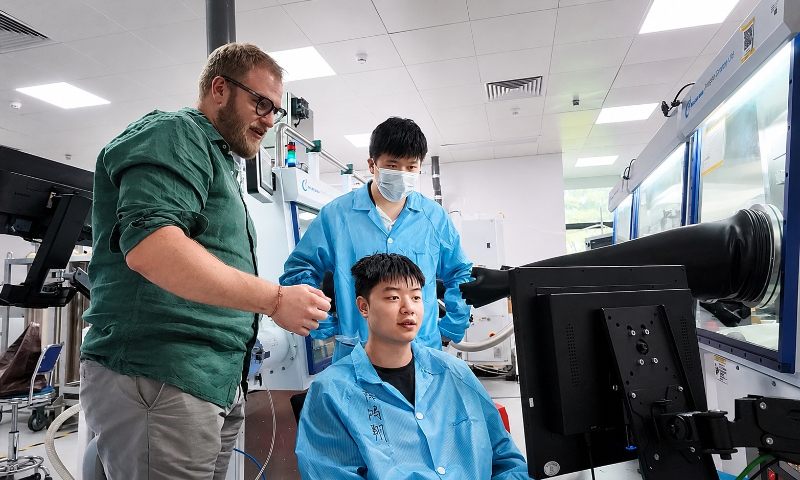
Mathias Uller Rothmann instructs his students to conduct experiments. (People's Daily/Song Yiran)
The vast pool of enterprises, equipment and application scenarios accumulated by the Pearl River Delta's manufacturing clusters allows researchers to bring real-world industrial challenges back to the laboratory and then test their research achievements in actual production.
Foshan is now home to 126,600 industrial enterprises. The city has established 25 proof-of-concept centers and 91 pilot-scale testing platforms.
The laboratory where Rothmann works has built a pilot production line for 100-megawatt perovskite photovoltaic modules. In addition, Xianhu Laboratory has assembled a research team of nearly 200 researchers and forged deep ties with some 200 local hydrogen‑energy enterprises to advance hydrogen‑energy applications across transportation, industry and other sectors.
To Matthias, Foshan is "ancient yet forward‑thinking": it keeps its eyes fixed on the future and consistently invests in it. He sees himself as a "partner" of the city, hoping his research can become part of Foshan's future growth.
Where heritage becomes part of modern life
A city that is both well-governed and pleasant to live in -- this is the deep impression Foshan has left on American native Ruben Diaz Jr.
Drawn to Foshan by Bruce Lee's movies, Ruben settled in the city in 2012. He soon discovered the reality of Foshan was far richer and more complex than anything he had seen on screen. Over the past decade, the cityscape has changed dramatically, yet its traditional character has never faded.
In his spare time, Ruben often visits the Donghuali area around Foshan's 900-year-old Ancestral Temple. Its arcades, gray-brick buildings and stone-paved streets have been carefully preserved, while new businesses and activities have turned the historical neighborhood into a popular leisure destination.
Urban renewal has not diluted the city's cultural identity. Instead, it has breathed new life into traditional cultural treasures such as kung fu, Cantonese opera, lion dancing and Cantonese cuisine. Foshan is now home to 15 national-level intangible cultural heritage items.
As an English teacher and online content creator, Ruben has begun introducing Foshan to audiences overseas. He has found that foreigners are often less interested in broad cultural symbols such as kung fu and lion dancing, and more intrigued by the history and traditions behind everyday practices, such as tapping one's fingers on the table to show appreciation while drinking tea or local cooking customs.
Through answering questions from his followers, Ruben has come to understand the city anew and developed an even deeper affection for it.
In Foshan, traditional industries are brimming with new vitality, cutting‑edge technologies are taking root in its fertile manufacturing landscape. And people from all corners of the world are settling down, pursuing fulfilling lives.
Holding fast to its heritage, embracing innovation, and keeping its people rooted - this is precisely the secret behind the enduring vitality of this time‑honored city.
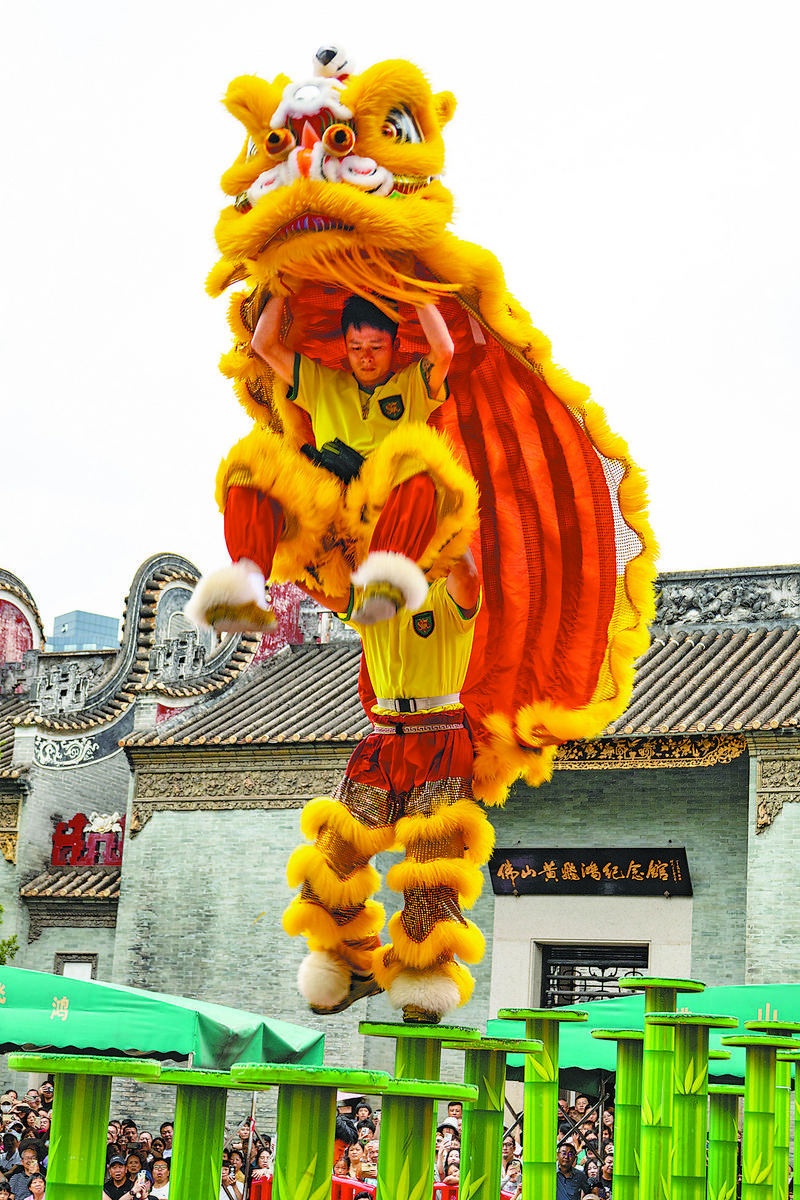
Photo shows a lion dance performance at the Ancestral Temple in Foshan, south China's Guangdong province. (Photo/Shi Jue)
RELATED ARTICLES