82-year-old Chinese hurdler wins world title, shows healthier, more active image of aging: expert
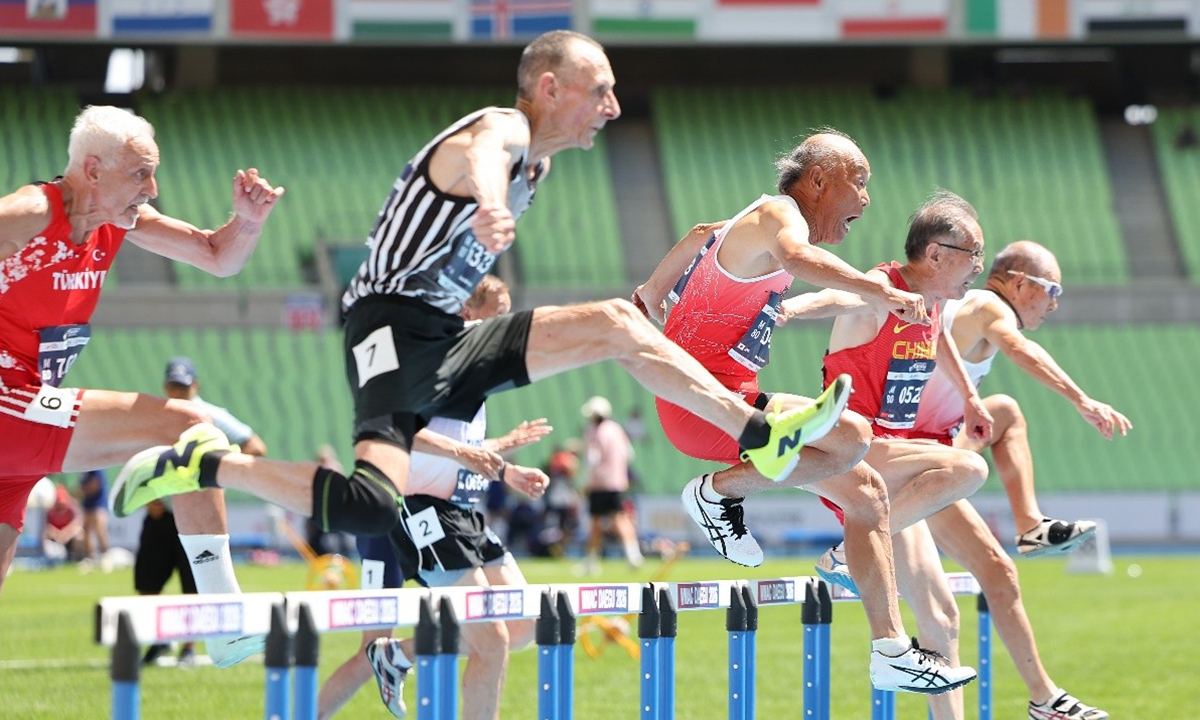
Senior athletes compete in a men's 80-meter hurdles at World Masters Athletics Championships (WMAC) held at Daegu Stadium in Daegu, South Korea on August 25, 2026. Photo: VCG
"There's no way I could outrun these grandpas!" "I probably couldn't even beat the last-place finisher!" Such comments poured in from Chinese netizens after 82-year-old Chinese athlete Ding Ming won the M80 (80-84 age group) men's 80-meter hurdles final at the World Masters Athletics Championships (WMAC) in the southern South Korean city of Daegu, reportedly setting a new Asian record.
Ding claimed the title with a time of 15.99 seconds, the official social media account of the WSE Athletics Open, a sport event certified by the Chinese Athletics Association, posted on Tuesday.
Two Japanese athletes finished second and third in 16.15 seconds and 16.53 seconds, respectively. According to Jimu News report, Ding's performance also broke the previous Asian record of 16.73 seconds held by Japan's Juji Tanaka.
Athletes from Turkey, New Zealand, France and Singapore also competed in the final, making Ding's victory at the age of 82 all the more striking.
Ding's achievement came against the backdrop of a championships where athletes are pushing the boundaries of age in competitive sport. More than 11,000 athletes from 106 countries are participating in this year's WMAC, which sets an age bottom line of 35, according to South Korea's Yonhap News Agency.
The oldest competitor is 106-year-old Thai athlete Sawang Janpram, who did not even begin exercising regularly until he was 80 and entered his first sporting competition at 97. Yonhap described the championships as a chance for senior athletes to prove that "age is just a number."
The 82-year-old athlete's victory offers a glimpse into the growing participation of elderly Chinese in sports and their increasingly active and healthy lifestyles, and can also be seen as a reflection of the progress made in building a Healthy China, Luo Le, a sports commentator from Beijing University of Chemical Technology, told the Global Times on Thursday.
Luo said that taking part in sports is about more than staying fit and preventing illness for elderly people. Sports also plays an important role in meeting elderly people's needs for social interaction, leisure and a richer life. Sports activities bring strangers together, helping them make friends and expand their social circles. In this sense, national fitness programs can improve not only physical health, but also the quality of life and social engagement.
In recent years, China has placed greater emphasis on sports for the elderly, which have become an important part of the national fitness program, with a range of supporting policies introduced.
Luo said that compared with the high costs of medication, hospitalization and surgery after people fall ill, improving health and reducing the risk of disease through exercise makes greater economic sense for both individuals and the society. It also reflects the idea of moving the focus of healthcare further toward prevention rather than treatment.
Luo noted that after retirement, many Chinese elderly people have more time and energy to devote to activities outside work, and sports can provide an important way for them to stay engaged, maintain social connections and find enjoyment in later life.
RELATED ARTICLES