Italian counselor stresses culture in bilateral relations: Friendship lies in true encounters beyond algorithms
Italian counselor stresses culture in bilateral relations
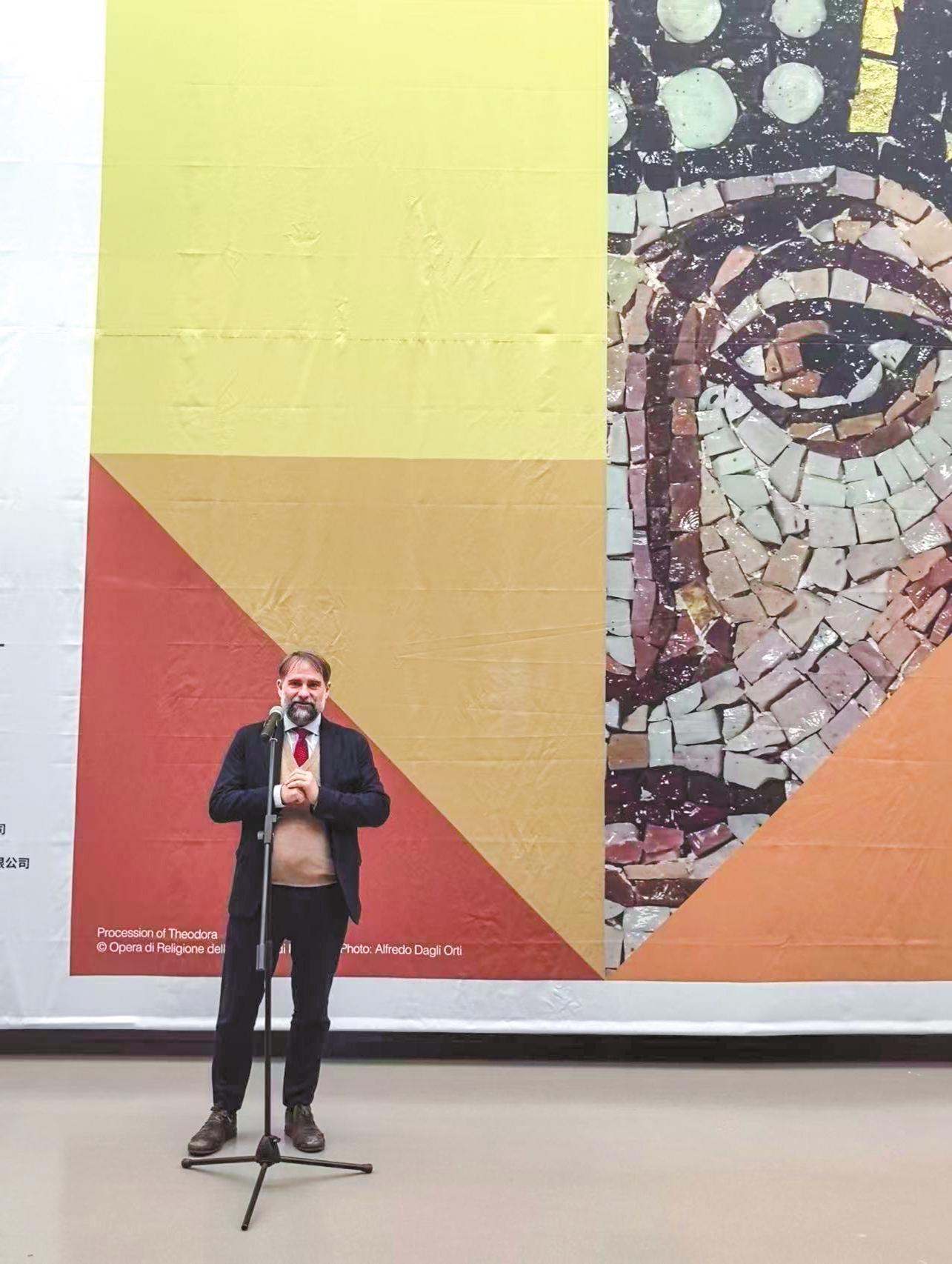
Federico Roberto Antonelli, the cultural counselor to the Italian Embassy in China gives remarks at an exhibition inauguration ceremony in Beijing on January 14, 2026. Photo: Dong Feng/GT
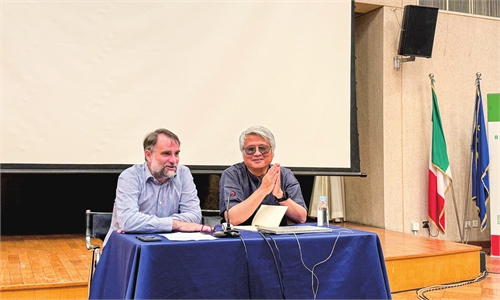
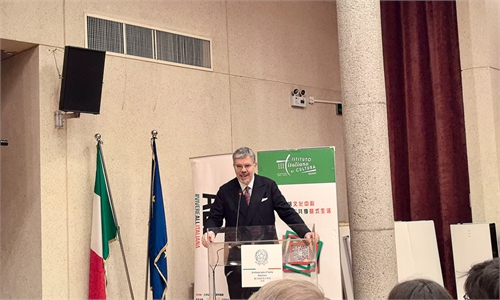
On August 25, Federico Roberto Antonelli, the cultural counselor to the Italian Embassy in China, gave an interview to the Global Times. The outgoing diplomat reflected on his 20-year diplomatic career in China.Antonelli's China story began before diplomacy. Influenced by his mother's diplomatic work from childhood, Antonelli first arrived in China at the age of two, accompanying his mother, a sinologist who served as the Cultural and Press Counselor at the Italian Embassy. He has personally witnessed the country's rapid, high-quality development over nearly half a century, spanning early days of reform and opening-up to the present day.
Antonelli shifted his focus from legal affairs to culture when he assumed the current role in 2022.
Since assuming the role of cultural counselor of the Italian embassy in China and director of the Italian Cultural Institute in Beijing in 2022, Antonelli has taken great pride in achievements including the widely acclaimed exhibition A Journey of Knowledge: The travels of Marco Polo and its legacy between East and West, which commemorated the 700th anniversary of Marco Polo's death - an initiative that fostered dialogue between the ancient civilizations of China and Italy amid a turbulent global landscape.
Through diverse channels - including exhibitions, music, children's book translation and publication in China, and Italian language promotion through grassroots singing competitions - cultural exchanges have reached the public and young people alike, blending classical and contemporary artistic narratives to strengthen people-to-people friendship.
"Italian is the language of art, opera [music], fashion, and cuisine," Antonelli elaborated.
Take Geronimo Stilton, a children's book series about a timid, globetrotting mouse journalist who gets dragged into wild, funny adventures, for instance. It was launched in China in January 2024 through the efforts of Antonelli and his team.
Additionally, Italian books have been featured at the Italian National Pavilion since 2024.
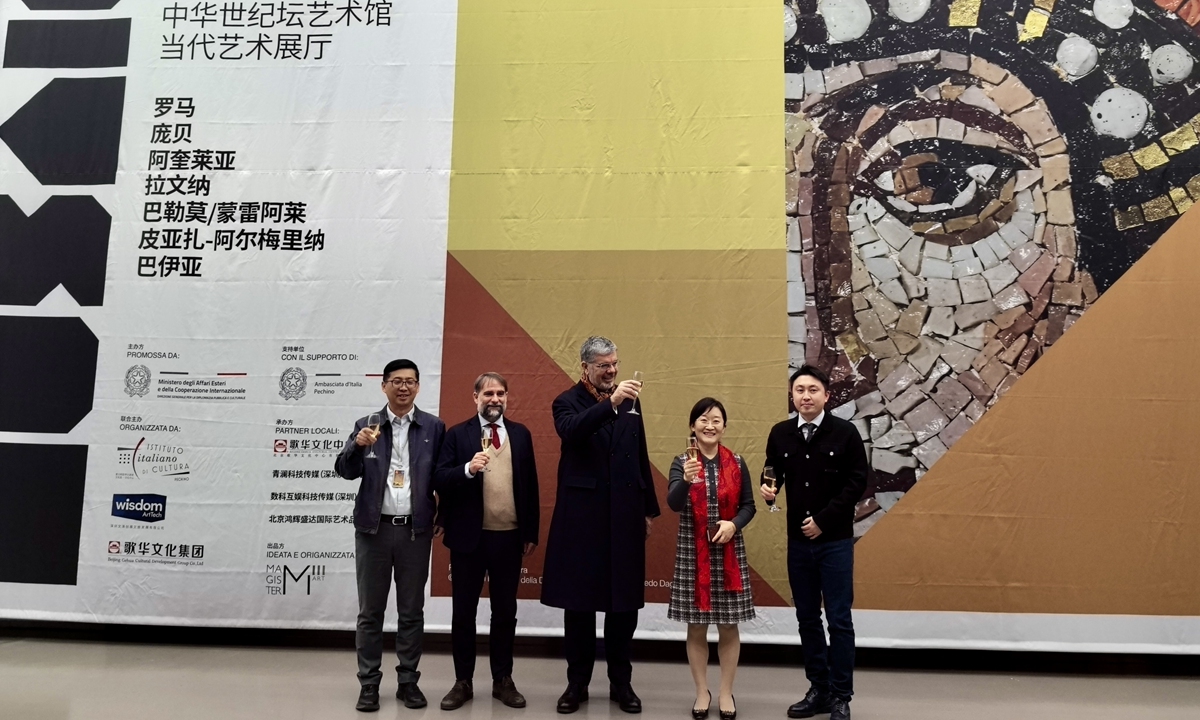
Federico Roberto Antonelli, the cultural counselor to the Italian embassy in China, (2nd from left) and Massimo Ambrosetti, Italian Ambassador to China (center) toast with Chinese delegates at the inauguration ceremony in Beijing on January 14, 2026. Photo: Dong Feng/GT
In mid-January, the Italian Cultural Institute in Beijing inaugurated Mosaico: Italian Code of a Timeless Art, a traveling multimedia exhibition, offering the Chinese public a unique journey through the most iconic works of the Italian mosaic tradition.What's more, the exhibition Geometry, Harmony and Life: The Architecture of Andrea Palladio from Antiquity to Classicism opened to the public at the National Museum of China on February 3 this year.
In mid-July, the exhibition Chinese voices on Palladio, featuring heritage of Andrea Palladio, an Italian architect of the 16th century in northern Italy, and contemporary architecture in China launched in Beijing at the Tsinghua University Art Museum, which, from Antonelli's regard, is another dialogue in architecture between China and Italy.
"We are fostering a dialogue between Italy and China - representatives of two great ancient civilizations of the East and West. When we look back at our 2,000-year history of interaction and view the present through the lens of a millennium, our perspectives shift significantly," Antonelli told the Global Times.
From his perspective, cultural diplomacy is very different from political or economic cooperation.
"Our work goes beyond a simple exhibition or concert; it carries broader significance. This collaboration not only benefits both countries but can also serve as a model for the rest of the world," he said.
Moreover, Antonelli believes it is important for individuals to build real connections between people rather than rely on virtual communication.
"The real world is not found inside a mobile phone, but in reality. It is crucial to first understand your own community, city, and country before setting out to learn about other countries," Antonelli said.
"New media and AI algorithms tend to push only the content you like while filtering out things you are unfamiliar with; this poses a significant risk, as it traps people within their own 'information cocoons,' a state where people only see and hear information that matches their own ideas and likes," said Antonelli.
From his observation, cultural exchanges build bridges, yet ultimately, it is merchants and tourists who leverage them and facilitate trade and tourism cooperation. In his outlook, cultural tourism is a field worthy of continued, in-depth cultivation in the future.
Antonelli drew a contrast between the historic figure of Marco Polo, the 13th-century Venetian explorer best known for his accounts of China, and people's lives today.
After all, Polo was one of those merchants who traveled to other countries.
The Italian diplomat believes both China and Italy cherish their rich civilizational heritage - a source of pride that also entails a responsibility to preserve and pass it on for the benefit of all humanity - and notes that many international conflicts stem from a lack of understanding regarding other nations' civilizations and histories.
"This sense of pride in our civilizations quickly transforms into a sense of responsibility. We have a responsibility to pass on the legacies of these two great civilizations to the next generation," Antonelli stressed.
His daughters, who received their university education in China, aspires to carry on the family's diplomatic legacy.
While diplomats may rotate, the enduring people-to-people bonds between China and Italy - forged over a millennium - remain constant.
"The friendship between the peoples of Italy and China is like a bridge cast in concrete, rooted in over a millennium of cultural and commercial exchanges; this foundation will not change - indeed, it has never changed," Antonelli said.
RELATED ARTICLES