ARTS / CULTURE & LEISURE
China-Russia team unearths fortress, rock art and elite tombs in Altai, revealing a stratified nomadic society linked to ancient China
Ancient exchanges across Eurasian steppe revealed
By Published: Aug 27, 2026 11:14 PM

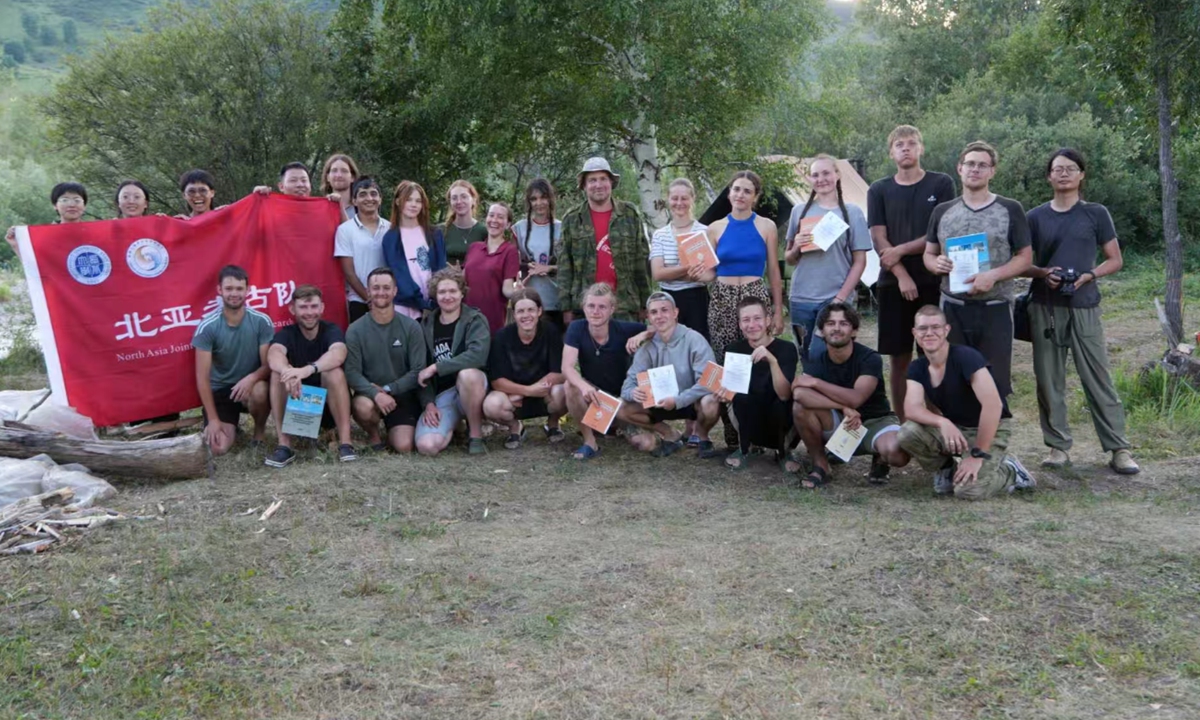
The joint China-Russia archaeological excavation team take a group photo at the Chileta tomb complex, Altai, Russia, on July 17, 2026. Photo: Courtesy of Mu Jinshan
A joint Chinese-Russian archaeological team has completed a month-long excavation and survey in Russia's Altai region, uncovering important evidence about early Iron Age social structures and cross-regional cultural connections across the Eurasian steppe, according to a press release that the Collaborative Research Center for Archaeology of the Silk Roads sent to the Global Times on Thursday.The excavation marks the first field season since the Altai Branch of the Collaborative Research Center for Archaeology of the Silk Roads officially began operations, signaling a new phase of cooperation between the two countries.
The expedition brought together more than 30 scholars and students from both sides. Over nearly four weeks, the team systematically excavated seven tombs at the Chineta-I and Chineta-II cemeteries, employing the real-time kinematic positioning (RTK) surveying, drone aerial photography, and 3D modeling to ensure precise documentation.
Mu Jinshan, the Chinese head of the joint archaeological team, told the Global Times on Thursday that the two teams adopted a truly collaborative working model rather than dividing tasks by nationality.
"The Russian team used baseline measurements and grid mapping to produce immediate field records, while the Chinese team applied RTK surveying, drone photography, and 3D modeling to capture complete spatial data for later analysis. The two methods complement each other, and results can be cross-verified."
Mu added that Russian scholars contributed invaluable regional expertise in site identification and stratigraphy, while Chinese researchers placed the findings within the broader context of Eurasian steppe archaeology, searching for evidence of interaction with northern China.
Among the most significant discoveries were six tombs belonging to the Pazyryk culture, dated to the 5th-3rd centuries BC, at the Chineta-I cemetery. The tombs show striking differences in scale, with the largest burial mound measuring 18 meters in diameter, while smaller tombs are far more modest. "This pronounced hierarchy provides crucial material for studying social stratification and organizational structures in the early Iron Age Altai region," Mu said.
Notably, Pazyryk culture tombs and Kara-Koba type stone cists were found within the same chain of burial mounds, suggesting that different groups may have shared common worldviews or social values, forming a complex multi-community society.
Mu emphasized that similar Pazyryk and Kara-Koba type tombs have also been found in Northwest China's Xinjiang Uygur Autonomous Region, providing solid archaeological evidence for close cultural links between the Altai region and northern China during this period.
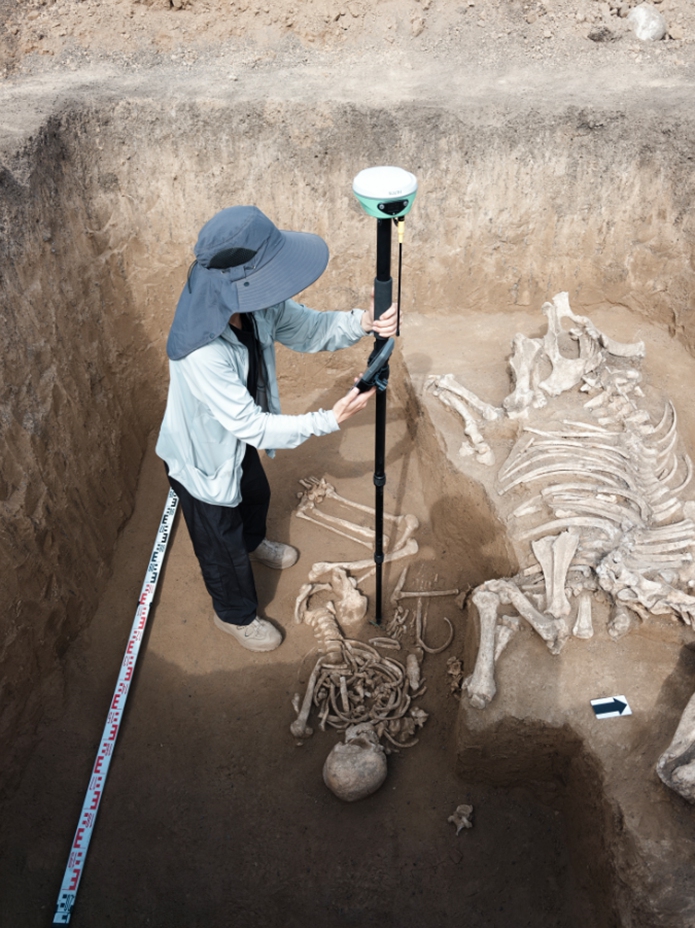
A member of the Chinese team precisely maps and records the spatial coordinates of small finds unearthed during the excavation at the Chileta tomb complex, Altai, Russia, on July 21, 2026. Photo: Courtesy of Mu Jinshan
A second major breakthrough, Mu pointed, came from applying a Chinese-developed theoretical framework to the Altai landscape.The "trinity" model of nomadic settlement distribution, which holds that residential remains, tombs, and rock art tend to cluster together spatially, was first developed by Chinese professor Wang Jianxin's team through more than two decades of fieldwork in the eastern Tianshan Mountains of China's Xinjiang.
The theory further identifies seasonal patterns: winter settlements typically lie on the southern and southeastern slopes of mountain ranges, while summer settlements are found on northern slopes. Using this framework, the Chinese team had previously discovered hundreds of nomadic settlement sites in the eastern Tianshan region.
"Altai is a core area for studying nomadic civilization, but nomadic settlements had never been clearly identified in the Russian Altai region," Mu explained, noting that "Previous research focused almost exclusively on tombs." By introducing the trinity model, the joint team not only verified its validity in a new region but also made significant new discoveries: one settlement site, one large rock art site, and one fortress site.
"This marks an important step for Chinese nomadic settlement archaeology to be tested and applied across the wider Eurasian steppe," Mu said.
The season also included a systematic survey of Bulan-Koba culture tombs across different parts of Altai, clarifying the cultural landscape of the region during the Xiongnu, Xianbei, and Rouran periods.
Looking ahead, Mu said both sides plan to deepen cooperation in several key areas. The Altai branch of the research center aims to promote a coordinated archaeological mechanism involving China, Russia, Mongolia, and Kazakhstan, focusing on major questions such as the formation and development of early nomadic civilizations and cultural exchange along the grassland Silk Road.
The team also plans to expand the use of remote sensing, satellite imagery, and Geographic Information System spatial analysis to identify potential settlement, tomb, and rock art distribution areas more efficiently across the vast steppe landscape. Multi-disciplinary approaches will be employed to reconstruct ancient environments, subsistence patterns, and population characteristics.
A long-term mechanism for joint training of young archaeologists through field schools, workshops, and exchange programs is also on the agenda.
"Working and living together in the field for over a month, scholars from both countries deepened each other's understanding and trust. Disagreements occasionally arose over interpretation, but we always focused on facts and evidence, and such academic dialogue ultimately enriched our research," Mu said.
RELATED ARTICLES