Huawei ‘collecting tuition’ from HP carries profound meaning: Global Times editorial
Huawei Photo: VCG
The fact that a US tech giant is paying a Chinese company that Washington has placed on its "Entity List" to license the latter's technology alone is enough to render the clamorous "decoupling" rhetoric within the US utterly hollow. The licensing agreement between Huawei and HP is a vivid illustration of this broader era.
On Wednesday, a piece of news made waves across the global tech industry: HP paid to obtain a global license to Huawei's patents, including those covering the Wi-Fi 7 standard, while Huawei secures rights to HP's high-value reciprocal patents.
The fact that a US tech giant is paying a Chinese company that Washington has placed on its "Entity List" to license the latter's technology alone is enough to render the clamorous "decoupling" rhetoric within the US utterly hollow. This win-win commercial agreement not only marks a reconciliation between two companies, but also offers a glimpse into the remarkable strides China has made in technological innovation.
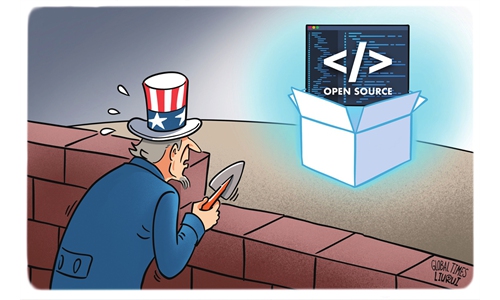
The agreement first represents an international "certification" of China's innovation capabilities. Looking back over the past several decades, vast quantities of Chinese-made products have been sold around the world, yet Chinese manufacturers often had to pay hefty patent licensing fees to overseas companies. Scaling the "patent walls" erected by others was once a required step for Chinese companies going global. It was practically unimaginable 20 years ago that a US tech giant would pay patent fees to a Chinese tech company, yet today it is fast becoming business as usual.
By the end of 2025, more than 1.6 billion consumer electronic devices worldwide, excluding mobile phones, had used Huawei's Wi-Fi related patents, covering major brands such as Microsoft, Sony and Amazon. As the world's second-largest PC maker, HP cannot avoid Huawei's standard-essential patents if its products are to legally connect to Wi-Fi. Chinese companies have evolved from technology followers into leaders in setting global standards.
Behind the agreement lies the wisdom of turning confrontation into reconciliation through rules. The two sides had previously taken their dispute over Wi-Fi patents to court in Europe. This reconciliation underscores a simple truth: Intellectual property disputes ultimately have to be resolved through rules and negotiations. Intriguingly, amid the broader China-US technology rivalry, an HP spokesperson repeatedly stressed that the deal was merely "something used broadly across the industry" and did not "represent a broader strategic or commercial relationship."
Such cautious remarks reflect the chilling effect currently facing US companies when engaging in technology cooperation with China. Yet it also demonstrates that political manipulation cannot block cooperation driven by market forces and genuine business needs. Companies may seek to make a "political distinction" in their rhetoric, but it is far harder to lie about their commercial interests.
Behind HP's long-term patent payments to Huawei stands a China whose innovation is advancing by leaps and bounds. The World Intellectual Property Organization's Global Innovation Index 2025 showed that China has become one of the world's top 10 most innovative economies and is home to 24 of the world's top 100 innovation clusters - the largest number of any country. China has become the first country to amass over 5 million valid domestic invention patents, while its number of international patent applications under the Patent Cooperation Treaty has ranked first globally for many consecutive years.
From telecommunications and new-energy vehicles to photovoltaics and artificial intelligence, a growing number of Chinese companies have made the leap from catching up technologically to being on par with and even taking the lead in the world in certain fields. They have become important builders and leaders of the global innovation ecosystem.
More fundamentally, the global pattern of value distribution is changing. Chinese companies used to be net payers of patent fees; today, they are starting to steadily collect technology licensing fees. This role reversal - from "paying tuition" to "collecting tuition" - marks a defining turning point in China's upward movement in the global industrial division of labor. More and more original technologies developed in China, along with standards established by Chinese companies, are steadily entering global markets and becoming integrated into the core links of global supply chains.
Huawei's decision to set its Wi-Fi equipment licensing rate at just $0.5 per unit, meanwhile, shows that charging fees is not the ultimate goal. The fundamental objective is to make the benefits of innovation accessible to consumers worldwide and build an open, mutually beneficial industry ecosystem. Truly valuable core technologies have never been about creating barriers to contain others; they are a driving force that enables the entire industry to advance together.
The agreement between Huawei and HP is a vivid illustration of this broader era. No country can monopolize every frontier technology. "Closed-door development" is not a viable path, and forcibly pursuing technological "decoupling and supply-chain severing" runs even more directly counter to the objective realities governing industrial development. Some US politicians are attempting to use administrative power to fracture the global technology ecosystem and artificially create technological blocs. Yet they cannot easily override multinational companies' rational pursuit of technology, markets, and profits, nor can they change the reality that global industries are deeply interdependent.
China has consistently advocated a global intellectual property governance system based on the principles of extensive consultation, joint contribution and shared benefits. Going forward, as China continues to strengthen its position as a global intellectual property powerhouse, more innovations originating in China will reach markets around the world and inject new Chinese momentum into the global technology ecosystem. The agreement between HP and Huawei is a milestone - but it's far from the end point.
RELATED ARTICLES