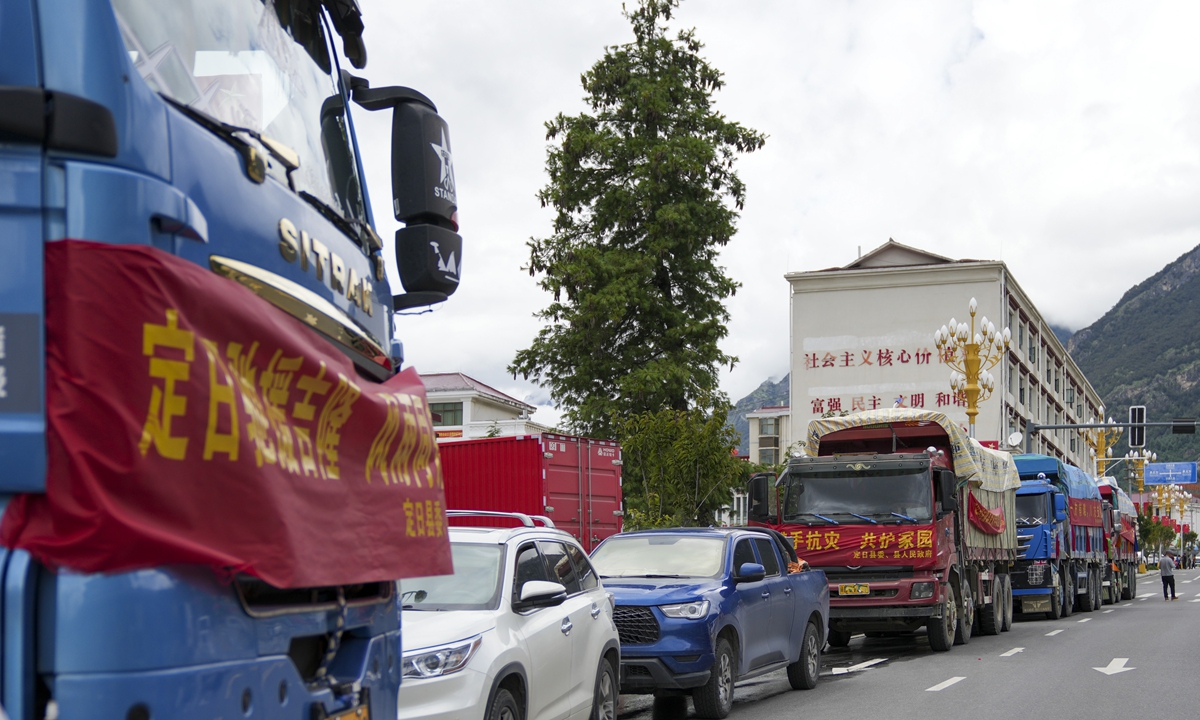
At 2 pm on August 27, 2026, six trucks carrying disaster relief supplies from Tingri County in Xigaze City arrived safely in Gyirong Township. Loaded with daily necessities including instant noodles, rice, flour and bottled water, the trucks set out from Tingri County at 7 am for Gyirong Township. Relief supplies from across China are now continuously arriving at Gyirong Township, providing support for emergency rescue and the resettlement of affected residents. Photo: Xinhua
At around 10:30 am on August 26, a mudslide occurred on the Nepali side, resulting in significant casualties and a large number of people go missing at the Gyirong Port in Gyirong county, Xigaze city in Southwest China's Xizang Autonomous Region.
According to Chinese authorities, as of the morning of August 27, two people had been successfully rescued in the Xizang region, while three deaths had been confirmed and 558 people remained missing, including 260 foreign nationals. China's Ministry of Foreign Affairs also reported that nearly 100 Chinese citizens were missing in the affected areas of Nepal, with the relevant information still being verified. The number of casualties and missing persons reported by Nepal continues to rise.
This was not simply a flash flood, but a typical cascading disaster in a high-altitude region.Experts from China's Ministry of Natural Resources said the disaster was triggered by a high-altitude glacier collapse inside Nepal. The collapsing ice rushed down the channel at high speed, swept up vast glacial moraine, or scraped rock, and evolved into a debris flow before hitting Gyirong Port and surging downstream into Nepali territory.Ice and snow, rocks, and sediment mixed with the floodwaters and surged downhill, causing the destructive force to increase exponentially.
Estimates indicate that the ice-collapse debris flow responsible for the Gyirong mudslide traveled at approximately 50 meters per second, leaving people with extremely little time to react and virtually no margin for error. Its impact extended for more than 20 kilometers, resulting in devastating losses. On the screens are satellite images showing mountainsides torn apart, videos of torrents of mud roaring downhill, and casualty figures that continue to climb in news bulletins. But what makes this disaster most heartbreaking is that behind every statistic are individual human lives. According to media reports, a 68-year-old survivor recalled desperately trying to grab his wife's hand and flee to higher ground when the mud came rushing toward them, only to watch helplessly as she was swept away. Such firsthand accounts reveal the brutality of the disaster: Beneath the overwhelming force of nature, the ordinary, peaceful lives of countless people can collapse in an instant.
In the face of a sudden and devastating disaster, all ornate rhetoric is meaningless. The only priority is to do everything possible to save lives. It is precisely at such critical moments of disaster response and rescue that a country's governing philosophy and ability to act are most clearly demonstrated.
Following the disaster, Xi Jinping, general secretary of the Communist Party of China (CPC) Central Committee, attached great importance to the disaster and issued important instructions at the earliest opportunity, ordering all-out efforts to search and rescue people who are missing, evacuate residents at risk and provide timely medical treatment to the injured to minimize casualties. He also stressed the need to strengthen monitoring and early warning, ensure scientific rescue operations and guard against secondary disasters. Premier Li Qiang also issued instructions, calling for an immediate verification of the number of the missing and affected people and for all-out rescue and relief efforts, and instructing the Foreign Ministry to strengthen communication and coordination with relevant countries, promptly share information and work together to properly handle rescue and relief efforts. Subsequently, relevant departments of the State Council, the Xizang Autonomous Region, and Xigaze city rapidly activated emergency response mechanisms and established an on-site command structure. Search and rescue, evacuation, medical assistance, communications, transportation, supplies, and risk assessments were carried out simultaneously on multiple fronts. On the afternoon of August 27, entrusted by Xi Jinping, general secretary of the CPC Central Committee, Chinese Premier Li Qiang led a group of senior officials from relevant departments to the disaster-hit area, to supervise rescue and relief operations, and visit rescue and relief personnel and people affected by the disaster.
The disaster response has demonstrated the speed and efficiency of China's national emergency-response system. "Putting people and their lives first" is not merely a slogan. It means placing saving lives at the forefront of all work, mobilizing resources, organizing personnel, and assigning responsibilities as quickly as possible. Only in this way can the critical golden window for rescue be seized and as many lives as possible be saved.
The disaster also reminds us once again that we must maintain a profound respect for nature. In recent years, under the influence of global climate change, glaciers in the Himalayas have been retreating, while freeze-thaw processes at high altitudes have intensified, making geological and glacial environments increasingly fragile and unstable. In the face of extreme natural disasters, individuals are extraordinarily vulnerable and small. Ultimately, people's sense of security depends on the strength of a state that puts human life at the center and has the courage to shoulder responsibility. Restoring roads, reestablishing communications, providing emergency medical assistance, coordinating across borders, and evacuating residents are all critical rescue tasks that cannot be accomplished by individuals, markets, or scattered acts of goodwill alone. They require the powerful coordinating and organizational capacity of the state. This is precisely the most tangible expression of "putting people and their lives first" in the face of major disasters.
The collapse of ice and rock is terrifying; torrents of mud surge through and tear across the mountains and valleys. Yet no matter how ferocious a natural disaster may be, it cannot crush the state's commitment to putting the people at the center. No matter how severe the predicament, it cannot shake the fundamental principle of doing everything possible to save human life. At this moment, we mourn those who lost their lives, pray for those who remain missing, and pay tribute to the rescue and relief workers holding the frontline. May the search and rescue efforts succeed, may more lives be saved, may the affected areas recover and rebuild as soon as possible, and may the people affected by the disaster in both China and Nepal emerge from these dark days soon.
We respect nature because mountains and rivers must never be taken lightly. We protect life because the people will always be the nation's deepest concern. And we pray together for safety because, when humanity confronts disaster, our most steadfast and universal conviction is to cherish and safeguard every human life.
RELATED ARTICLES