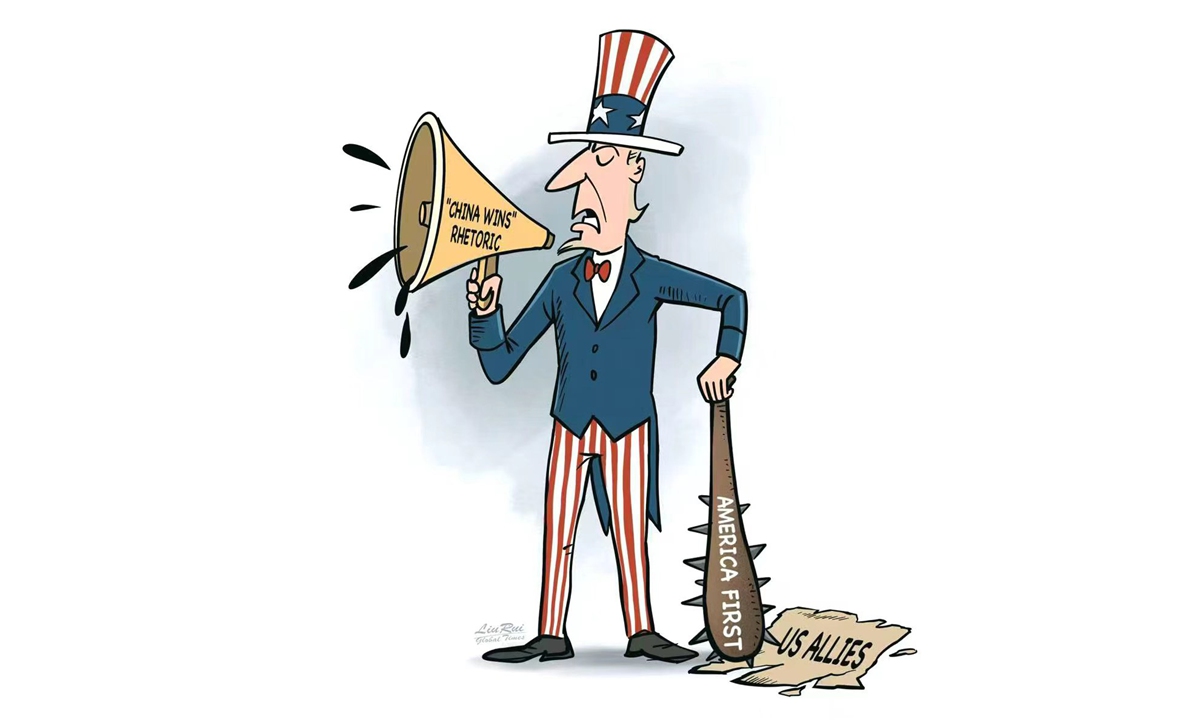
US-Canada trade war. Illustration: Liu Rui/GT
As the trade war between the US and Canada escalates, some US media outlets are already rushing to turn their sights on China.
A recent New York Times opinion piece claimed that China could emerge as the winner of the US-Canada trade war if Washington does not change course. The Washington Post went even further, asserting that as the US keeps piling tariffs on its allies, China "doesn't even have to do anything" for the US to abandon its economic leadership.
The two articles differ in tone, but they share a striking habit found across parts of the US media establishment: whenever the US runs into trouble, China somehow ends up in the middle of the story. A trade dispute between Washington and Ottawa becomes a question of whether Beijing is "winning"; a quarrel between two North American neighbors becomes another chapter in the supposed China-US strategic competition.
This is more than a matter of sensational headlines. It reflects a growing reflex to view almost any problem involving the US through Washington's perceived competition with China. When American policies produce unintended consequences, the question quickly becomes not what went wrong in Washington, but whether Beijing will "win." It is a convenient way of ignoring real problems.
Take the New York Times piece. It argues that Washington needs a strong Canadian manufacturing sector and wants Canada to remain deeply integrated into North American supply chains. Yet it also declared that Canadian consumers should continue buying North American products even if Chinese alternatives are cheaper.
In other words, Canada is expected to remain in US economic camp, absorb the costs of doing so and resist alternatives - all in the name of "fighting the real trade war with China." This says quite a lot about the way some American elites view their allies: when Washington wants support for its strategic agenda, allies are expected to stand together; when that agenda comes with a price tag, the bill can apparently be passed on to them.
Call it a "China competition tax": allies are expected not only to support Washington's reckless strategy toward Beijing, but also to bear the economic costs that come with it. And when those allies start looking for other options, guess who gets blamed? China, of course.
But Canada's efforts to diversify its trade should not be treated as evidence of China's growing influence. Nor does Canada's search for new markets automatically amount to a geopolitical choice between Washington and Beijing. If the US makes economic cooperation with itself more costly and less predictable, it should not be surprised at all when Canada looks elsewhere.
Yet there is an obvious fact that gets lost in all this talk of China's supposed "win": China did not start the US-Canada trade war. China did not impose tariffs on Canada's goods. China did not constantly threaten Canada during negotiations. And China certainly did not force Washington to ruin an economic relationship with its ally.
That is the deeper problem with the "China wins" rhetoric. When every dispute is automatically recast as another contest in which China is either "winning" or waiting to "win," something important gets lost: the responsibility of the policymakers who created the dispute in the first place.
The US may want to see every economic problem through the prism of its strategic competition with China, but doing so doesn't solve any problems. It only makes it easier to avoid confronting them.
A US-Canada trade war is, first and foremost, a US-Canada problem. If Washington's policies strain an economic relationship that has taken decades to build, the question worth asking is not whether "China is gaining from it," but why Washington is turning a dispute with one of its so-called closest allies into yet another story about China.
Perhaps some in the US have simply grown addicted to placing China at the center of every conversation. But when the reflex to blame others becomes second nature, the real problem is closer to home.
RELATED ARTICLES