Illustration: Liu Xiangya/GT
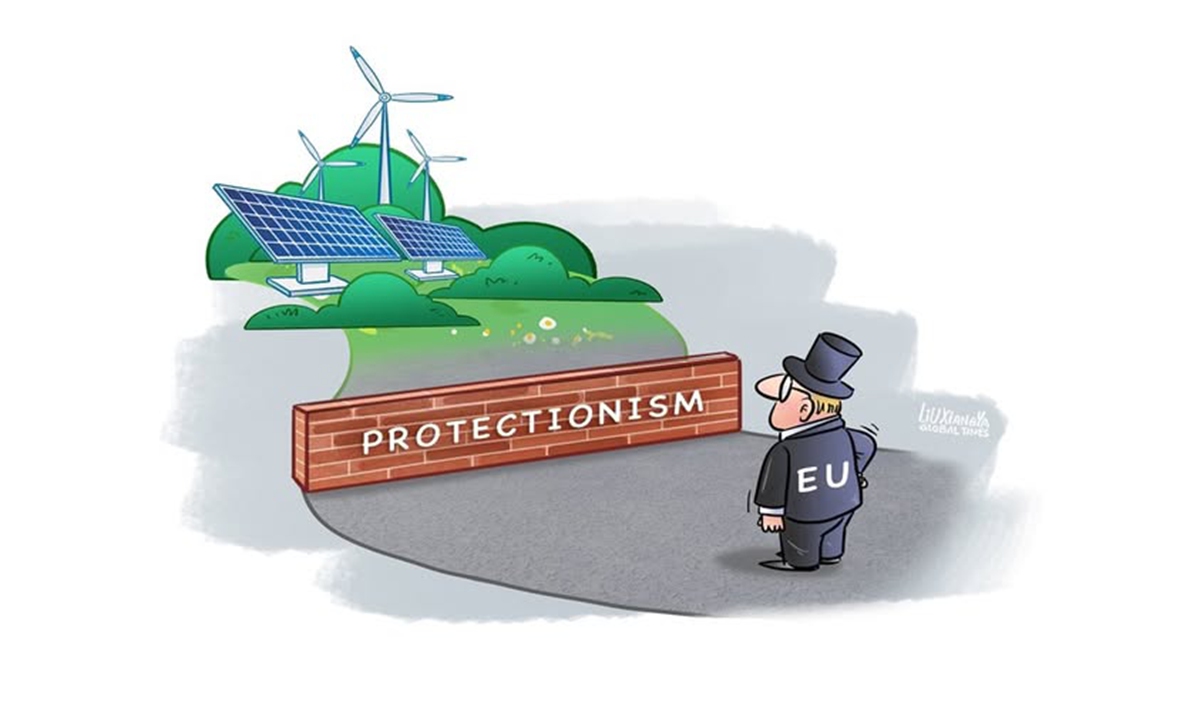
Against the backdrop of turbulence in global industrial and supply chains, pursuing openness and cooperation should naturally be the defining choice to counter economic downward pressure and fortify economic resilience. However, the European Union (EU) has repeatedly pushed forward a series of blatantly targeted protectionist trade policies, disrupting the healthy development of its economic and trade relations with China.On May 29, the European Commission held a meeting to discuss the so-called "Chinese overcapacity," aiming to implement new economic and trade measures against China. Reports indicate that Brussels is considering "broadening import quotas and tariffs against China to shield certain industrial sections," with industries believed to be jeopardized by Chinese competition. It is believed that trade relations with China will become a main topic at the G7 heads of state meeting and the upcoming EU Leaders' Summit.
In recent years, the EU's economic and trade policy toward China has steadily tightened. From enforcing regulations on foreign subsidies and procurement to tightening cybersecurity drafts and industrial legislation, the EU has rolled out several restrictive legislative and policy initiatives under the guise of "de-risking," disrupting the established order of China-EU trade and investment. These measures have heightened market volatility and undermined the stable ecosystem of China-EU economic cooperation.
However, this protectionist framework pushed by the EU is fundamentally incapable of achieving its intended goals of reshaping supply chains and regaining industrial advantages. The deep integration of Chinese and European industrial and supply chains is the natural outcome of long-term market competition, resource complementarity, and the alignment of comparative advantages. Forcing a rupture and reconstruction through short-term administrative intervention will only inflict severe industrial shocks.
In sectors the EU has long focused on, such as clean and digital technologies, China possesses distinct industrial advantages and supplies critical intermediate goods. The EU's approach of "shutting its doors to block entry" will only drive up the operational costs of its supply chains. Similarly, "competing behind closed doors" will dampen its industrial innovation, leading to a long-term outcome that runs counter to its original intentions.
The EU should know that implementing sanctions that violate the basic principles of international economic and trade relations will trigger lawful and compliant reciprocal countermeasures from China. In recent years, China has refined its foreign-related economic and trade legal system, fortifying institutional safeguards to protect the development rights and interests of its enterprises and industries. The country's trade countermeasure toolkit has grown robust, spanning routine measures, as well as dedicated legal mechanisms designed to counter unjustified extraterritorial jurisdiction and unilateral sanctions.
China remains strictly committed to the core principles of equality and mutual benefit; any unilateral action that compromises China's legitimate economic and trade development interests will inevitably meet with a resolute response. Persisting in rolling out policies that harm the interests of Chinese industries will only backfire.
The formulation of EU policies must fully respect market laws. Currently, numerous European multinational corporations remain deeply rooted in the Chinese market. Within the European business community, the call for stable cooperation and the opposition to "decoupling and severing supply chains" remains the rational and mainstream voice.
The EU urgently needs to abandon its misconceptions, rectify its policy deviations, and return to the correct track of mutual benefit, win-win results, openness, and cooperation with China. For one thing, the China-EU economic and trade relationship features a long-established system of division of labor and coordination, rendering cooperation mutually beneficial. For another, both sides also share vast opportunities for collaboration in areas such as the green transition.
More crucially, both China and the EU have previously borne the brunt of unilateralism and trade bullying. They share highly aligned common interests in upholding the authority of the multilateral trading system, defending free trade rules, and promoting an inclusive global economic recovery. Only by adhering to the cooperative principles of mutual respect, equality, mutual benefit, and rules-oriented engagement, and by abandoning the outdated mind-set of zero-sum games, can China and the EU drive their economic and trade relations forward sustainably, injecting greater certainty and positive energy into a fragile global economic recovery.
Tu is dean of the China Institute for WTO Studies at the University of International Business and Economics (UIBE). Wang is a PhD candidate at the China Institute for WTO Studies of UIBE. opinion@globaltimes.com.cn
RELATED ARTICLES