Autumn scenery along the G331 national highway as it stretches eastward through the Greater Hinggan Mountains in Northeast China's Heilongjiang Province, Sept. 19, 2021. Photo: VCG
Imagine a road trip tracing China's winding land borders and coastlines - a journey roughly two-thirds the circumference of the Earth, taking you past glaciers, rugged gorges, forests, waterfalls and oceans. China is working to make this vision a reality.China's Ministry of Transport recently announced that the G219 and G331 border highways and the G228 coastal highway would be fully connected during the 15th Five-Year Plan period (2026-30), creating an ultra-long-distance overland loop route called the "Golden Outer Ring."
Known as the "most beautiful border highway," G331 in northern China runs about 9,200 kilometers from Dandong in Northeast China's Liaoning Province to Altay in Northwest China's Xinjiang Uygur Autonomous Region, linking plains, forests, grasslands and mountains.
Further west, G219 has the greatest elevation range and the richest diversity of landscapes and ecosystems among the three routes. It passes through China's largest desert, the Taklimakan Desert, the Qinghai-Xizang Plateau, known as the "Roof of the World," the Himalayas, and the rugged gorges of the Hengduan Mountains region in Southwest China.
Another highway G228, following the coastlines, connects all core coastal ports in a pearl-like chain by traversing the Yalu River, Liaohe River, Haihe River, Yellow River, Huaihe River, Yangtze River and Pearl River.
While most people may first think of the diverse and spectacular views along the ring, analysts saw its significance in economic growth, security and opening-up.
From remote to connected
Connecting borders with the sea captures the core transportation function of the ring, an official from the Ministry of Transport said, according to CCTV News.
The ring breaks the fragmented pattern of isolated border and coastal roads, linking Dandong in Liaoning, Dongxing in Guangxi, and Altay in Xinjiang into a complete loop connecting China's northern and western frontiers with its coastlines, said Wu Zhihua, deputy director-general of the Department of Comprehensive Planning of the Ministry of Transport, per the report by CCTV.
The prospect of a continuous route nearly encircling the country has already caught the attention of Chinese travel enthusiasts, with many taking to social media to discuss and plan potential cycling and road trip routes. One netizen wrote, "I just need to find someone to go with me when the time comes."
Indeed, from snow-capped mountains and plateaus to grasslands, rainforests, deserts, and coastlines, the ring showcases diverse landscapes along its route while connecting historic cities along the way. The CCTV report noted that it creates a unique road trip corridor and has the potential to become a world-class, ultra-long cultural and tourism route.
This loop serves as a backbone for China's national trunk highway network, creating a more integrated and efficient ring-shaped transport structure, Hu Qimu, a professor at the Maritime Silk Road Institute of Huaqiao University, told the Global Times on Wednesday.
Coupled with the cultural tourism opportunities brought by its diverse landscapes along the route, the corridor will boost border area circulation and spur border region economic growth by integrating scattered roads into a closed-loop transportation network, Hu said.
Given the relatively underdeveloped industrial base and limited land resources in some border regions in China, these areas have fewer advantages in primary and secondary industries, making cultural tourism a key driver of local economic development, Hu said, adding that unlocking the potential of transport connectivity helps drive rural revitalization.
While the project is still under way, some villages have already seen the benefits, as it links more remote communities to the wider national economy.
China's Farmers' Daily reported that Hushan Village in Dandong, where national highways G331 and G228 begin, has attracted a steady stream of road trips and border tourists as the two highways pass through the village. By revitalizing idle land, the village has developed RV campsites and homestays, boosting collective income.
In the first half of this year, the G331 corridor welcomed more than 2 million visitors, according to the Xinhua News Agency. Border communities are also embracing tourism opportunities by offering homestays, dining services, and agricultural products, bringing new sources of income to residents.
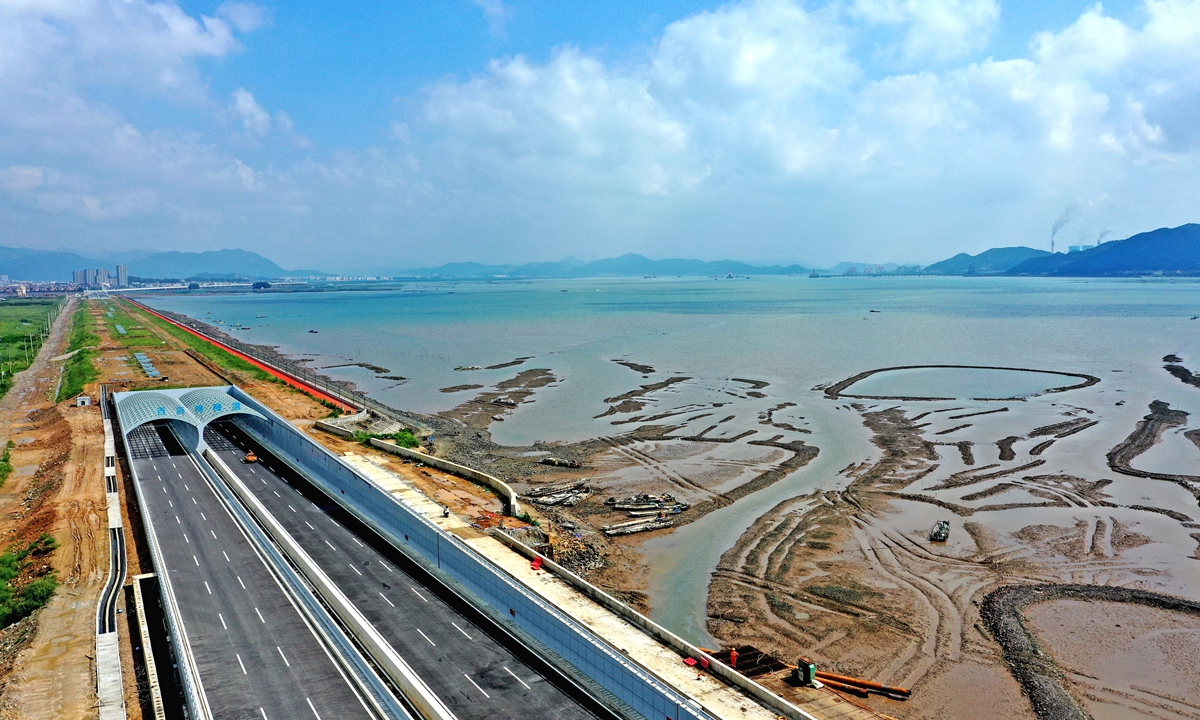
A section of the G228 national highway in Ningbo, East China's Zhejiang Province on September 28, 2024 before its official opening to traffic. Photo: VCG
Linking to the world
Stretching across China's borders and coastlines, the ring will also connect inland trade routes with global markets.
It can connect westward to the New International Land-Sea Trade Corridor and China-Europe Railway Express, and eastward to ocean-going foreign trade shipping routes. By linking major coastal ports nationwide with border ports of entry, it will enable China's land ports facing Central Asia, Southeast Asia and other regions to form an integrated network, per CCTV News.
By helping integrate coastal ports, border crossings and inland logistics hubs into a more complete transport network, different modes of transport will form positive interactions that lower costs, boost efficiency and reduce risks by offering more options for people and goods, Wang Limei, the president of China Road Transport Association, told the Global Times.
Wang said that when a particular route or transportation sector under the framework is unable to continue operating due to unforeseen circumstances, alternative channels can provide backup options, so it not only improves transportation efficiency but also enhances the resilience of the overall transport system and its ability to respond to risks.
"China occupies a unique geographic position in Eurasia, which requires greater emphasis on land transportation strategies and the issue of overland access rights. Leveraging its geographic advantages, China can extend its connectivity and influence in multiple directions across the continent," Wang continued.
The ring's greatest value for external connectivity is to demonstrate China's responsibility as a major country, as this infrastructure initiative will benefit people across China and its neighboring countries, setting a pioneering example for infrastructure development and reflecting China's strategic commitment, the expert concluded.
RELATED ARTICLES