Disasters testify to the shared destiny, and rescue operations embody the primacy of life: Hai Feng
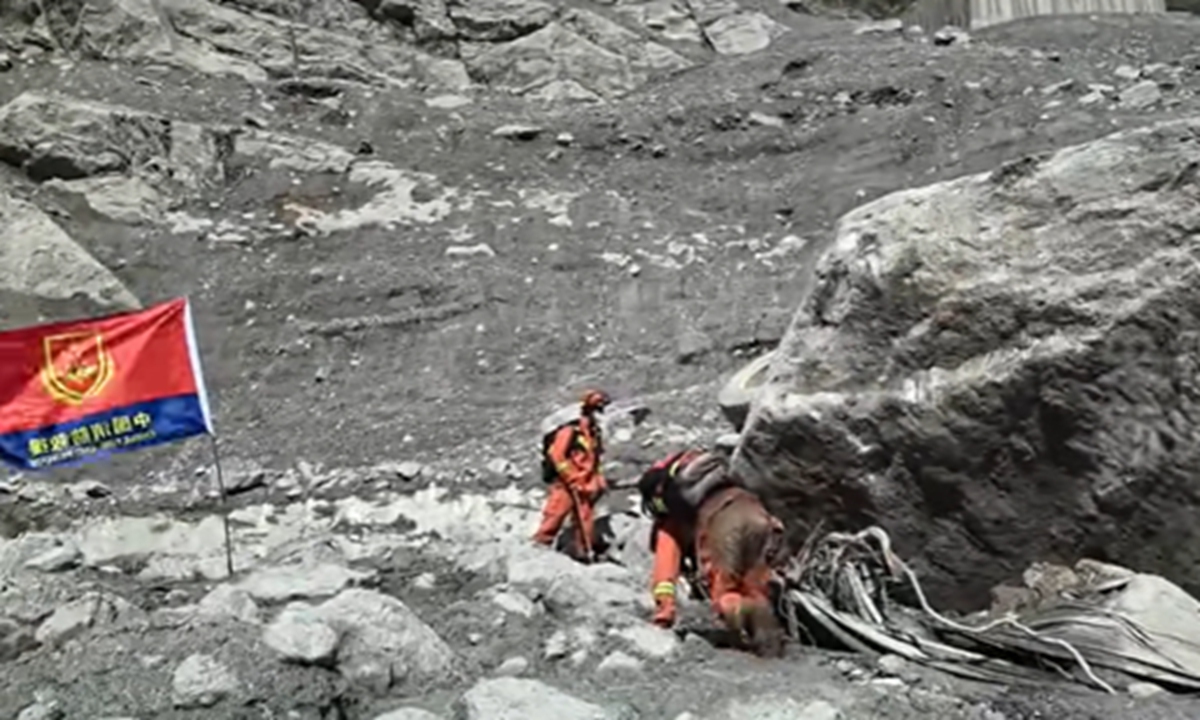
Rescuers reach the core area of the mudslide disaster in Southwest China's Xizang Region at around 4:30 pm on August 28, 2026. Photo: Screenshot from CCTV's video
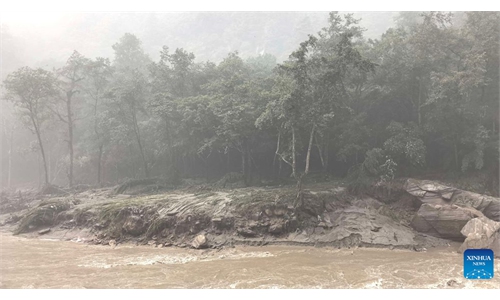
On August 26, a massive mudslide hit the Gyirong-Rasuwa area along the China-Nepal border. On the Nepalese side, a huge mass of ice and rock collapsed, sweeping down mud, boulders, ice, and snow. It surged rapidly along the valley, destroying roads, bridges, villages, and border facilities, plunging countless families into anguish and grief in an instant. Confronted with a disaster that resembled "liquid cement" and an "inland tsunami", we are once again profoundly reminded that in the face of drastic changes in nature, life itself must be protected above all else.
On Friday, the Political Bureau of the Communist Party of China (CPC) Central Committee convened a meeting to deliberate and make arrangements on rescue and relief efforts after the devastating mudslide hit Gyirong County in Southwest China's Xizang Autonomous Region. At the beginning of the meeting, all participants observed a moment of silence to mourn the victims of the disaster. In that brief moment, the silence weighed as heavily as a thousand pounds. The moment of silence was not a ceremonial pause, but a solemn placement of life; not a formal expression, but a public declaration of values: when disaster strikes, what a country first affirms is the weight of life itself.
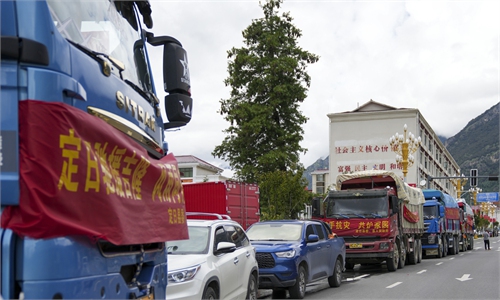
Following the disaster, the CPC Central Committee attached great importance to the situation. Xi Jinping, general secretary of the CPC Central Committee, issued important instructions at the earliest possible time, setting out clear requirements for rescue and emergency response. Entrusted by President Xi, Chinese Premier Li Qiang arrived at Gyirong Township to guide on-site relief work. Relevant departments, firefighting and rescue teams, engineering emergency units, as well as the PLA and the Armed Police, were rapidly deployed. At high altitude, in extreme cold, with broken roads, power and communications outages, and a high risk of secondary disasters, rescue operations became a race against time, against danger, and against death itself.
It is precisely for this reason that the phrase "people first, life first" in the meeting carried exceptional weight and clarity. It represents an operational logic that must be fulfilled under the most complex and dangerous conditions: scientifically formulating search and rescue plans and making every effort to locate missing persons both domestically and internationally; strengthening consultation and risk assessment to prevent secondary disasters such as barrier lakes and slope instability; strengthening on-site personnel management to ensuring safety throughout the entire rescue operation; properly resettling affected residents while carefully carrying out compensation, relief, and post-disaster assistance. In the face of natural disasters, it becomes a true test of whether a society genuinely places "people" at its center, and whether "life first" is a principle written on paper or implemented in practice.
This disaster also confronts us with a deeper reality: today's natural disasters are increasingly no longer isolated events, but chain reactions driven by the superposition of climate change, geological vulnerability, cross-border watershed risks, and infrastructure exposure. Reports and expert analyses from multiple sources at home and abroad have broadly converged on the view that the direct trigger of this disaster was not short-duration heavy rainfall in the traditional sense, but a large-scale ice collapse in a high-altitude glacier region on the Nepalese side. This collapse entrained large volumes of moraine, rock, and sediment, forming a high-velocity mudslide and causing devastating destruction to the border port and downstream areas.
This means that our understanding of disasters must shift from "single-point events" to "systemic risks." In the past, mudslides were often associated with heavy rain and flash floods. But in today's context of global warming, glacier retreat, ice mass destabilization, expanding glacial lakes, and rising extreme temperatures have fundamentally altered how disasters form and spread. This summer's record-breaking heat in Europe, extreme heatwaves in South Asia, the Nepalese ice collapse, and the Gyirong mudslide - though occurring in different places - are interconnected in their underlying mechanisms. The phrase "the whole world shall share the same warmth and coolness" is no longer a literary metaphor, but an increasingly tangible reality. The Earth is an integrated system, and so is the climate system. A seemingly localized ice collapse in a border valley in fact reflects a shared existential challenge facing humanity. No country can remain unaffected.
In this sense, the Gyirong mudslide serves as a warning not only because of its severity, but also because it exposes shortcomings in international cooperation on disaster governance. In cross-border regions in particular, disaster sources, transmission paths, and affected areas often fall under different national and administrative systems. When dealing with cascading disasters such as ice collapses, glacial lake outburst floods, and mudslides, insufficient coordination in information sharing, monitoring linkage, and emergency response can easily cause the loss of the most critical early-warning window. The Political Bureau meeting explicitly said that "international cooperation on disaster management in border areas should also be strengthened to jointly enhance emergency management as well as disaster prevention, mitigation and relief."
It is also in this context that President Xi on Friday sent a message of condolences to Nepali President Ram Chandra Poudel over the mudslide disaster that hit Nepal. China and Nepal, President Xi said, are connected by mountains and rivers and share a common destiny, adding that China is ready to actively assist Nepal in its rescue efforts and provide support and assistance to the best of its capability. Xi also expressed his belief that both peoples will be able to work together to overcome the disaster and rebuild their homes as soon as possible. These words are warm and powerful. They not only express the goodwill of neighbors, but also restate a basic truth the world urgently needs to recognize: in the face of major natural disasters, no one can stand alone, and no one can respond to all challenges by themselves. Only through mutual assistance, coordination, and shared responsibility can more lives be saved.
From collective moments of silence to full-scale search and rescue; from domestic emergency deployment to condolences and assistance extended to Nepal; from disaster relief operations to strengthened international cooperation in disaster management - this disaster contains sorrow as well as resilience; loss as well as responsibility; the cold severity of nature as well as the warmth of human solidarity. The silence of mourning embodies not only grief for the deceased, but also responsibility for the living. "A shared destiny" is not merely diplomatic rhetoric, but a consensus about humanity illuminated once again in the depths of disaster.
The history of human survival is, in essence, a history of continuous struggle with natural disasters, continuous learning, and continuous adjustment. True civilization does not lie in the illusion of conquering nature, but in the ability to safeguard life amid uncertainty, to build order amid risk, and to support one another in hardship. The mudslide at Gyirong Port will eventually subside, and the valley will return to calm, but the questions it leaves behind will not disappear on their own: how to strengthen monitoring of high-altitude glacier disasters, how to build robust cross-border real-time early-warning networks, how to enhance emergency response capacity in remote border areas under conditions of disrupted roads, electricity, and communications, and how to redefine the boundaries of "security" in the context of global warming - all of these require long-term and substantive answers.
Glaciers reflect not only fractures in mountains and rivers, but also the true interdependence between people and between countries. Moments of silence reveal not only sorrow, but also a firm affirmation of the value of life by a nation. Disasters are never worth glorifying, but what shines through them deserves to be remembered forever: placing people first, placing cooperation on a longer horizon, and transforming respect for nature into more prepared action. Only in this way can we do justice to those who have been lost, and to the days yet to come.
RELATED ARTICLES