Rescuers advance by land, water and air to mudslide-hit area in China's Xizang
Smears on rescue efforts ‘aim to drive wedge between China, Nepal’
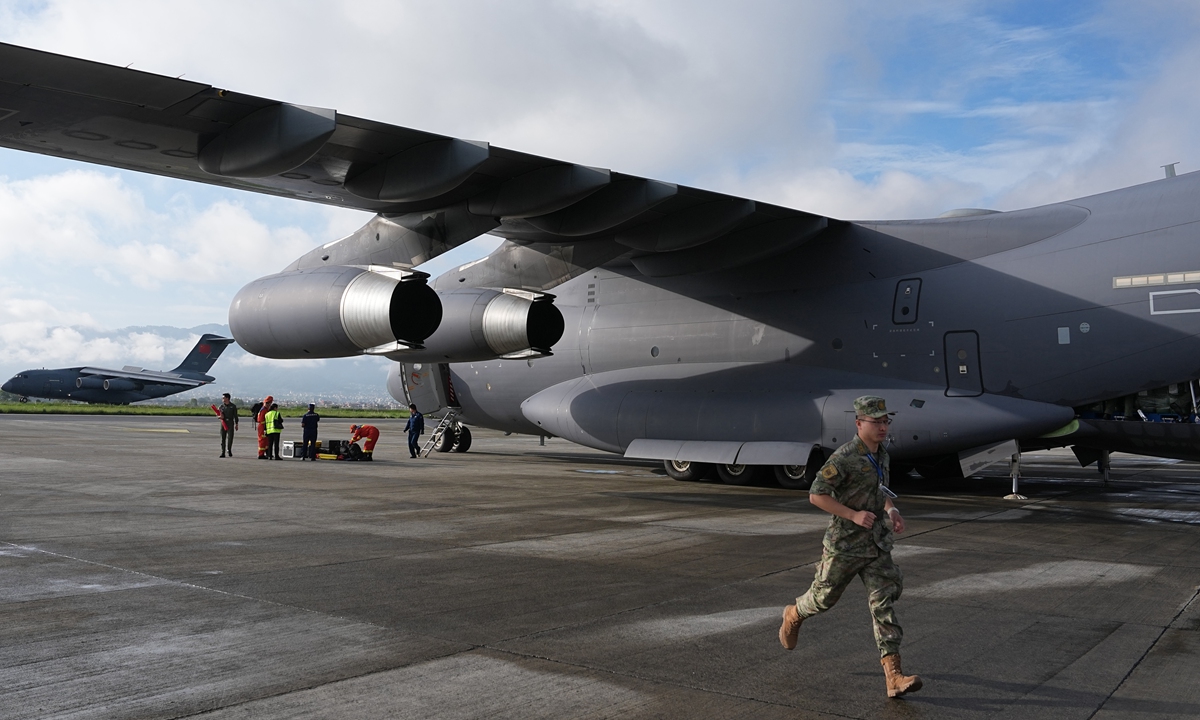
Two Y-20 transport aircraft of the Chinese People's Liberation Army (PLA) Air Force carrying 50 tons of emergency relief supplies totaling 13,200 items arrive in Nepal on August 30, 2026. Photo: CNS Photo
As rescue teams pushed toward the devastated Gyirong Port by land, water and air, and Chinese military transport aircraft ferried emergency supplies to Nepal, authorities in Southwest China's Xizang Autonomous Region continued to reveal details about the deadly August 26 mudslide in Nepal that has left at least 16 dead and 546 missing in China.
At a press conference held by the Information Office of the People's Government of the Xizang Autonomous Region on Sunday, officials outlined the formidable difficulties confronting rescuers, and presented a scientific assessment tracing the disaster to the collapse of a high-altitude glacier in Nepal. Participants at the press conference first observed a moment of silence for those who lost their lives in the disaster.
According to the press conference, some 2,141 rescue personnel have been mobilized, including members of the PLA, the People's Armed Police Force, the China Search and Rescue Team, border defense units, police and engineering and rescue enterprise China Anneng, while 269 vehicles and 3,922 sets of rescue equipment were dispatched to the disaster-hit area.
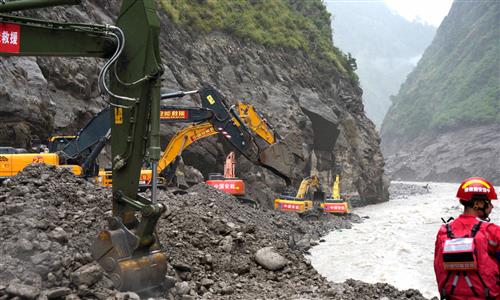
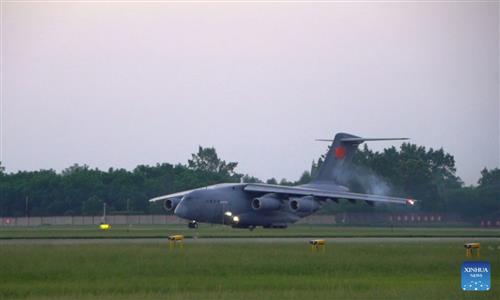
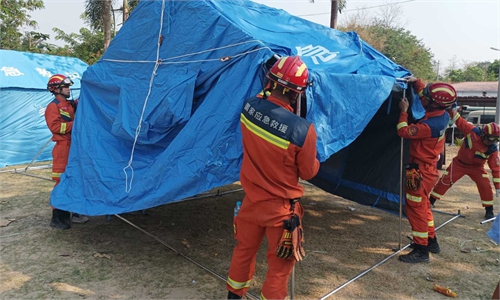
Rescue teams are advancing toward the core disaster zone from three directions - over land, along waterways and from the air, an official said at the press conference.
Local authorities have relocated 499 residents from five villages in risk-prone areas of Gyirong Township and Sale Township, while more than 57,000 pieces or sets of relief materials, including cotton coats and tents, have been allocated. Meanwhile, 555 domestic tourists were also transferred from Gyirong Township.
The authorities have identified 261 foreign nationals from 23 countries as unaccounted for, including 104 Nepalis, 49 Indians, 15 Britons and 18 Americans. The countries' embassies and consulates in China have been notified.
Following persistent searches, on-site inspections and cross-checking of information, no foreign tourists are currently stranded in Gyirong county, officials said.
However, tracing those unaccounted for remains extremely difficult. The mudslide struck suddenly with enormous destructive force, extensively damaging infrastructure and personnel registration records in the affected area, an official said.
The terrain has made the rescue operation equally challenging. The disaster zone is marked by high mountains, deep valleys and fast-flowing rivers, while complex and rapidly changing air currents constrain aerial operations. Numerous glaciers and glacial lakes in the surrounding area pose further risks.
In particular, a barrier lake formed on the Purepu Tsangpo upstream of Gyirong Port has threatened the safety of rescuers. The disaster also severely damaged national highway G216 leading to the port and cut off electricity and communications, leaving rescue conditions far more difficult than those encountered in conventional geological disasters, officials said.
Glacier instability
A key focus of Sunday's press conference was the cause and progression of the disaster. Su Pengcheng, a researcher with the Institute of Mountain Hazards and Environment under the Chinese Academy of Sciences who has studied disaster prevention and mitigation in the central Himalayas for more than two decades, said at the press conference that an ice-rock avalanche originating from a high-mountain glacier in Nepal has been identified as the cause of the devastating mudslide that struck Gyirong Port in China's Xizang.
The assessment was based on remote-sensing monitoring, field-transmitted data and on-site surveys conducted over recent days, Su said, detailing that at around 10:52 am on August 26, a glacier on Mount Langtang Lirung in Nepal fractured at an altitude of about 5,200 meters, triggering an ice-rock avalanche. The collapsing mass plunged rapidly to around 4,000 meters, scouring the mountainside and developing into a massive debris flow.
The flow then raced for about 22 kilometers through the Purepu Tsangpo and Donglin Tsangpo valleys before reaching Gyirong Port, which lies at an altitude of around 1,800 meters. It flattened approximately 0.7 square kilometers of land and destroyed 27 buildings and related facilities. Roads, power supplies and communications leading to the port were all damaged or cut off.
Monitoring showed that the ice-rock avalanche took only six to seven minutes to reach Gyirong Port.
Su said the disaster resulted from glacier instability under the long-term effects of climate warming. Its sudden onset, enormous peak flow, extreme speed, destructive force and wide impact area represent a new and increasingly pronounced feature of cryospheric disasters on and around the Qinghai-Xizang Plateau, he said.
Science versus politicization
The scientific findings serve as solid refutations against malicious narratives promoted by some overseas media outlets and anti-China figures that are seizing the opportunity to smear China.
For example, India's Firstpost, while acknowledging in a Thursday report that the disaster was caused by a glacial collapse, sought to redirect attention to an unrelated Chinese project, saying the tragedy "has also drawn attention to another major development in the same fragile mountain system."
The BBC, meanwhile, sought to discredit China from another angle. In a Saturday report titled "Footage of Tibet floods isn't being shown in China - and we know little about victims there," Laura Bicker, the BBC's Beijing-based China correspondent, painted a picture of an apparent media blackout. "Only a single still-frame shot has been broadcast so far by the country's state-run flagship news bulletin," she claimed, while accusing China of providing little detailed information about the disaster-hit area.
The report immediately drew backlash on X. Users flooded the replies with Chinese-language news reports and videos posted by media outlets - including footage the BBC had claimed was deleted. One user pointed out the glaring contradiction: "Dear BBC News, you say the flood is not covered in Chinese media, but YOUR OWN REPORT is based on footage lifted from Chinese media. (Shakes head sadly)"
On Thursday, a day after the disaster struck, the Chinese Embassy in Nepal rebutted false claims concerning the origin of the disaster and an alleged failure by China to provide an early warning. "Accusations do not help; cooperation saves lives," the embassy said.
Scientific assessments published in Nepal also pointed to the same origin identified by the Chinese team.
The Kathmandu Post reported that scientists believe a glacier and rock collapse sent ice and debris into the Lhende valley, temporarily blocking the river before a massive surge of water and debris travelled into the Bhote Koshi and Trishuli river systems.
Nepal's Department of Hydrology and Meteorology reached a similar conclusion using satellite imagery shared by the Chinese side. Binod Parajuli, a senior divisional hydrologist at the department's Flood Forecasting Division, said the imagery indicated a combination of an ice avalanche, permafrost movement and a rockslide, according to the Kathmandu Post.
"The avalanche originated on Nepali territory, but after it came down it crossed the Nepal-China border, causing extensive damage on both sides," Parajuli said.
Attempts by certain media outlets to steer discussion of the disaster toward China's infrastructure are groundless, as there is no causal link between the two, Qian Feng, director of the Research Department at Tsinghua University's National Strategy Institute, told the Global Times on Sunday.
Qian said such narratives amounted to political manipulation rather than a serious assessment of the disaster. Certain media outlets and anti-China forces, he said, are hostile to closer China-Nepal ties and the continued development of the Xizang region. They are exploiting the loss of life caused by a natural disaster to drive a wedge between Beijing and Kathmandu and manufacture rumors over China's Xizang, he said.
Emergency rescue to Nepal
Meanwhile, rescuers continued advancing toward the port's hardest-hit area, as two Y-20 transport aircraft of the Chinese People's Liberation Army (PLA) Air Force arrived in Nepal with a new batch of emergency relief supplies.
Four Chinese tunnel rescue experts arrived aboard the aircraft with specialized equipment. The plane also carried 13,200 relief items weighing 50 tons in total, including tents, blankets, sleeping bags, compressed food and first-aid kits, according to the Chinese Embassy in Nepal.
The experts began preparing for rescue operations as soon as they arrived in Nepal. In an interview with Chinese state broadcaster CCTV News, they identified three major challenges: changing weather conditions and the risk of secondary disasters, the condition of those trapped and their access to essentials needed for survival, and blocked roads leading to the disaster-hit area.
Upon reaching the disaster zone, the team will first assess conditions on the ground and begin search and rescue operations. They will use drones and other reconnaissance, monitoring and detection equipment to locate trapped people as quickly as possible before drawing up targeted rescue plans that prioritize safety, according to CCTV News.
RELATED ARTICLES