Xi says China-Kyrgyzstan cooperation entering 'golden period' of rapid development
Visit expected to broaden co-op scope beyond traditional areas: expert
By Ma Jingjing in Bishkek and in Beijing Published: Aug 31, 2026 12:31 AM

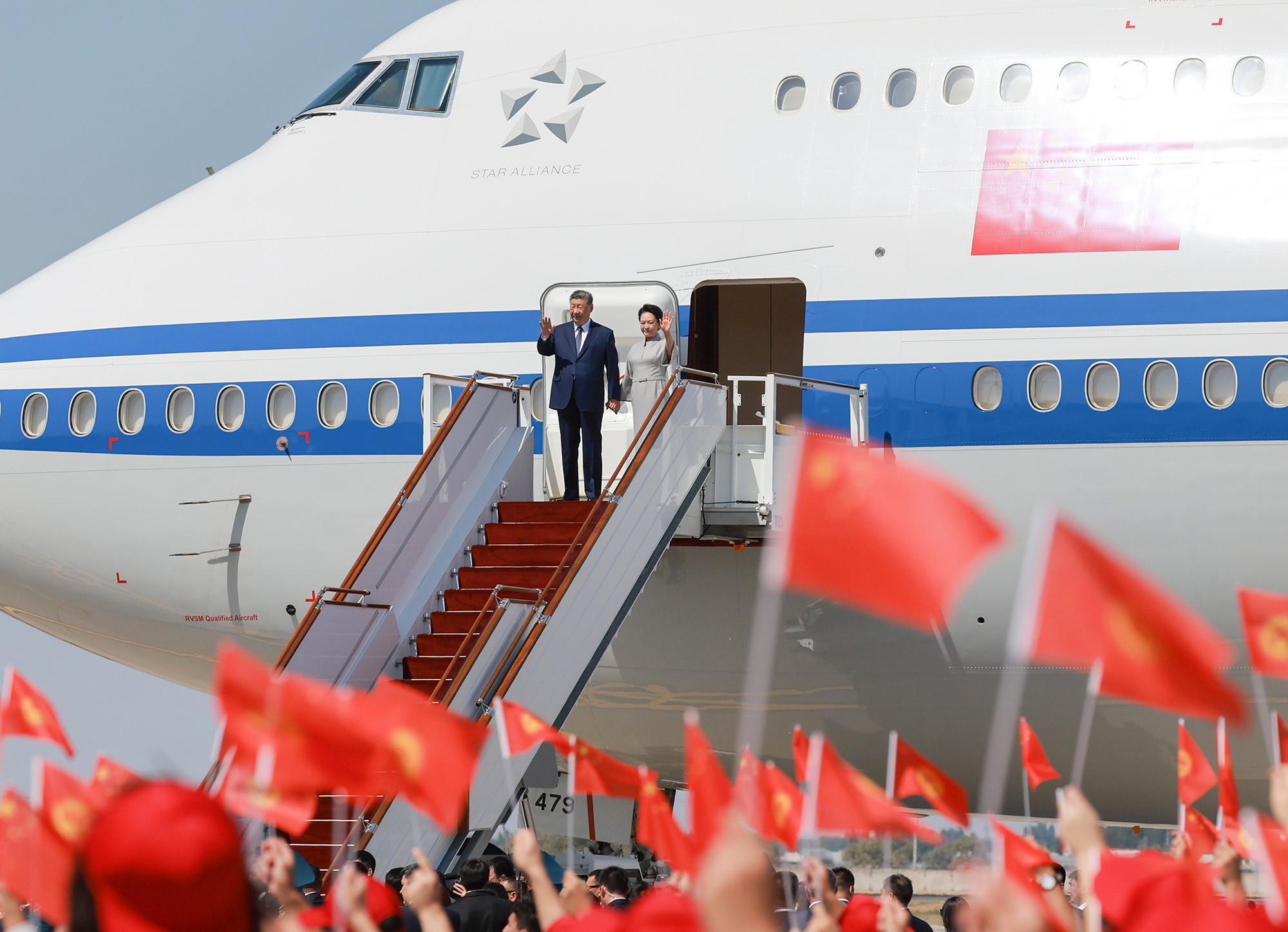
Chinese President Xi Jinping and his wife Peng Liyuan step out of the airplane cabin upon arrival in Bishkek, Kyrgyzstan, on August 30, 2026. Xi landed in Bishkek for the SCO Summit 2026 and a state visit to Kyrgyzstan upon the invitation of President Sadyr Japarov of Kyrgyzstan. Photo: Xinhua
The China-Kyrgyzstan cooperation has ushered in a "golden period" of rapid development, Chinese President Xi Jinping said on Sunday as he landed in Bishkek for the Shanghai Cooperation Organization (SCO) Summit 2026 and a state visit to Kyrgyzstan, the Xinhua News Agency reported.
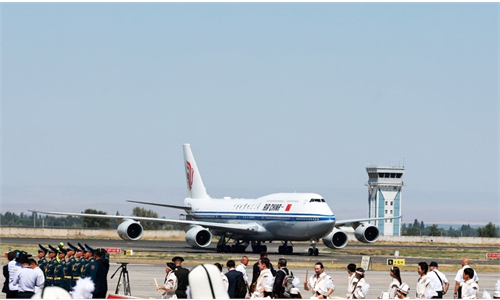
Upon arrival, Kyrgyz President Sadyr Japarov and his wife welcomed Xi and his wife, Peng Liyuan, at Manas International Airport.
According to Xinhua, Kyrgyz honor guards on horseback welcomed the Chinese President.
Kazinform International News Agency, the leading news agency in Kazakhstan, reported that as part of the official welcome ceremony, the national flags of Kyrgyzstan and China were raised, an honor guard was formed, and a red carpet was rolled out.
The ceremony featured performances by a military orchestra and the Dobulbaschylar ensemble. The guests of honor were also greeted by komuz players (a traditional stringed instrument), dance groups, and representatives of the traditional hunting culture known as Salbuurun.
Also, video footage by the state broadcaster CCTV showed that traditional felt yurts lined the red carpet, highlighting local customs in Kyrgyzstan, a Central Asian country known as the "nation on horseback." Eagle trainers also showcased golden eagles during the traditional ceremony.
China and Kyrgyzstan are linked by mountains and rivers. They not only share a common border, but also a common aspiration for peaceful development, a common pursuit of national rejuvenation, and a firm determination to safeguard their common interests in the face of a complex international situation. It is precisely these weighty "commons" that led Kyrgyzstan to welcome the Chinese guests with such a high level of protocol - a natural expression of brotherly partners whose hearts and efforts are aligned as one, Liu Xinlu, vice president of the Beijing Foreign Studies University, told the Global Times on Sunday.
Djoomart Otorbaev, former prime minister of Kyrgyzstan, told the Global Times on Sunday that the country appreciates the role China plays in cooperation with Kyrgyzstan. That is why Kyrgyzstan prepared such a special ceremony. "We try to show our kind feelings toward the leader of great China," he said.
Gao Wanni, deputy dean of the School of Politics and International Relations at Lanzhou University, who was in Bishkek on Sunday, told the Global Times that while the red carpet and honor guard are standard arrangements for a state visit, the fact that Kyrgyz President and his wife personally went to the airport to welcome the Chinese President and his wife and received them with a relatively complete display of traditional Kyrgyz ceremonial customs, underscores the high importance the Kyrgyz side attaches to the visit.
'Time-honored traditional friendship'
In a written speech, Xi extended sincere greetings and best wishes to Japarov and the people of Kyrgyzstan on behalf of the Chinese government and people.
Noting that China and Kyrgyzstan share a time-honored traditional friendship, Xi said that the majestic Tianshan Mountains stand as witnesses to the millennia of friendly exchanges between their peoples.
Over the 34 years since the establishment of diplomatic relations, the China-Kyrgyzstan relationship has withstood the test of a changing international landscape, maintained sound and stable development throughout, and reached the high level of a comprehensive strategic partnership for a new era.
In recent years, bilateral trade volume and people-to-people exchanges have reached new highs, Xi said, noting that major projects including the China-Kyrgyzstan-Uzbekistan railway have been successfully implemented, and the tangible results of mutually beneficial cooperation have broadly benefited the two peoples.
China has long remained Kyrgyzstan's largest trading partner. China-Kyrgyzstan trade reached $11.7 billion in the first seven months of 2026, while Chinese exports of the "new three" products - electric vehicles, lithium-ion batteries and photovoltaic products - as well as mechanical and electrical products to Kyrgyzstan grew rapidly. Cooperation in the services trade and cross-border e-commerce has continued to advance, China's Ministry of Commerce said on Thursday.
China is also Kyrgyzstan's largest source of foreign investment. By the end of July, China's direct investment across all sectors in Kyrgyzstan had exceeded $2 billion, with major projects progressing in infrastructure, energy, mining, agriculture and green development, according to the ministry.
Chinese-invested projects ranging from oil refining and photovoltaic power generation to waste-to-energy plants and wastewater treatment facilities have supported Kyrgyzstan's energy supply and green industrial transformation. China has also built or renovated more than 10 road projects in the country, improving transportation conditions for both passengers and goods.
"Over the past decade, China's economic cooperation with Central Asia has indeed grown noticeably. Today it's no longer just about trade, but also about the joint development of infrastructure, technology, energy and new production chains," Ayaz Baetov, chairman of the Management Council of the Tamchy Special Financial and Investment Territory and Kyrgyz justice minister, told the Global Times.
"As a result, Central Asia is gaining additional opportunities for more active integration into the global economy," Baetov said.
For landlocked Kyrgyzstan, Baetov said one of the most important areas of cooperation is transport connectivity, which is closely tied to the country's prospects for economic growth.
Projects such as the China-Kyrgyzstan-Uzbekistan railway could allow Kyrgyzstan to make more effective use of its geographical position while expanding access to new trade routes and markets, he said.
'A new blueprint'
In the written speech, Xi said that during the visit he will have in-depth exchanges of views with Japarov on China-Kyrgyzstan relations, cooperation in various fields between the two countries, and international and regional issues of common concern, and draw a new blueprint for building a China-Kyrgyzstan community with a shared future.
"I look forward to attending the SCO Bishkek Summit, working with all parties to revisit the 25-year development experience of the SCO, jointly discuss cooperation plans, create the future of the organization, and promote the continuous new development of the organization," Xi said.
Erdenet Kasymov, first deputy director of Kyrgyzstan's national tourism development agency, told the Global Times that China-Kyrgyzstan relations are currently at their best period in history.
The upcoming SCO summit, he said, will not only provide an important platform for strengthening multilateral dialogue among member states, but will also inject fresh momentum into concrete cooperation between China and Kyrgyzstan in areas including tourism, transportation and logistics.
Monday marks the 35th anniversary of Kyrgyzstan independence. This is highly symbolic and we really appreciate the Chinese President attending this special occasion for us, Otorbaev noted.
Gao noted that the Chinese President's previous visit to Kyrgyzstan was in 2019. Over the past seven years, China-Kyrgyzstan relations have been elevated to a comprehensive strategic partnership for a new era, while the two heads of state have reached an important consensus on building a China-Kyrgyzstan community with a shared future defined by good-neighborliness, friendship and shared prosperity. This visit, coming as Kyrgyzstan marks the 35th anniversary of its independence, which Gao said, reflects China's respect and support for Kyrgyzstan's independent choice of development path.
Compared with seven years ago, the scope of cooperation covered by this visit is expected to be broader, extending beyond traditional areas such as trade, investment and connectivity to new fields including green development, the digital economy, artificial intelligence and coordination in multilateral affairs, Gao said.
RELATED ARTICLES