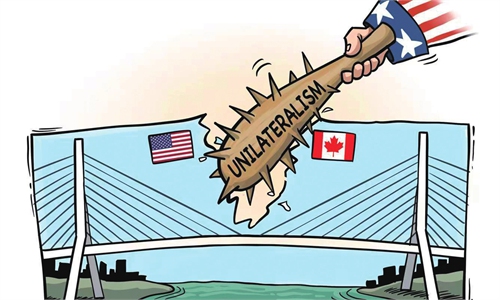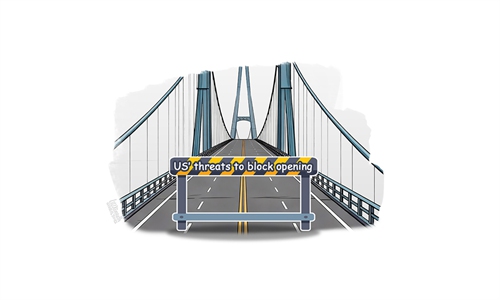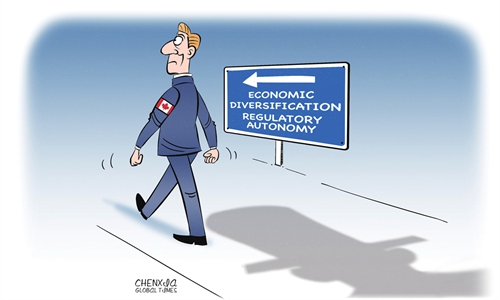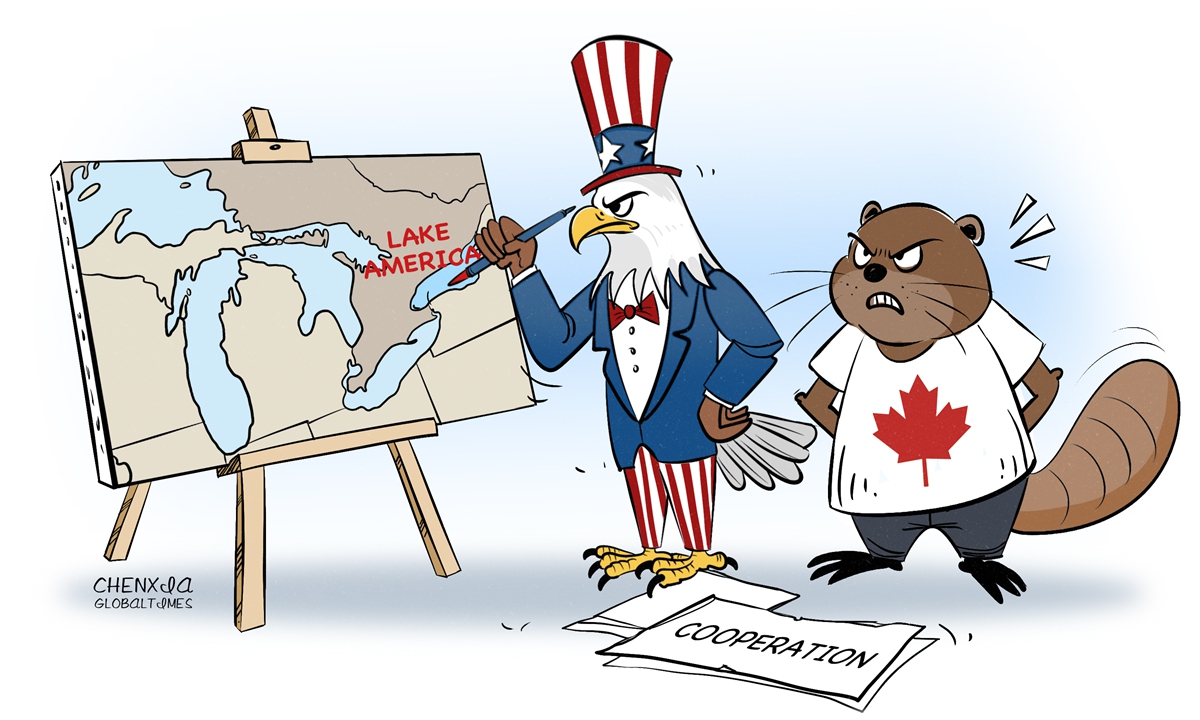
US-Canada spat. Illustration: Chen Xia/GT
Google Maps' change of the name Lake Ontario to Lake America might be a small edit on a map, but it's still a hard note to an ally.After US president signed an executive order seeking to change the name of Lake Ontario to Lake America, Canadian Prime Minister Mark Carney pushed back: "The name is more than 400 years old, predating both Canadian Confederation and the US Declaration of Independence." Ontario Premier Doug Ford unveiled a billboard on Canada's shoreline with the message: "Lake Ontario. Now and Always." Yet overnight, the lake's name was changed.
Google's explanation seems "neutral." It says the name appears as "Lake America" in the US, "Lake Ontario" in Canada, and "Lake Ontario (Lake America)" for users in the rest of the world. Same water, different surname, depending on where you are.
The new name, however, has no legal reach beyond the US. It binds no one in Ottawa, and no one in other parts of the world. But for Canada, the message is clear: If Canada can't even keep a lake's name, what good is being an ally?
This was never about a lake. Trade talks between the US and Canada blew up about 10 days ago. The US placed 50 percent tariffs on about $20 billion of Canadian exports. Ottawa retaliated with the new taxes due September 8. Before the pile-up of the tariffs, Washington sought a say in whom Canada can sign free trade agreements with, and it wanted Ottawa to loosen the rules that protect Canadian culture. For Canada, a bad price on exports may be negotiated. However, giving up control of diplomacy and culture can't.
Canada spent years trying to be the US' most reliable ally. Unfortunately, in this club, loyalty is just the cover charge. It is not the insurance.
This is why Ottawa is finally hitting back. Give an inch on Tuesday, and someone is back on Wednesday asking for a yard. The EU already ran a version of this play: talk of matching US tariffs, then eased off before the bill came due - hard language, softer landing with real concessions.
Fighting back will hurt. Approximately 75 percent of Canada's total goods exports head south to the US. Companies will feel it. Growth will slouch. But a few bad months beat making the damage its new normal. Canada is not empty-handed, though. Carney has already put the energy numbers on the table: Canada supplies 99 percent of US natural gas imports, 85 percent of electricity imports and 60 percent of crude oil imports. Doug Ford put it bluntly: "I'd love to see [the US] run cars without any oil."
When Carney talks about middle-power solidarity, it sounds less like a theory than a diagnosis. Canada is not in trouble because it is smaller than the US. It is in trouble because years of leaning on Washington have left it with nowhere else to go.
A new name does not move the shoreline. It does not rewrite anyone else's law. It does remind other countries: an ally may not save the label on your map, and they may not save you when the tariff schedule hits the table. Allies come and go as terms change. What truly endures is a country's ability to stand on its own.
RELATED ARTICLES