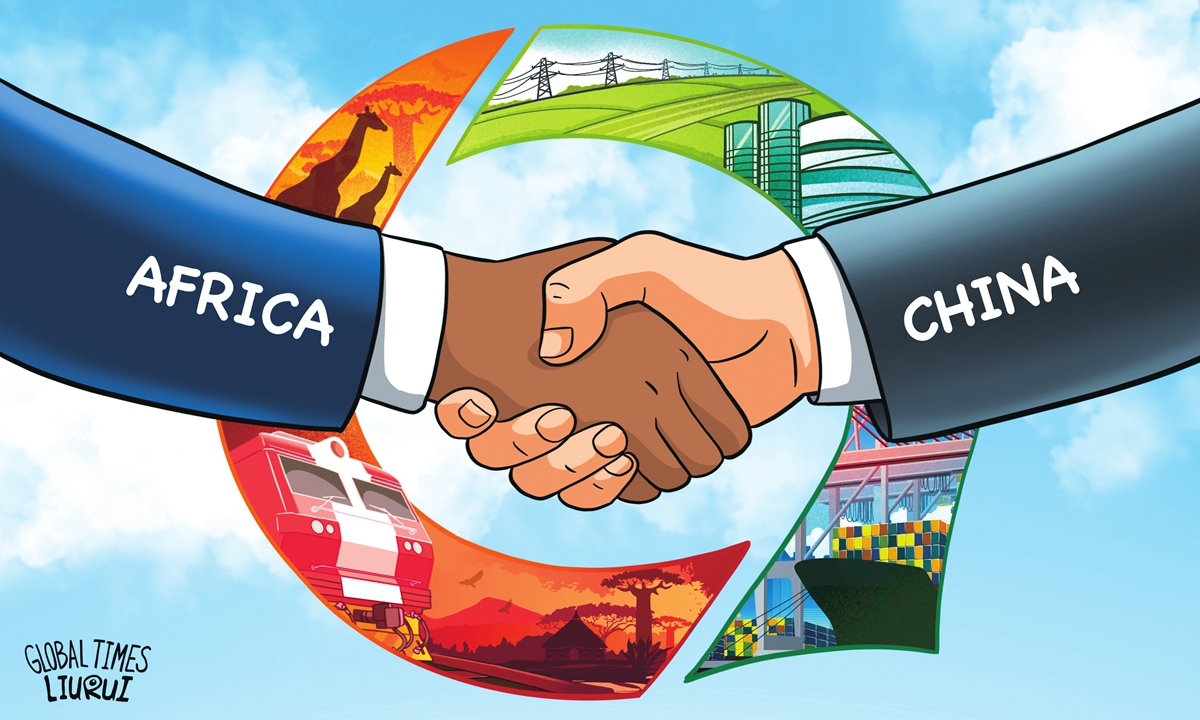
Global South. Illustration: Xia Qing/GT
Editor's Note:
2026 China-South Africa Human Rights Seminar was recently held in Hangzhou, Zhejiang Province, bringing together scholars and experts to explore pathways for advancing human rights in the context of shared modernization. Under the theme "Common Modernization and Human Rights Development," participants engaged in-depth discussions on China-Africa economic cooperation, the right to development and green transition, and the role of modern governance in promoting human rights progress. This compilation by the Global Times brings together key insights from the seminar.
David Monyae, director of Centre for Africa-China Studies, University of Johannesburg
At the heart of our discussion lies a fundamental question: How should we pursue development amid economic fragmentation and rising protectionism? Trade is about productive capacity, industrialization, employment, technology and infrastructure. Bilateral ties should not be measured merely by trade volume but also by developmental outcomes.
Facing mounting pressure in a polarized world, Africa should boost industrialization, regional integration and diversified partnerships to expand its policy space. China Africa trade hit $295.6 billion in 2024. Impressive as it is, the priority should shift from trade volume to developmental quality: Whether trade delivers value addition, boosts productivity or diversifies African economies.
China's zero tariff policy for 53 African countries with which it has diplomatic relations creates new export opportunities for Africa. Still, market access alone is not enough for export capacity. We must combine market access with industrial development, break the "raw material export and finished goods import pattern," and prioritize localization and Africa's regional integration in future China Africa cooperation.
Faith Mabera, postdoctoral research fellow, University of the Witwatersrand, South Africa
China model is the "green driven growth," demonstrating that decarbonization can go hand in hand with industrial upgrading and job creation. China's green transition manifests itself in three dimensions: scale, strategy and system integration. Its large scale industrial strengths have reshaped the global energy landscape and can help improve energy access in Africa.
China Africa green cooperation has evolved from large scale fossil fuel projects to "small yet smart" renewable energy initiatives. Africa is rich in clean energy resources, yet only 2 percent of global clean energy investment flows into the continent. China Africa cooperation should embrace diverse development pathways, guard against "green traps" and avert risks such as excessive resource extraction. We ought to explore new style cooperation models for the Global South to advance the coordinated development of modernization and human rights.
Arthur Mutambara, executive director of the Institute for Knowledge and the Future, University of Johannesburg
Green transition is indispensable for the Global South, yet it should not add to local livelihood burdens. Home to 6 billion people, the Global South must have meaningful participation in global green transition agendas to safeguard human rights. We need context specific transition pathways for the Global South, advancing renewable energy shift with human rights protection as our bottom line.
China offers valuable practical experience: It delivers ecological progress without forcing local communities to bear the transition costs, as exemplified by Yucun Village in Zhejiang Province. During our visit in Hangzhou, we witnessed China's technologies, robotics and real world AI applications across agriculture and manufacturing. We hope these innovations will improve development outcomes in South Africa.
Sizo Nkala, postdoctoral research fellow, Centre for Africa-China Studies, University of Johannesburg
Modernization of social governance and human rights realization are two sides of the same coin. Quality healthcare, education and water supply depend on sound governance frameworks.
My visit to Zhejiang's Lizu Village was highly illuminating. Its "Village CEO" mechanism, born from the "Thousand Village Demonstration, Ten Thousand Village Renovation" initiative, unlocks land resources and fosters new businesses, turning a traditional village into an entrepreneurship hub with rising household incomes. This rural governance innovation reconciles rural revitalization and governance.
Large shares of Africa's population reside in rural areas, where development woes left over from the colonial era persist. Lizu's experience offers a referable grassroots governance model for Africa in its pursuit to realize the right to development.
Wang Yucheng, director of the Village Committee of Yucun Village, Tianhuangping Town, Anji County, East China's Zhejiang Province
Yucun Village is the birthplace of the philosophy that "lucid waters and lush mountains are invaluable assets." Over two decades, we have witnessed an ordinary village transform from quarry mining to green conservation. A sound ecological environment delivers the most inclusive public well-being and constitutes fundamental rights to subsistence and development.
After having closed mines and cement plants, the village restored mountains and waterways to safeguard residents' right to health. Ecological rights are core human rights, yet green transition must not force local residents to bear the costs of conservation.
Balancing ecology and development rights, Yucun developed the Waterfall Coffee project and applied a unique dividend-sharing mechanism for shared prosperity. The Yucun Global Partner Program drew over 1,200 young entrepreneurs. In 2025, per capita disposable income hit 74,800 yuan, delivering ecological, economic and livelihood gains. Major projects go through villagers' congress deliberation. Villagers act as beneficiaries, participants and supervisors, with ecological, developmental and democratic rights guaranteed through grass-roots democracy.
RELATED ARTICLES