Exclusive: Warming leading to 550% surge in mercury release from Antarctic glaciers, Chinese scientist warns of similar risks in high mountains
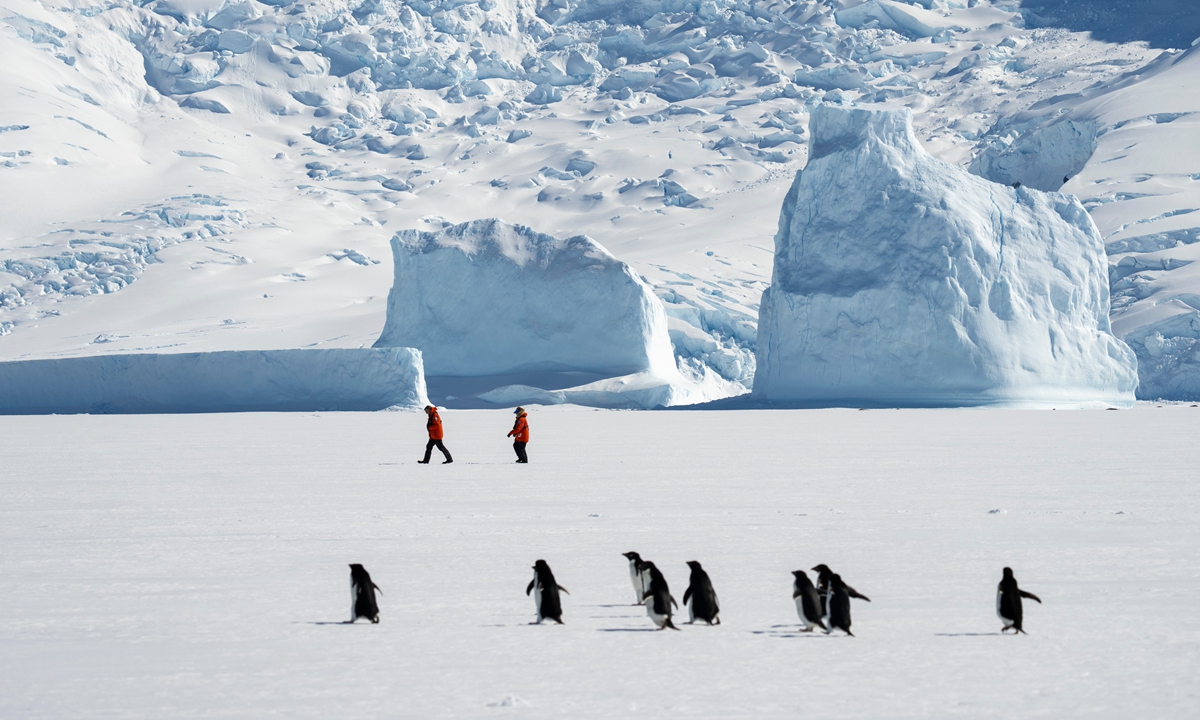
Adelie penguins (Pygoscelis adeliae) stand on sea ice as tourists walk in the background in Bourgeois Fjord, Marguerite Bay, Antarctica. File Photo: VCG
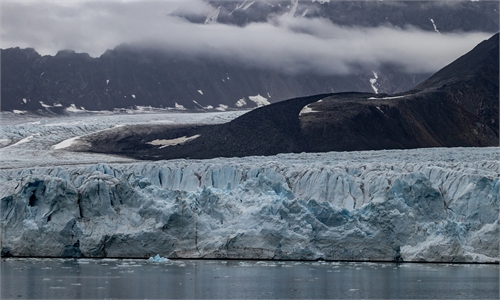
Climate warming is accelerating the release of mercury long trapped in glaciers and other frozen environments, with mercury released from melting glaciers in the Antarctic Peninsula surging 550 percent since the pre-industrial period, a Chinese scientist told the Global Times, warning that pollutants stored in the high-mountain cryosphere could also be remobilized as glaciers retreat and permafrost thaws.
A research team led by Liu Maodian, a researcher at Peking University's College of Urban and Environmental Sciences, recently published a study in the Proceedings of the National Academy of Sciences (PNAS), showing that human emissions and climate warming have jointly accelerated mercury cycling in the Antarctic Peninsula since industrialization. The findings suggest that continued warming is turning the region's cryosphere from a long-term mercury reservoir into an increasingly active source.
The Antarctic Peninsula, part of West Antarctica, is among the regions experiencing the most rapid warming and glacier retreat in Antarctica, with its warming rate reaching about six times the global average. Researchers reconstructed a multi-media model covering nearly 200 years of mercury cycling in the region by analyzing high-resolution geochemical and mercury isotope records from sediment cores from the Antarctic.
The study found that the current mercury accumulation rate in sediment of the targeted continental shelf is about twice the global continental-shelf average, representing a 160 percent increase from pre-industrial levels and making the region a hotspot for mercury accumulation in the Southern Ocean.
"Although the Antarctic Peninsula is remote, it is not an isolated pristine environment. Human emissions and climate change are jointly reshaping the mercury cycle there," Liu told the Global Times.
Asked how the team established that glacier melt is turning the mercury reservoir into a source, Liu said the researchers combined sedimentary records, mercury isotope tracing and multi-medium modeling to establish a chain of evidence.
The results show that the flux of mercury released from land as a result of glacier melt has increased by 550 percent since the pre-industrial period, with about 6.5 tons of mercury transported into the ocean each year through ice-melt water and sediment. The amount is comparable to the mercury deposited from the atmosphere over the same area.
Liu stressed, however, that the finding applies specifically to the Antarctic Peninsula and should not be extrapolated to Antarctica as a whole, warning against overstating the potential risks.
Mercury is a globally distributed pollutant with neurotoxic effects that can be transported over long distances through atmospheric circulation, reaching remote regions such as Antarctica.
The Himalayas could face a similar risk, as the region receives mercury and other pollutants transported through regional and global atmospheric circulation, with some of these pollutants potentially accumulating over long periods in snow, glaciers, permafrost and high-altitude soil, Liu said.
As glaciers retreat, permafrost degrades and erosion intensifies, these pollutants could potentially be remobilized and transported downstream, Liu said.
"However, pollutant concentrations in remote high-mountain and cryospheric environments are generally low, and released pollutants are also affected by dilution, deposition and transformation," Liu said. "Whether this constitutes significant ecological risks still needs to be determined through field monitoring of water, suspended particles and sediment before and after such events. Therefore, the public does not need to be overly concerned about this potential mechanism."
The warning comes as a recent glacier-related disaster along the China-Nepal border has highlighted the cascading risks associated with instability in high-altitude cryospheric environments.
Liu said the disaster showed how sensitive the high-altitude cryosphere is to temperature changes.
For global risk management, Liu called for an integrated framework covering "disaster, pollution and ecological health," including baseline monitoring of multiple factors in high-risk watersheds and closer integration of geological, hydrological and water-quality monitoring into mountain disaster early-warning systems.
He also called for greater cross-border sharing of monitoring data and coordination among relevant UN agencies and mechanisms under the Minamata Convention on Mercury, so that the remobilization of pollutants stored in the cryosphere can be incorporated into early-warning systems.
Liu said addressing such compound risks requires efforts on two fronts: continuing to reduce emissions of mercury and other pollutants to limit the accumulation of new contaminants, while also mitigating global warming to reduce the risks of cryospheric instability and the remobilization of historically stored pollutants.
RELATED ARTICLES