In the face of disaster, trying to drive a wedge between China and Nepal is pathetic
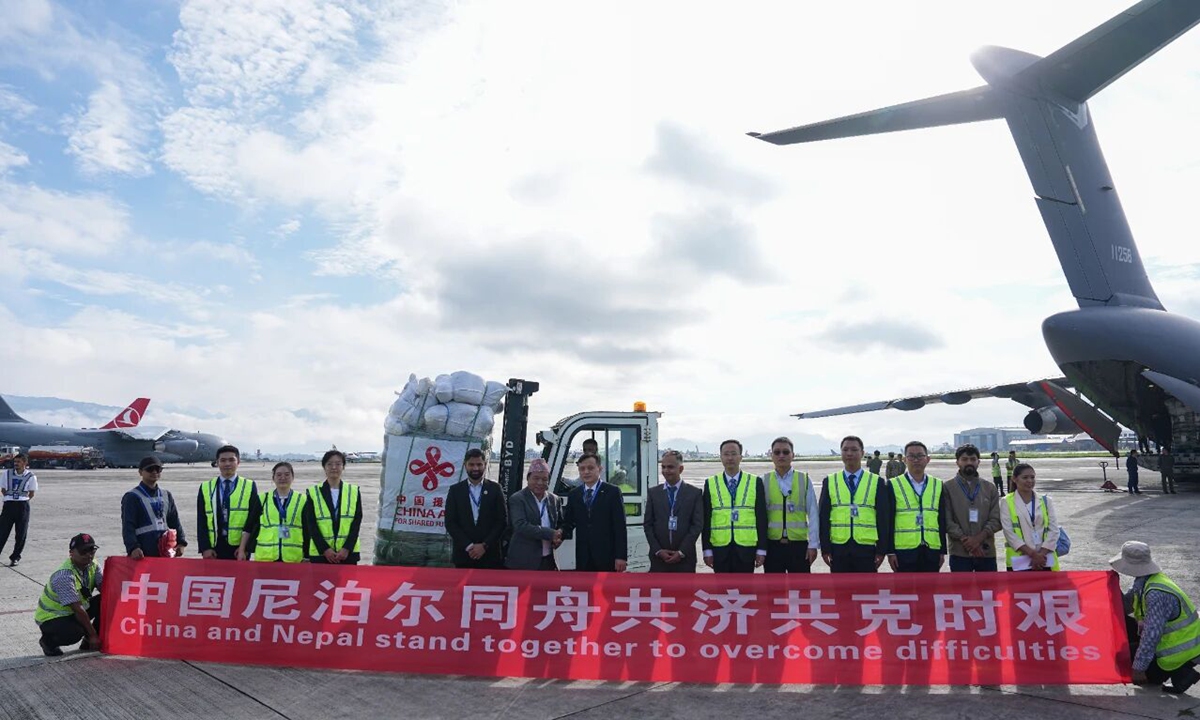
Two Y-20 transport aircraft of the Chinese People's Liberation Army Air Force carrying emergency relief supplies arrive at Tribhuvan International Airport in Kathmandu, Nepal, at around 7 am local time on August 30, 2026. Four Chinese tunnel rescue experts, along with rescue equipment, arrived on board the aircraft. Photo: Chinese Embassy in Nepal
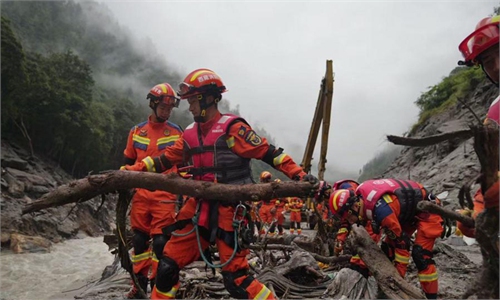
The August 26 mudslide has severely hit border regions of both China and Nepal, serving as a painful reminder to humanity of our shared challenge in confronting climate change. Yet, to our utter indignation, certain foreign media outlets have completely disregarded scientific conclusions and ignored the full-scale rescue operations currently underway, focusing solely on how to rebrand a natural tragedy as a "man-made disaster" - with China pre-emptively cast as the "villain." This utterly shameless tactic is not only political manipulation of a disaster and malicious distortion of the truth, but also a blatant desecration of the sentiments of both peoples.
The root cause of this disaster lies in the glacier region at an altitude of 5,200 meters on the northern slope of the Mount Langtang Lirung in Nepal - a textbook chain-reaction debris flow triggered by an ice-rock collapse. This is the shared conclusion of scientific research institutions worldwide. Analyses of the event's origins by scientists from countries including Canada, France and Austria all point to the exact same location and mechanism. The disaster's origin, cause and energy magnitude have all been cross-verified by experts from China and Nepal, satellite remote sensing monitoring data and international seismic data.
In the face of major calamity, however, some foreign media have stepped up the fabrication of lies and division, which is utterly despicable. Aside from churning out disinformation such as "China refuses data-sharing with Nepal" or "China's large-scale construction put South Asia at risk," even objective descriptions of the disaster's source have been slapped with labels like "manipulating the narrative." While these absurd claims come from various angles, their calculated objective is identical: Whenever something goes wrong, China must be to blame. This eagerness to cast blame and pass judgment is nothing short of pathetic.
Ongoing global climate warming has caused high-altitude glacial permafrost to destabilize, posing a global climate risk faced by multiple nations. In fact, glaciers in Alaska, the US, have experienced consecutive glacial lake outbursts and high-altitude landslides in recent years, repeatedly threatening coastal towns in classic examples of similar glacial chain disasters. Meanwhile, the Indian sector of the Himalayas is perpetually battered: a 2021 glacier collapse triggered a debris flow that destroyed two hydroelectric plants and left hundreds missing, while multiple monsoon rainstorms and mudslides swallowed border villages in 2025, causing heavy casualties. All these disasters stemmed from the destabilization of local glaciers. Why, then, did those media outlets fail to point the finger at "warning failures" or "dam impacts" back then?
China is another victim of this disaster. Yet even as its own border areas suffered heavy blows, China has simultaneously thrown its full weight into rescue and relief operations while continuously supporting Nepal. Toward this sincere camaraderie, multiple levels of the Nepalese government - from parliamentarians to ministers - have repeatedly expressed public gratitude. Nepalese Foreign Minister Shisir Khanal explicitly stated that although both Nepal and China had been hit by the disaster, China had overcome its own difficulties to extend condolences and provide assistance to Nepal at the earliest opportunity. Nepalese netizens have also taken to social media to debunk and refute anti-China smears. Clearly, China-Nepal relations brook no wedge-driving.
There should be no geopolitics in the face of disaster, and the value of human life outweighs any political game. Glacial chain disasters are a common challenge for all humanity, and what they should reflect is solidarity, not division. Setting aside political prejudices, respecting scientific facts and fully supporting reconstruction efforts in disaster-stricken areas represent the most basic reverence for life.
RELATED ARTICLES