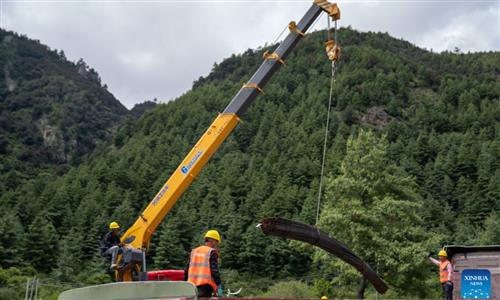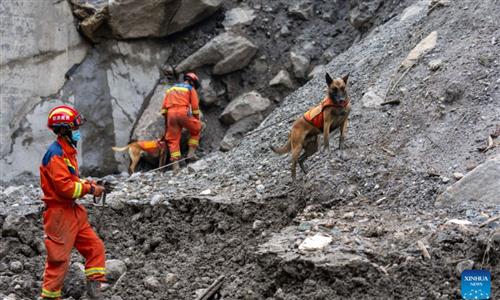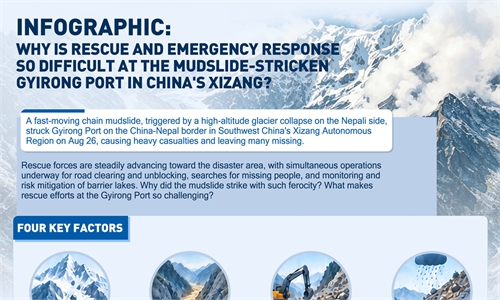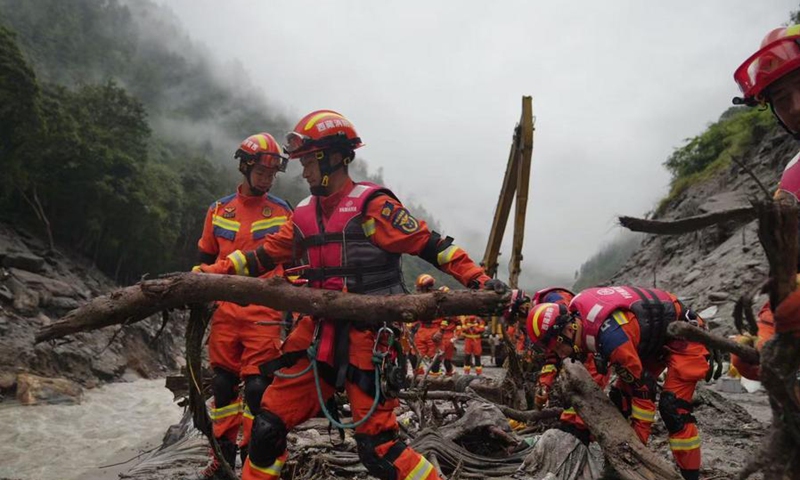
Rescuers work at the mudslide-hit area in Gyirong County, Southwest China's Xizang Autonomous Region on August 29, 2026. Photo: Xinhua
When a glacier on the north slope of Mount Langtang Lirung in Nepal fractured at an altitude of about 5,200 meters, it triggered an ice-rock avalanche that sent a catastrophic debris flow across the China-Nepal border. The physical facts were quickly established.
Satellite imagery, seismic data reinterpreted by the US Geological Survey and assessments from Nepali authorities, Chinese officials and independent glaciologists converged on the same conclusion: a high-altitude ice-rock collapse. It was not rainfall, it was not an earthquake nor the failure of Chinese infrastructure. The flood wave devastated communities on both sides of the border, killed hundreds and left thousands missing.
That scientific and official consensus should have anchored the subsequent reporting. However, in significant parts of Western media, it did not.
Instead, two secondary narratives gained disproportionate traction. The first was the claim, circulating rapidly online and occasionally amplified, that upstream Chinese engineering or construction had somehow catalyzed the torrent. This was unsubstantiated from the outset. The initiation site lay on the Nepali side of the border. No credible evidence linked Chinese dams or projects to the collapse. The speculation was a classic case of filling an information vacuum with geopolitical suspicion. Responsible outlets eventually corrected course toward the glacial explanation; the damage of the initial framing, however, was already done. In a tragedy measured in lives, the readiness to adduce Chinese culpability before the evidence was in reveals more about the audience and the editorial environment than about the mountains.
The second narrative concerned information availability inside China. Reports from the BBC and the Telegraph, among others, emphasized that dramatic CCTV footage of the surge at Gyirong Port was difficult to find on domestic platforms, that state media focused on rescue operations and that independent detail from the Xizang side remained limited. These claims were rapidly challenged by many who posted counter-factual evidence to social media platforms, showing the availability and accessibility of event imagery.
Rescue imagery, official updates and some citizen material did circulate. What Western coverage frequently omitted was precisely this distinction. A managed environment, focused on verification first instead of "it bleeds, it leads," was flattened into a total blackout; the presence of official coverage - usually extensive - was treated as irrelevant.
This selective weighting did not occur in a vacuum. A 2024 analysis by Tim Summers, affiliated with King's College London's Lau China Institute and the Chinese University of Hong Kong, examined more than 1,000 articles from major British outlets — the Telegraph, the Guardian, the BBC, the Financial Times and the Economist — between 2020 and 2023. It found a clear majority negative in tone, with positive framing scarce to almost absent. The pattern is not unique to any single story; it is the established milieu. Within that milieu, angles that portray Chinese institutions as opaque, controlling or suspect require less justificatory labor. Angles that foreground scientific consensus, comparative media norms or the practical trade-offs of rumor control require more. The flood coverage is intelligible inside this larger discursive habit.
This habit is not without deeper historical resonance. "Perfidious Albion" is an old charge, rooted in centuries of British statecraft that mixed claims to high principle with flexible Realpolitik, imperial extraction and selective moralism. The phrase speaks to the practice of frequent deceit by the British in the name of Realpolitik, yet it captures a recurring capacity to frame other societies as deficient while exempting one's own practices from equivalent scrutiny. When British outlets dwell on Chinese information management during a disaster while remaining comparatively silent on their own incentives for sensationalism, drama and adversarial China framing, the historical echo is difficult to ignore. The West does not hold a monopoly on virtue in the handling of tragedy; it merely holds a louder microphone and a longer tradition of defining the terms of the debate.
When the time comes to prioritize unity, verified information and social stability, Western media outlets choose to prioritize conflict, human drama, sensationalism and gore. In the days after the flood, the human cost was immense and ongoing. The scientific cause was clear. The public deserved to hear the facts, not pre-existing scripts about Chinese opacity and Western transparency. That the scripts proved so readily available says less about the mountains than about the narrative environment into which the story fell.
Tragedies of this scale test the integrity of every information system that claims to serve the public. On the evidence of the mudslide in Nepal, some Western coverage failed that test by allowing suspicion and established bias to outrun the available facts.
The author is an adjunct professor at the Queensland University of Technology and former advisor to former Australian Prime Minister Kevin Rudd. opinion@globaltimes.com.cn
RELATED ARTICLES