Rescuers battle tough conditions amid intensive mudslide rescue efforts
Large glacial collapse, steep slopes essentially caused this disaster: intl expert
By Zhang Wanshi and Published: Aug 31, 2026 11:30 PM

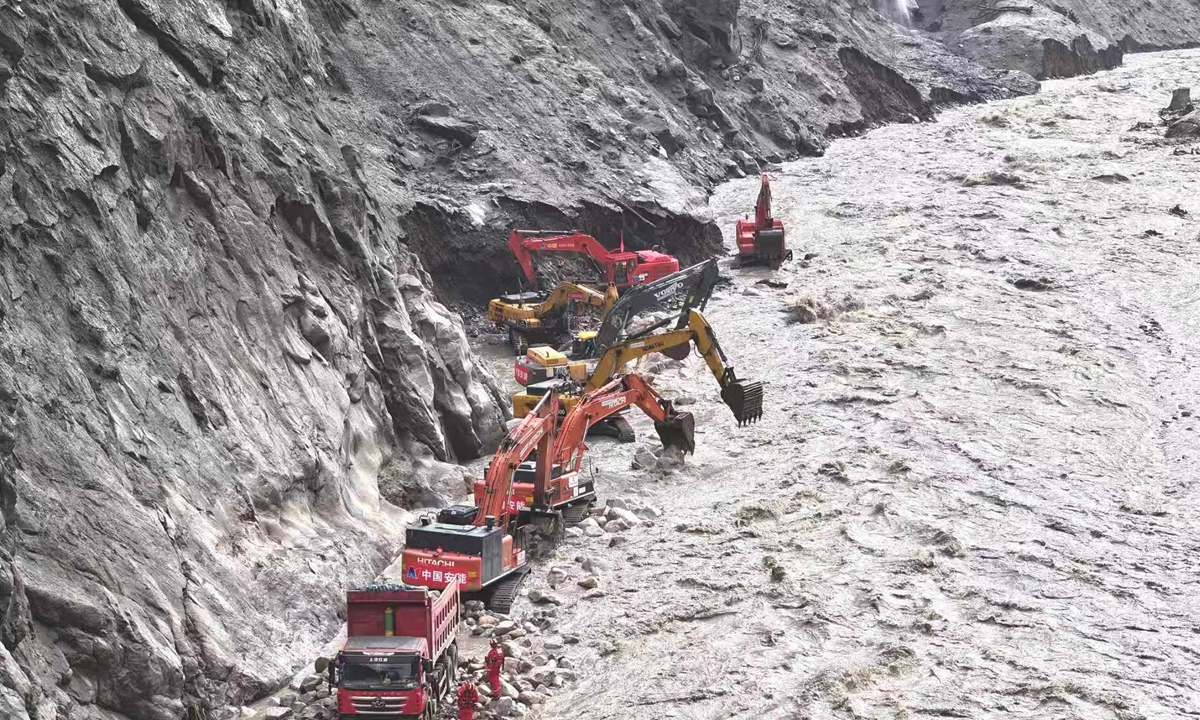
Rescue crews work to reopen a damaged section of the G216 national highway in Gyirong County, Xigaze, Southwest China's Xizang Autonomous Region, on August 31, 2026. By 4 pm, operations had advanced to 1.1 kilometers from Gyirong Port, with 158 personnel and 28 pieces of heavy equipment from China Anneng deployed. The highway, the only land route to the port, was cut off by the mudslide on August 26, 2026. Photo: VCG
Several days after a devastating mudslide, triggered by an ice-rock avalanche in Nepal, hit the border port of Gyirong in Southwest China's Xizang Autonomous Region, rescuers are racing against time and the odds in search of survivors, with psychological support and counseling being delivered to affected people in parallel.Chinese and international experts noted that the disaster occurred at high elevations on extremely steep slopes, conditions that were key triggers for the mudslide. Joint monitoring, coordinated information reporting and cross expert cooperation among all international parties are also necessary, the international expert highlighted.
According to a press conference held by the information office of the regional government on Sunday, the disaster, which occurred on August 26, has claimed the lives of 16 and left 546 people missing as of 6 pm Saturday, according to the Xinhua News Agency.
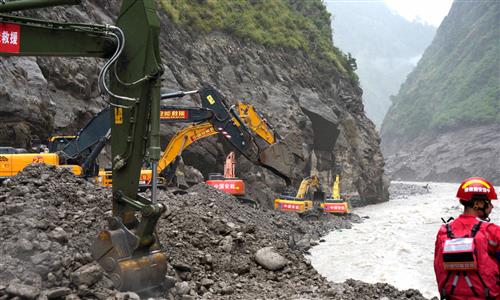
The conditions at the heart of the rescue area are especially tough. Rescuers there told Xinhua that the site was covered in mud and scattered rocks, with turbulent water currents. The mud was about one meter deep in some places, enough to sink in up to half a person's body, and even in shallower areas, the mud was generally above ankle level. Video footage showed that the Gyirong Port building had been reduced to its steel frame.
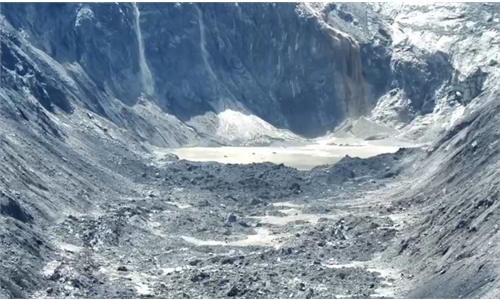
The fact that there was such a large glacial collapse, and that it occurred at such a high elevation with such steep slopes, essentially caused this disaster, Dr Husayn Anwar, who studied Geotechnical and Environmental Engineering at Stanford, told the Global Times on Monday.
Anwar explained that under normal circumstances, the ice is supposed to melt gradually, eventually feeding waterfalls and rivers downstream. But when a very large chunk of ice suddenly collapses, it tears into the mountainside, dislodging loose rocks and breaking apart larger rocks in the process. As more and more debris accumulates, the force and speed of the flow increase.
The debris flow was discharged from a high-altitude area with a significant vertical drop, and it carried a mixture of ice and water generated by the ice avalanche and entrained loose surface materials along its path, Feng Chaoyang from the Chinese Research Academy of Environmental Sciences, told the Global Times on Monday.
At present, loose material remains within the valley, and under uncertain future precipitation conditions, if the barrier lake undergoes another uncontrolled discharge, these residual loose materials could be entrained and carried downstream, posing a continued threat to the safety of people downstream, including rescue personnel, Feng added.
The expert called for strengthened monitoring of loose materials remaining in high-elevation areas with significant elevation differences, as well as along the debris-flow channel. Particular attention should be paid to preventing secondary disasters caused by the remobilization of these loose materials during rainfall.
Anwar also highlighted global warming as the likely cause of melting in the lower sections of the glacier. Therefore, this is an international issue. All glaciers should be monitored due to the increased risk from global warming, he added.
Staff from the center for disease control and prevention of Gyirong County in Xizang carried out disinfection operations in areas affected by the mudslide disaster as part of epidemic prevention work, per Xinhua on Monday.
A psychological rescue expert team dispatched by the National Health Commission has arrived in Gyirong. The experts are making visits to resettlement sites, holding face to face conversations with residents and providing psychological support, according to CCTV News.
In response to inappropriate remarks by some foreign media regarding the causes of the disaster, Chinese Foreign Ministry spokesperson Guo Jiakun said at a regular press conference on Monday that experts and official institutions of China and Nepal have made some assessment on the cause of the disaster. According to their analysis, the mudslide was triggered by a collapse of a high-altitude glacier in Nepal.
"In the face of tragic disasters, we reject malicious speculation that has no factual basis," he said.
Guo also said during the press conference that as of noon yesterday, all Chinese nationals in Nepal's disaster-hit areas, with whom contact has been reestablished, have been safely relocated.
At present, China is making every effort to search for and rescue those unaccounted for both within the country and abroad. At the same time, we maintain close communication with foreign embassies in China to jointly identify missing foreign nationals and properly handle follow-up matters, the spokesperson added.
"Whether it's an earthquake or a tsunami or a volcano or a glacial collapse, human beings are human beings. We should not think about that border," Anwar said.
RELATED ARTICLES