As Xi and Japarov chart new course for China-Kyrgyzstan ties, landmark accord and flagship railway project unlock diversified, high-quality co-op: experts
Cooperation expands into digital, green and innovation sectors
By Ma Jingjing in Bishkek and in Beijing Published: Aug 31, 2026 11:42 PM

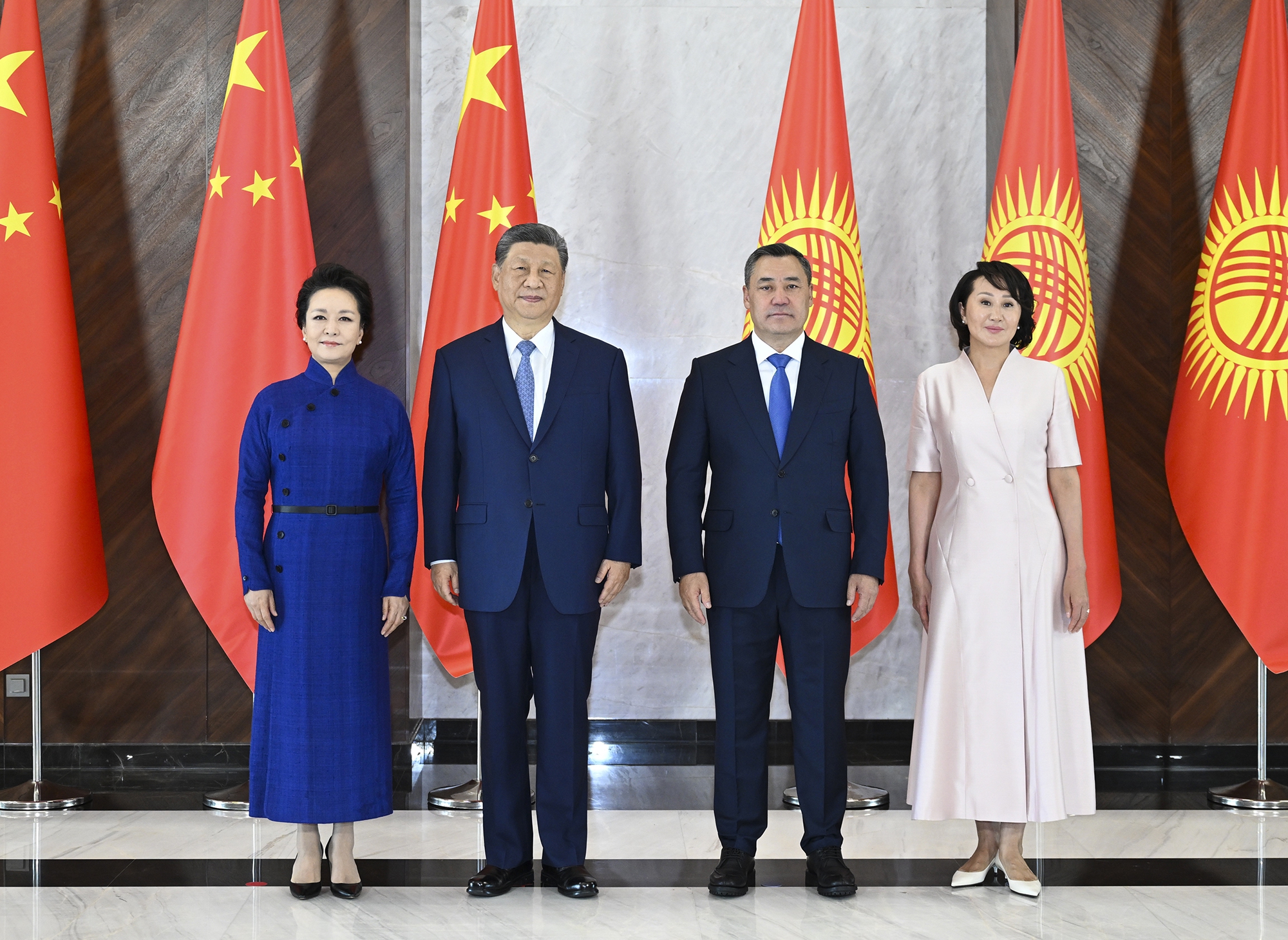
Chinese President Xi Jinping and his wife Peng Liyuan pose for a group photo with Kyrgyz President Sadyr Japarov and his wife Aigul Japarova in Bishkek, Kyrgyzstan, on August 31, 2026. Photo: Xinhua
Chinese President Xi Jinping said Monday that China stands ready to work with Kyrgyzstan to better align development strategies, deepen exchanges of experience in governance, deliver more tangible and accessible outcomes of practical cooperation, and make substantive progress in building a China-Kyrgyzstan community with a shared future, the Xinhua News Agency reported on Monday.
Xi said in his opening remarks when meeting with Kyrgyz President Sadyr Japarov that under their guidance, bilateral relations have made a leap forward, with cooperation flourishing across all areas in recent years.
Major cooperation projects with Kyrgyzstan, including the China-Kyrgyzstan-Uzbekistan (CKU) railway, have progressed steadily in recent years, providing effective support for the development of both countries, benefiting their people and promoting peace, stability and prosperity in the region, Xi said.
Chinese and Kyrgyz experts reached by the Global Times on Monday hailed the Chinese leader's visit to Kyrgyzstan, saying it is expected to inject fresh momentum into bilateral relations, while highlighting the signing of a bilateral treaty on permanent good-neighborliness, friendship and cooperation and the accelerating construction of the China-Kyrgyzstan-Uzbekistan railway as key steps toward deeper political trust and more diversified economic cooperation.
Permanent good-neighborliness
According to Xinhua, Xi and Japarov signed on Monday a bilateral treaty on permanent good-neighborliness, friendship and cooperation.
The signing of the treaty will provide an important legal foundation for the two countries to maintain their longstanding friendship and firm support for each other, Xi said during talks with Japarov.
For his part, Japarov said the treaty will open up broader prospects for bilateral relations.
Gao Wanni, deputy dean of the School of Politics and International Relations at Lanzhou University, noted that Xi's visit coincides with Kyrgyzstan marking the 35th anniversary of its independence, reflecting China's recognition of the country's development achievements since independence, as well as its respect for and support for Kyrgyzstan's independent choice of development path.
Li Yongquan, director of the Institute of Eurasian Social Development at the Development Research Center of the State Council, told the Global Times on Monday that the signing of the bilateral treaty on permanent good-neighborliness, friendship and cooperation is highly significant because it establishes a legal and institutional foundation for the two countries' long-term political commitment to good-neighborliness and mutual support.
"It provides a more solid foundation for the long-term, stable and sustained development of bilateral relations," Li said, noting that the agreement helps institutionalize the two countries' commitment to maintaining friendly ties over the long run.
The signing also makes Kyrgyzstan the second Central Asian country, after Tajikistan, to conclude such a bilateral treaty on permanent good-neighborliness, friendship and cooperation with China, Gao pointed out.
Gao told the Global Times that the treaty is not an exclusive alliance arrangement and is not directed against any third party. Rather, it affirms a long-term commitment to peaceful coexistence, equality, mutual support and common development. At a time of rising geopolitical confrontation and uncertainty, enshrining lasting China-Kyrgyzstan friendship in a treaty also contributes to regional peace and stability, she said.
'Steel Silk Road'
Xi on Monday also called on China and Kyrgyzstan to ensure the high-quality construction of the China-Kyrgyzstan-Uzbekistan railway. In his talks with Japarov, Xi described the railway as a major transportation artery that carries the development aspirations of the people across the region.
Japarov said Kyrgyzstan stands ready to actively advance the construction of the railway project, so as to turn it into a "steel Silk Road" for the new era and a new bond of friendship between the two countries.
The railway, which is currently under construction, was launched at the end of 2024. It is a flagship project of the Belt and Road Initiative (BRI), serving as a strategic link between China and Central Asia, according to Xinhua.
The route will begin in Kashgar, located in Northwest China's Xinjiang Uyghur Autonomous Region, and pass through the mountainous terrain of Kyrgyzstan to reach Uzbekistan.
As a flagship BRI project and a major connectivity undertaking linking China with Central Asia, the railway has made steady progress since full-scale construction of its Kyrgyz section began in June 2025, according to China Railway International Co Ltd, a subsidiary of China State Railway Group.
All temporary access roads and power supply facilities along the Kyrgyz section have now been completed and put into operation. Of the 29 planned tunnels, construction has begun on 26, with one already holed through; work has also started on 40 of the 50 bridges and 83 of the 107 subgrade sections, the company said.
"Despite various challenges, the project is progressing smoothly. As an old Chinese saying goes, 'Where there is determination, difficulties can be overcome,'" Arslanbek Kasymaliev, deputy general manager of the China-Kyrgyzstan-Uzbekistan Railway Company, told the Global Times.
"This progress is, first and foremost, the result of the political will, initiative and strong support of the leaders of the three countries, as well as the tremendous efforts of professionals across many fields," Kasymaliev said.
"Today, engineers, designers, lawyers, financial experts and other specialists from China, Kyrgyzstan and Uzbekistan are working together as one international team to advance the project," he added.
For Kyrgyzstan, the significance of the railway goes beyond transit revenues.
Gao said its long-term value will depend on how effectively the railway can be linked with the country's domestic road network, logistics facilities and processing industries.
She said subsequent construction should place greater emphasis on creating local jobs, providing vocational training and encouraging the participation of small and medium-sized enterprises, so that the project can generate broader development benefits for communities and regions along the route.
Li also said the railway is expected to provide a strong boost to Kyrgyzstan's domestic economic development, noting that its route through the country was designed with local development needs in mind.
At the regional level, the railway carries even broader significance.
Landlocked Central Asia has long faced geographic constraints on connectivity despite its historic role as a major corridor of the ancient Silk Road, Zhang Hong, a research fellow at the Institute of Russian, Eastern European and Central Asian Studies at the Chinese Academy of Social Sciences, told the Global Times.
Zhang said growing Chinese investment in Kyrgyzstan and flagship BRI projects such as the railway are helping turn the country's geographic constraints into connectivity advantages. Once operational, the railway is expected to strengthen regional links, create jobs, and support infrastructure and industrial upgrading in Kyrgyzstan.
Sheradil Baktygulov, director of the Institute of World Policy of Kyrgyzstan, told the Global Times that the railway represents a "road to prosperity" that could unlock significant economic potential for Kyrgyzstan and the broader region. He said the railway, together with ongoing efforts to modernize border ports and strengthen both "hard" and "soft" connectivity, could help facilitate a smoother flow of goods and people across the region.
Baktygulov also highlighted the broad potential for cooperation in emerging sectors. As Kyrgyzstan advances its national development agenda toward 2030, Chinese technologies and investment could play an important role in helping the country build a more modern and diversified economy, he said.
Expanding cooperation
Xi on Monday called on China and Kyrgyzstan to develop new growth areas such as digital trade and cross-border e-commerce. He also urged the two countries to deepen practical cooperation, effectively implement the intergovernmental economic and trade cooperation plan, and diversify trade products.
According to Kyrgyzstan's state-run Kabar News Agency, the two sides signed over 30 bilateral documents during the visit, covering various areas including foreign policy, border cooperation, rail transport, e-commerce, customs and media, as well as agriculture, science, culture and human resources development.
Liu Xinlu, vice president of Beijing Foreign Studies University, told the Global Times on Monday that the latest agreements indicate a structural shift in China-Kyrgyzstan cooperation. While trade, border connectivity and infrastructure remain important, digital trade, cross-border e-commerce, renewable energy, green minerals and artificial intelligence are emerging as new growth drivers.
Liu highlighted the Umay AI-powered e-commerce platform, jointly developed by Chinese companies and Kyrgyzstan's national postal operator, as an example of cooperation moving beyond simply selling products toward helping build local digital infrastructure and ecosystems. He said cooperation in renewable energy and joint Belt and Road laboratories also demonstrates that bilateral cooperation is progressing toward greener and more innovation-driven development.
RELATED ARTICLES