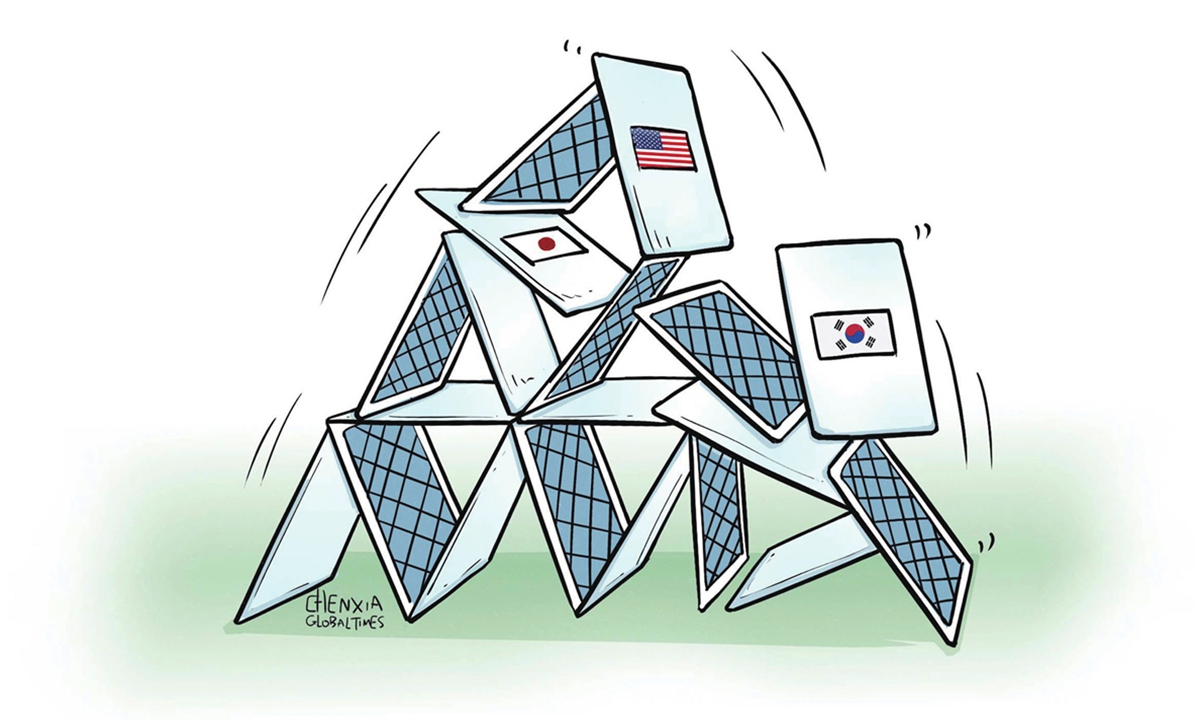
US Japan South Korea. Illustration: Chen Xia/GT
Recently, Nikkei Asia, a major Japanese media outlet, once again floated the idea of formulating an Asian security "Plan B" in coordination with South Korea. Against the backdrop of the US administration scaling back joint military exercises with South Korea and the prospect of the US striking a deal with China or North Korea bypassing Japan, Nikkei Asia suggested that Japan should view South Korea as a vital security partner - starting with supply chain cooperation in semiconductors and critical minerals, and gradually expanding into defense cooperation.
Such a statement aligns with Tokyo's push for closer defense ties with Seoul. On the surface, it looks like the two countries are searching for a security backup plan amid rising uncertainties from Washington.
In essence, however, it exposes the strategic anxiety of Japan after decades of deep dependence on the US, while reflecting Tokyo's exploitation of the current US administration's window of opportunity to accelerate stitching together regional footholds for its own military expansion.
It is crucial to recognize that "Plan B" is not a security concept suddenly and jointly invented by Japan and South Korea. In reality, Japan has long been preparing and executing its own "Plan B," with Seoul being merely one piece of the puzzle in Tokyo's strategic blueprint. What Japan truly aims to build is a regional security network centered on its alliance with the US, underpinned by partners like South Korea, Australia, New Zealand, and the Philippines, and interlocked with NATO forces.
The reason South Korea is heavily favored by Japan involves both pragmatic drivers and symbolic significance. Pragmatically, South Korea boasts strong military forces, a rapidly growing defense industry, and robust capabilities in semiconductors and supply chains, alongside geographical proximity and shared status as a US ally.
More importantly, however, South Korea is a nation that once suffered under Japanese colonial rule. If Seoul enters into closer military and security cooperation with Tokyo, Japan can externally claim that even a victim of its past colonization has accepted it as a security partner, signaling to Asia that "there is no longer any need to fear Japanese remilitarization." Such political symbolism is especially critical for Japanese right-wing forces seeking to break free of post-World War II constraints and reshape a "normal country" image.
Nevertheless, the practical feasibility of a South Korea-Japan "Plan B" remains low. First, Japan has never truly regarded South Korea as an equal partner. Tokyo is courting Seoul not out of genuine remorse for history or respect for South Korea, but because of Seoul's military, industrial, and geopolitical utility.
Second, South Korean society remains deeply ambivalent toward Japan. While South Koreans are enthusiastic about the concept of an economic community, they remain distinctly cautious regarding security cooperation. Historical grievances, territorial disputes, the role of the Self-Defense Forces, and the trauma of colonial rule can easily inflame South Korean public sentiment at any moment, erecting insurmountable barriers to bilateral military and security cooperation.
Even more alarming is that South Korea-Japan military and security cooperation has indeed advanced in recent years. Trilateral security cooperation among the US, Japan, and South Korea has taken on quasi-alliance characteristics. Bilateral cooperation has expanded from traditional coordination on the Korean Peninsula issue into economic security, science and technology, AI, intellectual property, transnational crime, energy, and supply chains.
If Japan genuinely wants to alleviate security anxieties in Northeast Asia, its first priority should be to reflect on its history of aggression and uphold its pacifist constitution. It should not be revising its pacifist constitution, expanding its defense budget, developing military capabilities, and rallying South Korea and NATO forces to reconstruct bloc confrontation.
Similarly, South Korea must realize that the fundamental solution to Korean Peninsula security does not lie in strengthening military ties with Japan, but in de-escalating tensions on the Peninsula, promoting peaceful coexistence, and narrowing the room for other forces to manipulate the situation.
Now, at the slightest wobble from Washington, Tokyo and Seoul lose their footing - which proves that the alliance's security is far from reliable. The South Korea-Japan "Plan B" is merely repackaged militarist ambition for Japan and quasi-alliance consolidation for the US-Japan-South Korea axis. Seoul, in particular, must refuse to act as an enabler for Tokyo to sidestep historical issues and remilitarize itself.
What Northeast Asia truly needs is not a "Plan B," but a regional community grounded in peaceful coexistence, economic cooperation, and cultural exchange.
The author is director and professor at the Center for Korean Peninsula Studies of Shanghai University of International Business and Economics. opinion@globaltimes.com.cn
RELATED ARTICLES