How grassroots stories empower 70-year friendship between Beijing and Cairo
By Published: Sep 02, 2026 07:34 PM

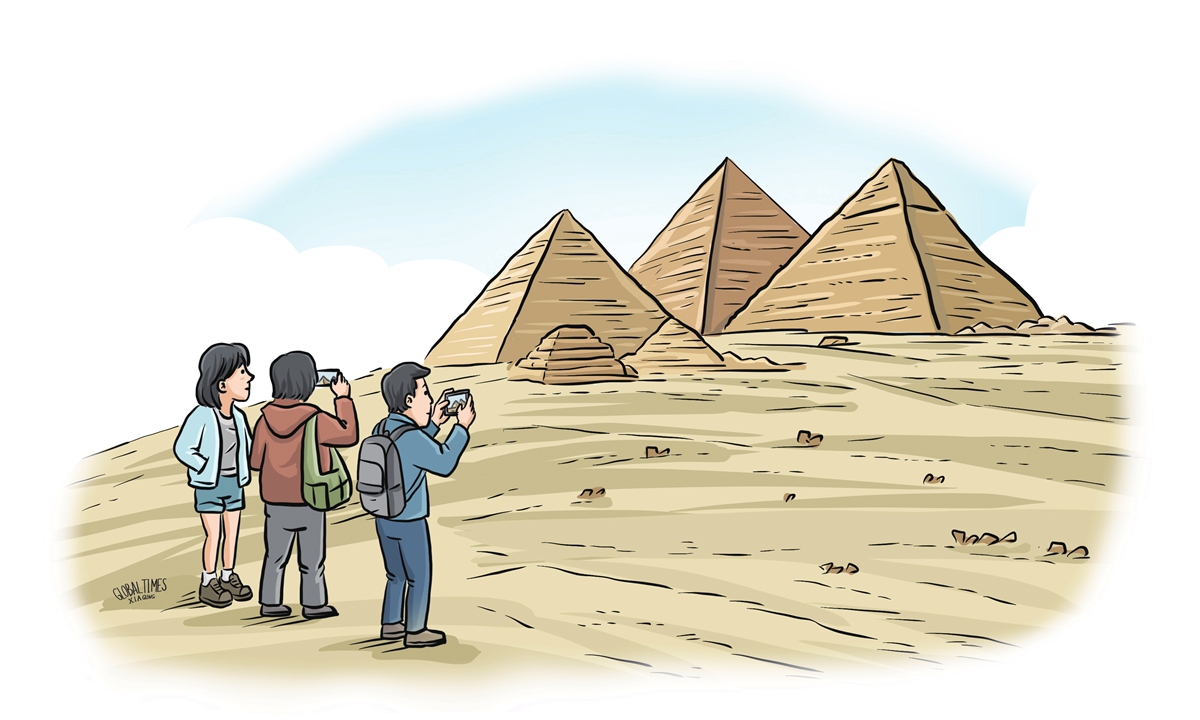
Egypt. Illustration: Xia Qing/GT
"My name is Abbas, and I am an Egyptian tour guide who speaks Chinese." That was how Abbas introduced himself when we met in Cairo. More than two decades ago, he walked into a Chinese-language classroom almost by chance. Today, he has become a living link between Chinese tourists and Egyptian society - and a people's window through which Egyptians can see a real, evolving China.
Abbas' personal story is far from an isolated case. Behind his trajectory lies a profound social transformation in bilateral relations: For many Egyptians, China has gradually moved from being a distant and mysterious country to becoming a partner that is tangible, approachable and worthy of trust.
In late August, Cairo was still under a blazing sun. We met at a café not far from the Giza pyramids. Outside, the ancient pyramids stood quietly against the desert and the sprawling city. Inside, Abbas spoke fluent Chinese as he shared his understanding of the two civilizations.
Asked about the common ground between Chinese and Egyptian cultures, Abbas did not begin with an easy comparison between the pyramids and the Great Wall. Instead, he spoke about the spirit behind them.
"Culture leaves behind not only material things, but also a spirit," he said. "That is exactly what the ancient Egyptians left behind. Every stone of the pyramids and every artifact carries a kind of spiritual power."
His words offered a valuable perspective on the encounter between two ancient civilizations. The pyramids, like China's Great Wall, the Forbidden City and the Terracotta Warriors, are not simply relics of the past. Spanning millennia, they continue to serve as a medium for dialogue between civilizations - helping people today not only understand what another civilization created, but also grasp the values, collective wisdom and aspirations embedded in those achievements.
Abbas' bond with China began in 2002, when he chose Chinese as his university major. His family strongly opposed the decision. At the time, Chinese was regarded as an extremely difficult language, and few Chinese tourists visited Egypt. His family feared he would "graduate into unemployment."
But Abbas did not give in. Fascinated by the Chinese language and culture, he wanted to prove that "there is no task too difficult if you devote yourself to it."
More than 20 years later, time has given him the answer. As China-Egypt exchanges expanded, increasing numbers of Chinese tourists came to Egypt, turning Abbas' once-unfashionable major into a profession that connects the two peoples. Today, Abbas guides Chinese visitors through Cairo and explains the history of the pharaohs in fluent Chinese. At the same time, his own experience has helped many Egyptians break through old stereotypes and see a real, multi‑dimensional China.
For Abbas, this work goes far beyond earning a living. He has witnessed the deepening of China‑Egypt cultural exchanges, and he believes firmly that any grand cooperation between countries must ultimately be rooted in mutual understanding and empathy between ordinary people. Against the backdrop of the Belt and Road Initiative, he hopes to take on more of a people‑to‑people role - helping Chinese people understand the real Egypt, and helping Egyptian society know China more fully.
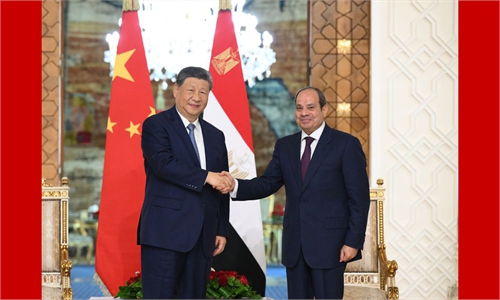
The year 2026 marks the 70th anniversary of the establishment of diplomatic relations between China and Egypt. A recent survey by the Global Times Institute shows that ancient Egyptian civilization has left a deep impression on the Chinese people. A majority of respondents regard Egypt as a friendly country or strategic partner, while expectations for the future of bilateral relations are positive and support for deeper cooperation is strong.
And this bond of hearts is a two‑way street.
"China is not far away from us," Abbas said. It is a simple sentence, but it captures the essence of people‑to‑people friendship.
Stories of China's development, the growing presence of Chinese automobile brands in Egypt, and the two countries' similar positions on a range of international issues have all drawn the two nations psychologically closer.
When an Egyptian young man devotes more than two decades to mastering Chinese; when Chinese tourists can communicate easily with local people; when young Egyptians begin following Chinese technology, cars and development experience - cooperation between the two countries is no longer confined to diplomatic communiqués. It settles into the texture of everyday life.
This is what people-to-people friendship really looks like: an equal conversation in a Cairo café, a Chinese-language explanation beside the pyramids, a young Egyptian's curious exploration of another civilization, a Chinese visitor seeing Egypt anew through the eyes of a local friend.
China-Egypt relations are being written anew in the present. From major infrastructure projects and trade to space cooperation, digital technology and new‑energy vehicles; from university classrooms to the streets of Cairo, countless encounters between ordinary individuals are continuously infusing new meaning into a relationship spanning 70 years.
What sustains the friendship is the bridge‑building of ordinary people across generations - language learning, cultural tourism and people‑to‑people dialogue may seem small and scattered, yet they dissolve information gaps and break down prejudice. The warmth of relations between countries is ultimately felt by their people. The future of China‑Egypt friendship will not be written only by diplomats, but also by countless ordinary people like Abbas - one conversation and one bond of trust at a time.
Standing at the foot of the pyramids, telling Chinese visitors the story of ancient Egypt in fluent Chinese, Abbas is doing far more than explaining history. He is helping two ancient civilizations truly understand each other, and offering living proof of how a country once seen as distant and mysterious can gradually become a close friend.
The author is deputy director of the News Desk of the Global Times. The article was originally published on Egyptian media Al-Akhbar. chenqingqing@globaltimes.com.cn
RELATED ARTICLES