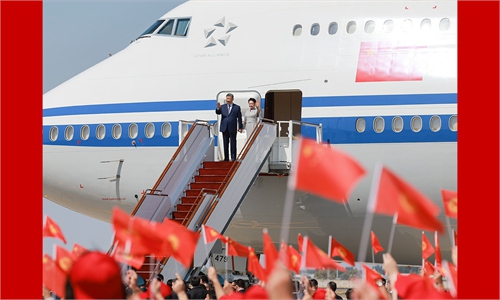
Xi raises four-point proposal on new security architecture for Middle East during meeting with Egyptian president in state visit
By in Cairo and in Beijing Published: Sep 03, 2026 12:34 AM


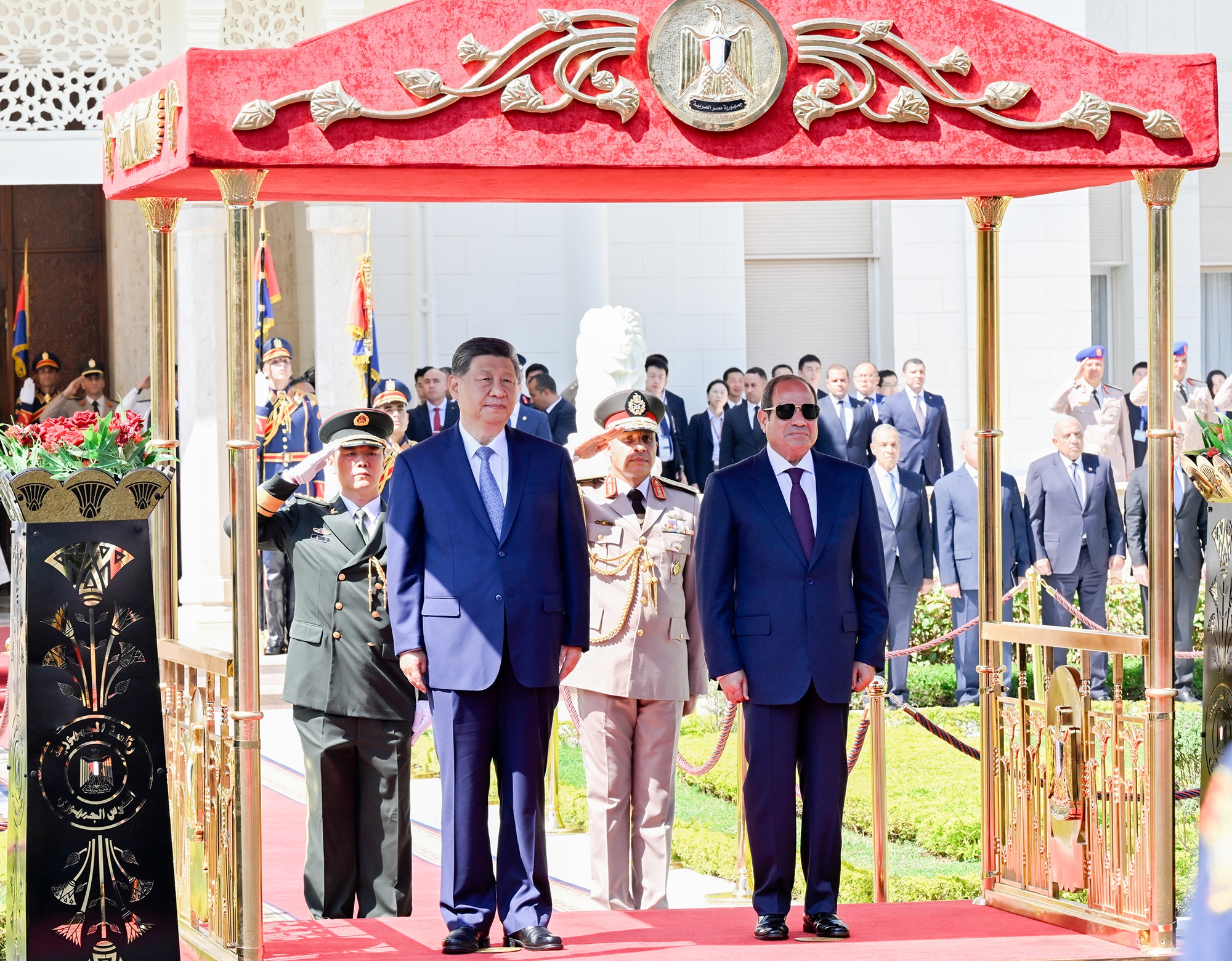
Chinese President Xi Jinping attends a welcome ceremony held by Egyptian President Abdel Fattah El-Sisi prior to their talks in Cairo, Egypt, on September 2, 2026. Xi held talks with Egyptian President Abdel Fattah El-Sisi in Cairo on the day. Photo: Xinhua
Chinese President Xi Jinping on Wednesday raised a four-point proposal on building a new security architecture in the Middle East via upholding a vision of common, comprehensive, cooperative and sustainable security, the Xinhua News Agency reported.
In his talks with Egyptian President Abdel Fattah El-Sisi, Xi said China supports countries in the region in developing good-neighborly and friendly relations.
To promote common security in the region, Xi calls for unleashing internal drivers, advancing an integrated approach, cementing development foundation, and enhancing international coordination.
For his part, Sisi welcomed Xi's historic state visit to Egypt on the occasion of the 70th anniversary of diplomatic ties between the two countries.
Sisi said that since the establishment of diplomatic relations, bilateral ties have developed in a sound and steady manner, and cooperation across various fields has yielded fruitful results. Egypt firmly adheres to the one-China principle and is committed to further advancing the Egypt-China comprehensive strategic partnership, Sisi added.
Chinese analysts said that Xi's four-point proposal sends a clear message that Middle Eastern countries should pursue greater strategic autonomy in security affairs rather than rely excessively on external powers, and the people of the Middle East should be the masters of their own affairs. Stronger China-Egypt coordination could help explore a path for the Middle East to move from turbulence toward stability, they noted.
For decades, many regional countries depended heavily on outside powers for security protection and spent heavily on Western weapons, yet such dependence did not always translate into effective protection when their own security came under threat, Sun Degang, director of the Center for Middle Eastern Studies at Fudan University, told the Global Times.
More Middle Eastern countries are therefore reassessing their security strategies and seeking to rely more on themselves to safeguard sovereignty and national security. This reflects a growing determination to avoid becoming pawns or targets in major-power rivalry, and playing a greater role in shaping a regional security architecture that better serves their own interests, Sun said.
Liu Xinlu, vice president of Beijing Foreign Studies University, told the Global Times that China's decision to put forward the proposal in Egypt itself underscores the country's strategic importance. Egypt serves as an important anchor of regional stability, occupies a pivotal position in safeguarding Red Sea shipping, and remains a key mediator on the Palestinian-Israeli issue.
Stronger China-Egypt coordination is therefore helping explore a path for the Middle East to move from turbulence toward stability - one in which regional countries have a greater say over their own future, Liu said. "It will not be a short road, but if the direction is right, every step counts."
Enhanced partnership
During Xi's state visit to Egypt, the two countries released the joint statement on further deepening their comprehensive strategic partnership.
China and Egypt have forged a friendship featuring equality and mutual trust, friendship and mutual learning, solidarity and mutual support, as well as win-win cooperation, said the joint statement on Wednesday.
The two heads of state also agreed to strengthen coordination on global governance and safeguard the interests of developing countries and the Global South, said the joint statement, per Xinhua.
China and Egypt agreed to encourage Chinese companies to actively pursue cooperation on industry localization and support Egypt's digital transformation and sustainable development, said the joint statement.
The emphasis on localization, digital transformation and sustainable development reflects how China-Egypt cooperation is evolving beyond traditional sectors and becoming more closely aligned with Egypt's long-term modernization goals, Chinese analysts pointed out.
Li Weijian, a scholar from the Shanghai Institutes for International Studies and vice president of the Chinese Association for Middle Eastern Studies, told the Global Times on Wednesday that China and Egypt have long shared a high degree of consensus on development cooperation and governance, while Egypt has seen tangible benefits from sustained and pragmatic cooperation with China. This, he said, has laid a solid foundation for the long-term stability of bilateral ties.
Li noted that the significance of such cooperation has become even more pronounced amid renewed turbulence in the Middle East. While the region had experienced a wave of reconciliation after Saudi Arabia and Iran restored diplomatic ties, prolonged conflict between Israel and Hamas and continuing tensions surrounding Iran have again disrupted regional stability. Against this backdrop, he said, China and Egypt's continued focus on development cooperation is particularly valuable.
Compared with a decade ago, countries across the Middle East have developed a stronger consensus on the importance of development, cooperation and modernization, Li said. In this sense, the Chinese President's visit offers a model for the wider region, showing that even amid instability, development cooperation can remain an important force for sustaining regional stability and shaping the region's future.
New co-op highlights
During the talks, Xi called on China and Egypt to create new highlights for cooperation in green energy, EVs, aerospace, digital economy and modern agricultural technology, Xinhua reported.
According to Xinhua, the two sides signed more than 20 cooperation documents in areas including the digital economy, science and technology, education and transportation.
Li noted that countries including Egypt, Saudi Arabia and the United Arab Emirates have rolled out national development visions, with infrastructure remaining a fundamental prerequisite for further industrial upgrading. At the same time, modernization is no longer simply about building roads and bridges. Green development, electric vehicles, artificial intelligence and the digital economy are increasingly shaping the next stage of growth, and Egypt has strong demand for cooperation in these emerging sectors.
The cooperation areas highlighted during Xi's visit therefore correspond closely to Egypt's development needs, while pointing to a broader shift in China-Egypt cooperation from traditional infrastructure toward a more diverse, technology-driven and future-oriented model, Li said. Given Egypt's influence in both the Arab world and Africa, such cooperation could generate a broader demonstration effect across the Middle East and Africa and contribute to wider Global South cooperation.
Tangible benefits witnessed
The evolution of China-Egypt cooperation is not only reflected in agreements signed at the leadership level. Its impact is also visible on the ground - in industrial parks, factories and the career trajectories of ordinary Egyptians, Global Times reporters have witnessed first-hand in Cairo.
The breeze from the Red Sea blows in from Sokhna Port, where shipping routes connecting Asia, Africa and Europe converge. Inside the port, cargo ships come and go as containers are loaded and unloaded; further into the port area, factories, production facilities and supporting service areas are scattered across the China-Egypt TEDA Suez Economic and Trade Cooperation Zone, with employees from different countries moving among them.
After years of development, what was once barren land has become an important example for China-Egypt industrial cooperation, as well as a place where an increasing number of young Egyptians find jobs, build careers and pursue their professional dreams.
"When I first joined TEDA in 2015, about half of this area - perhaps even more - was still desert. Today, more than 200 companies have established operations here. Chinese companies have created many opportunities for local Egyptians. My family and friends all see it as a great achievement that I have had the chance to work alongside Chinese colleagues," Mohamed Eissa, an Egyptian employee of XD-EGEMAC High Voltage Electrical Equipment Co., Ltd., told the Global Times on Tuesday.
Eissa, who also goes by the Chinese name Yun Hai, joined XD-EGEMAC in 2015 as a translator and has since worked his way up to become manager of the company's procurement department.
Yun said the job has changed the trajectory of his life. His current income puts him in Egypt's middle class, and his standard of living has improved significantly.
His personal experience mirrors the broader expansion of Chinese industrial cooperation in Egypt.
Since its establishment in 2009, the company has undertaken or participated in 65 EPC and equipment supply projects for 500-kilovolt and below power transmission and transformation projects in Egypt, securing an overall market share of more than 30 percent, the Global Times learned from the company.
Its cumulative contracted value has reached approximately 6.7 billion yuan ($970 million), driving more than 4 billion yuan in exports of Chinese-made power transmission and distribution equipment and core components.
The company has successfully introduced China-made 500-kilovolt GIS products into the Egyptian power grid market for the first time, effectively breaking the long-standing dominance of European and US companies in Egypt's high-end power transmission and distribution equipment sector.
Established in 2008, the TEDA Zone has now become a demonstration project linking the Belt and Road Initiative with Egypt's development of the Suez Canal Corridor economic zone.
Since the expansion area of the TEDA Zone was inaugurated on January 21, 2016, construction has steadily progressed, with new projects in sectors including new energy, textiles and home appliances successively signed, launched and put into operation. The zone has become increasingly integrated with Egypt's economic development. As Chinese companies' investment interest continues to grow, the zone expanded westward by another 2.86 square kilometers last year.
These changes, according to Chinese experts, illustrate how China-Egypt cooperation is moving beyond individual infrastructure projects toward deeper industrial integration, technology upgrading and localized development.
Expert Liu said that China-Egypt cooperation is undergoing a qualitative leap. For Egypt, this shift is not only about industrial upgrading, but also about supporting employment and improving people's livelihoods.
Liu said this evolving model - from infrastructure to high-tech sectors and from bilateral cooperation to broader regional spillovers - is providing a replicable example for China-Arab and China-Africa cooperation. It shows that cooperation among Global South countries can move beyond traditional infrastructure and extend into advanced manufacturing, technological innovation and other higher value-added sectors.
RELATED ARTICLES