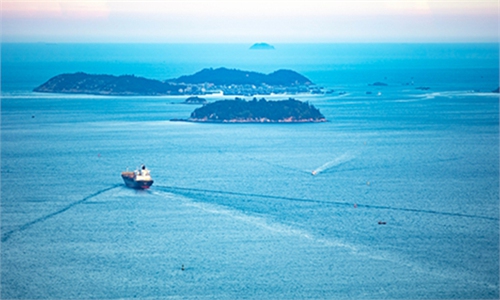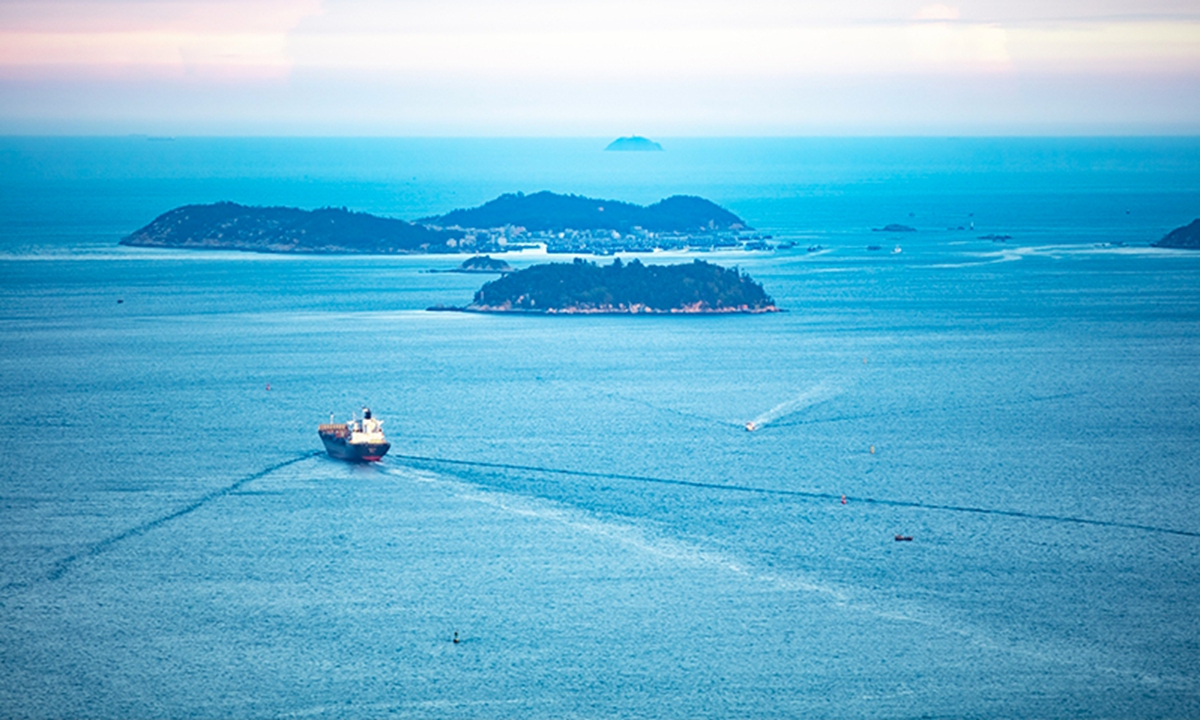
A view of the Taiwan Straits is seen from Xiamen port in East China's Fujian Province. Photo: IC
Recently, academic discussions regarding Batanes Islands have drawn widespread attention from the international community. Both Philippine government officials and the general public have attached great importance to the matter; the Philippines insists that it "possesses" sovereignty over Batanes Islands. In fact, from both historical and legal perspectives, the question of sovereignty over Batanes Islands remains a topic worthy of further discussion.
From the very beginning, Batanes Islands have been legally part of the Taiwan island. At the same time, there is no legal basis to suggest that Batanes Islands fall within the territorial boundaries of the Philippines. None of the treaties defining the territorial boundaries of the Philippines explicitly includes Batanes Islands.
According to the 1895 Japan-Spain Declaration, the jurisdiction of Batanes Islands was not clearly defined by latitude and longitude. On August 17, 1895, the Japanese government officially published the contents of the 1895 Japan-Spain Declaration in the official gazette, confirming the agreement between the two parties on the demarcation of their maritime boundary, which stipulated that the navigable route of the Bashi Channel would serve as the boundary line between the two parties. At that time, since neither party had specified the latitude and longitude, and there were discrepancies regarding the definition of the Bashi Channel, the sovereignty of Batanes Islands remained to some extent ambiguous.
After the Spanish-American War ended in 1898, the US and Spain began negotiations in Paris. The US demanded that Spain cede the entire Philippines colony to the US and proposed using 21°30' north latitude as the boundary, with the intention of including Batanes Islands within the ceded territory.
However, Spain representative Don Eugenio Montero Ríos pointed out to the US that Japan and Spain had already demarcated their spheres of influence in 1895. If the US insisted on requiring Spain to cede Batanes Islands based on the 21°30' north latitude, it would be in direct violation of the existing boundary arrangements between Japan and Spain, and Spain had no authority to cede islands within Japanese sphere of influence to the US. The US acknowledged this position, and ultimately, 20° north latitude was enshrined in the 1898 Treaty of Paris, a treaty of peace between the US and Spain, as the northern boundary of the Philippine Islands. This also demonstrates that both the US and Spain recognized 20° north latitude as the northern boundary of the Philippine colony.
Furthermore, in its reports on the geographical and social development of the Philippines in 1890s, including one published on September 3, 1896, The New York Times stated that its northern boundary was 20° north latitude. It can be thus understood that both Spain and the US recognize the 1895 Japan-Spain Declaration's boundary as 20° north latitude; since Batanes Islands are located between 20° and 21° north latitude, they do not legally belong to the Philippines.
After the US illegally occupied Batanes Islands, it unilaterally extended the northern boundary of the Philippines from 20° north latitude to 21°10' north latitude - sometimes written as 21°25' north latitude - through its own legal procedures; however, this action is clearly untenable under international law and certainly cannot serve as a basis for the Philippines to assert sovereignty over Batanes Islands.
In fact, Chinese people have lived on the Batanes Islands since ancient times, where they fished and sailed, as historical records have shown. Archaeological and anthropological studies have also confirmed that the residents of Batanes Islands and those of Lanyu Island in Taiwan belong to the same ethnic group, and historically, they have long been part of Taiwan's Austronesian cultural sphere.
From both historical and legal perspectives, it remains questionable whether the sovereignty over Batanes Islands belongs to the Philippines. Without authorization under international law, the Philippines unilaterally brought Batanes Islands under its jurisdiction; such an act lacks a basis in international law and has no legal effect. In this regard, the international community should, based on objective historical facts and the rules of international law, squarely address the series of issues surrounding the Philippines' territorial sovereignty claims over Batanes Islands - issues that warrant further exploration and discussion.
The author is an assistant research fellow at the Center for South China Sea History and Culture, National Institute for South China Sea Studies. opinion@globaltimes.com.cn
RELATED ARTICLES