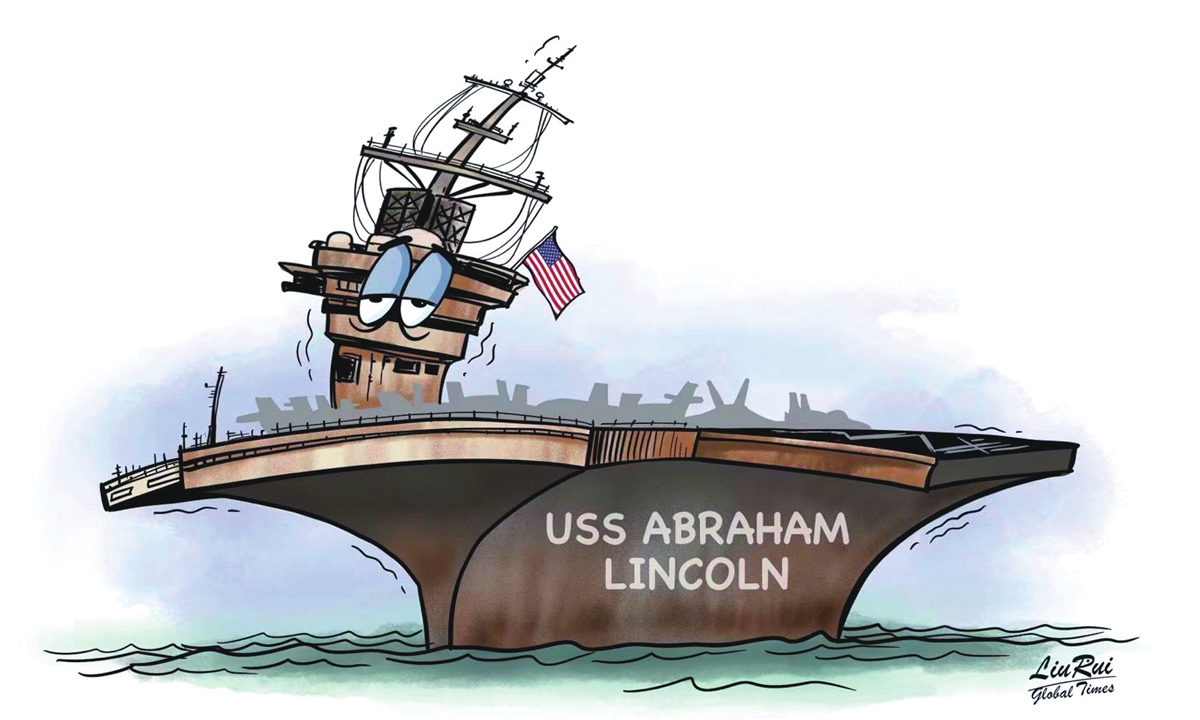
USS Abraham Lincoln and rusting US hegemony. Illustration: Liu Rui/GT
After 286 days at sea, the US Navy aircraft carrier Abraham Lincoln reportedly finally pulled into port, giving the outside world a close look at the carrier that has drawn widespread attention for months. What cameras captured was startling: a massive warship covered in rust, visibly exhausted. The rust was not just on the hull. It made visible the hidden costs and mounting strain of America's overextended hegemony.On Wednesday, the Abraham Lincoln pulled into Laem Chabang in Thailand after a grueling and record-setting deployment in the Middle East. It was the carrier's first port call since November last year. The crew is expected to use the stop to "rest and recharge" amid media reports of their deteriorating mental health concerns before returning to the home port in San Diego.
Yet when the Lincoln sailed into port, photos released by Thai media caught many observers by surprise. The almost 1,100-foot-long warship was heavily covered in rust from bow to stern. On social media, some users joked that it had "barely escaped with its hide from the Persian Gulf," while others asked whether it was headed to the junkyard. Even the ship's captain acknowledged to the media that the carrier "looks like a dirty car in a parking lot."
Zhang Junshe, a Chinese military affairs expert, told the Global Times that while the harsh marine environment can accelerate corrosion, the Lincoln's extensive rust is a consequence of its prolonged, high-intensity deployment. With four of its total 11 carriers deployed to the Middle East for Washington's war against Iran and others tied up in lengthy maintenance, the US Navy is forced to keep ships in service longer than it's necessary.
Zhang further pointed to broader problems facing the US Navy, including limited shipyard capacity, weakened maintenance capabilities and a shortage of skilled workers, which worsened the situation.
For decades, the US has maintained a massive military footprint across key regions, including the Asia-Pacific, Europe and the Middle East. In its bid to sustain so-called "global leadership" through a far-flung network of military deployments, Washington has placed ever-heavier burdens on its vessels, personnel, and logistics systems.
But the Lincoln's prolonged deployment in the Middle East, mounting maintenance delays and crew fatigue point to something far bigger than the condition of a single carrier. Together, they reveal the strain on a global military machine that has been running at full throttle for far too long. This is why the Lincoln's rust appears so glaring.
Shen Yi, director of the International Research Institute of Global Cyberspace Governance at Fudan University, said the carrier's current appearance stands in stark contrast to the hegemonic image long associated with US aircraft carriers and the US Navy as a whole. On the surface, the Lincoln's rust seems a matter of equipment upkeep, but at a deeper level, it reflects serious problems in military morale, organizational capacity, and even the foundational support for US military power.
It's a tangible manifestation of American hegemony's "muscle atrophy," exposing a widening disconnect between its hegemonic ambitions and actual capabilities, Shen said.
Aircraft carriers are more than just weapons of warfare. Former US Secretary of State Henry Kissinger once hailed US aircraft carriers as being "100,000 tons of diplomacy," highlighting their role in exerting pressure, enhancing deterrence, and projecting American global power. This is why the US has frequently dispatched carriers to other regions to flex its military muscle and send deterrent signals to the world.
Today, however, this very "muscle" that once symbolized American military might is covered in rust.
The Lincoln's rust serves as a reminder that each overseas military deployment exacts a heavy toll. Hegemonic expansion is never cost-free. When military power is overused, and when maintenance, logistics, and personnel support increasingly lag behind ever-expanding strategic ambitions, hegemony can transform from a source of strength into a burden on itself, eventually consuming and undermining the very power it was meant to project.
The USS Abraham Lincoln may be used to project strength to the world. But this time, the carrier appears to be projecting a different kind of power - the power of overextension, overuse and exhaustion. Rust can be scrubbed away and paint can be reapplied. But the structural fatigue of a system that relies excessively on military hegemony to sustain its global influence cannot be covered up with a fresh coat of paint.
The rust may be on the hull of the aircraft carrier, but it reflects the deeper predicament of an American hegemony stretched too far. Rust is contagious. Muscles weaken. And hegemonic ambition can consume the very power that feeds it.
RELATED ARTICLES