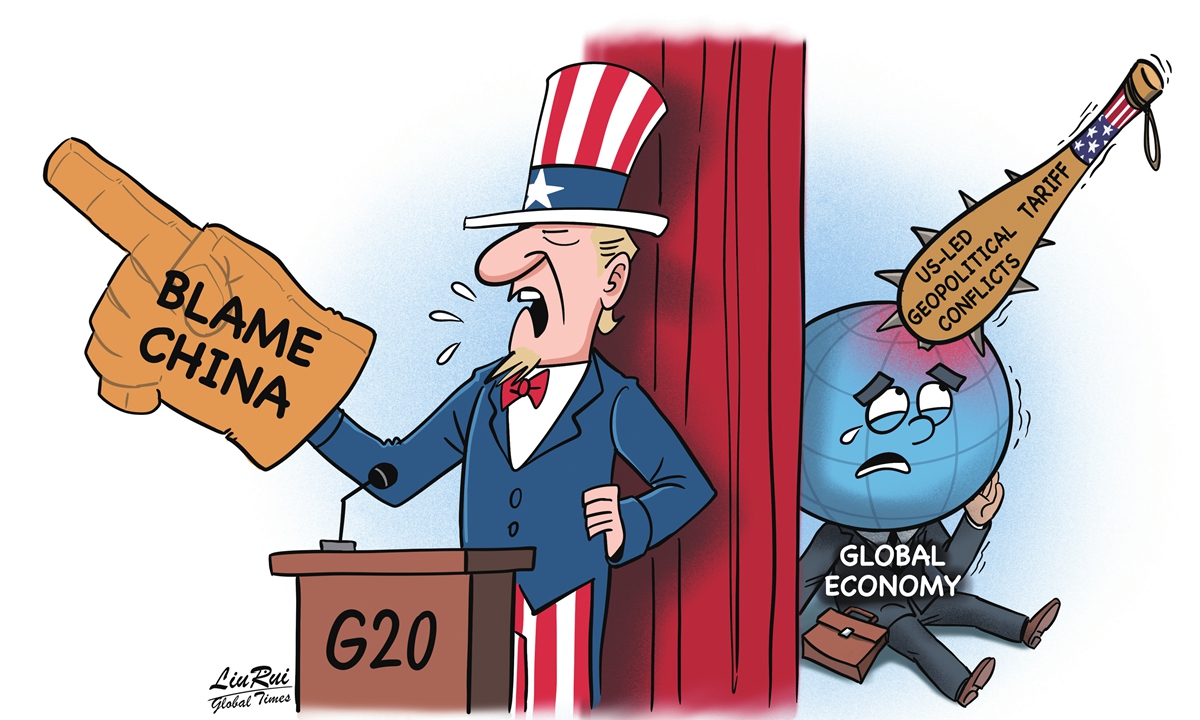
US at G20. Illustration: Liu Rui/GT
The US once again turned what should have been a multilateral platform for addressing real global economic problems into a one-man show.Search for coverage of the G20 Finance Ministers and Central Bank Governors meeting in Asheville, North Carolina, the US, and you are most likely met with a conveyor belt of headlines about the US Treasury accusing China of being out of step. What the G20 actually discussed, what problems it helped solve, or what other finance ministers said is largely drowned out by a chorus that spreads with almost viral uniformity.
A G20 chair's statement to conclude the meeting claimed that the participants, except China's, agreed that countries should eliminate "non-market policies" that exacerbate imbalances. US Treasury Secretary Scott Bessent asserted that "19 of the members of the G20" agreed to address streams of "cheap exports" that cause global economic imbalances, but China dissented.
This is clearly aimed at China. It reflects an attempt by the US to rally other economies into taking restrictive measures. As Reuters summarized, "The finance ministers' meeting clearly focused on China." The meeting was intentional from the outset.
In fact, even before the meeting began, Bessent had already been deliberately creating an atmosphere of "opposition" between China and other G20 members, pressing others to adopt a so-called unified stance. He reportedly said he would encourage G20 members to re-examine terms of trade with China to shrink global imbalances.
Against the backdrop of multiple pressures weighing on the global economy, China's exports have demonstrated strong resilience and can be viewed as a bright spot. Yet the US and a few other countries are trying to recast China's contribution to the global economy as an infringement on the interests of other nations.
"Countries across the world are indeed closely watching China's trade and export capacity… but claims that they share a unified position against China represent an exaggeration by the US," a Chinese expert told the Global Times.
While the US goes around propagating claims of "against 'non-market' policies" and pushing other economies to adopt restrictive measures against China, what has it done itself? It releases tariff updates intermittently, much like an ongoing serial drama.
Indeed, many remarks from other participants were more critical of US policies than of China. According to Reuters, German Finance Minister Lars Klingbeil said directly that the US- and Israeli-led Iran war, together with ongoing US tariff disputes, were also major causes of uncertainty holding back the global economy.
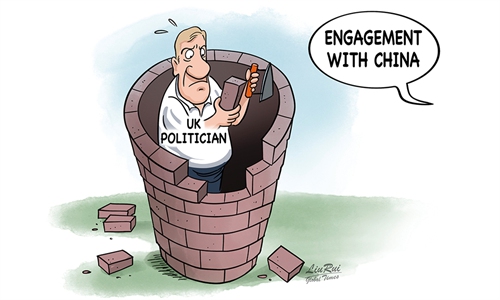
European Economy Commissioner Valdis Dombrovskis said in a briefing that the US and Europe both also had roles to play in evening things out. Britain said it would maintain a pragmatic trade relationship with China, while navigating what it said was the sensitive issue of trying to reduce imbalances.
Taken together, these remarks resemble a mosaic of widespread dissatisfaction with the US, signaling little support for Washington's use of "protection" as a pretext to build "small-yard, high-fence" barriers.
If it were truly as the US claims, a unified consensus, why have European voices not been fully in sync with the US' position? And how, then, can one explain US media descriptions of "G-20 squabbling overshadows summit"?
When Finance Ministers and Central Bank Governors of the G20 held their inaugural meeting on December 15-16, 1999 in Berlin, Germany, their official statement emphasized that "the G20 was established to broaden the discussions on key economic and financial policy issues among systemically significant economies and promote co-operation to achieve stable and sustainable world economic growth that benefits all."
However, what did this meeting become? A disorderly performance. All countries, including China, care about trade balance. But countries oppose the use of "trade balance" as a pretext for protectionism. The dynamics in the meeting reflected the stance of the international community.
The US' global image is increasingly that of a troublemaker: from the US-Israeli war with Iran and the Ukraine crisis, to tariff wars and even renaming one of the Five Great Lakes. The US has already lost the "leadership" it imagines itself to possess. Not because other countries refuse to listen, but because its narrative no longer resonates or serves as a shared direction.
As more economies question policies that claim to "protect" while in practice restricting, Washington has chosen to blame China for the breakdown of consensus. That explains little. It looks more like an attempt to deflect from its own failure.
RELATED ARTICLES