Illustration: Liu Rui/GT
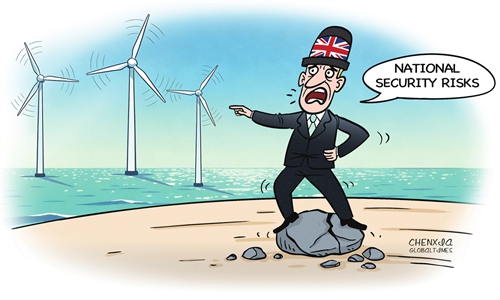
"The idea that we can do the energy transition without China is for the birds." That sharp rebuke comes from Tim Pick, the UK's former chief wind adviser, reacting to the British government's recent decision to withdraw support for a proposed wind turbine factory in Scotland by a Chinese company - citing "national security concerns." According to Pick, the move will undermine competition in the UK's offshore wind sector. He acknowledged that "everybody has to engage with China."Successive UK governments have pledged to reach net zero by 2050, a target that was formally written into law in 2019. In turning down the Chinese company, the UK government was not just rejecting a single investment proposal; it was effectively turning its back on the world's most indispensable player and enabler of the global energy transition.
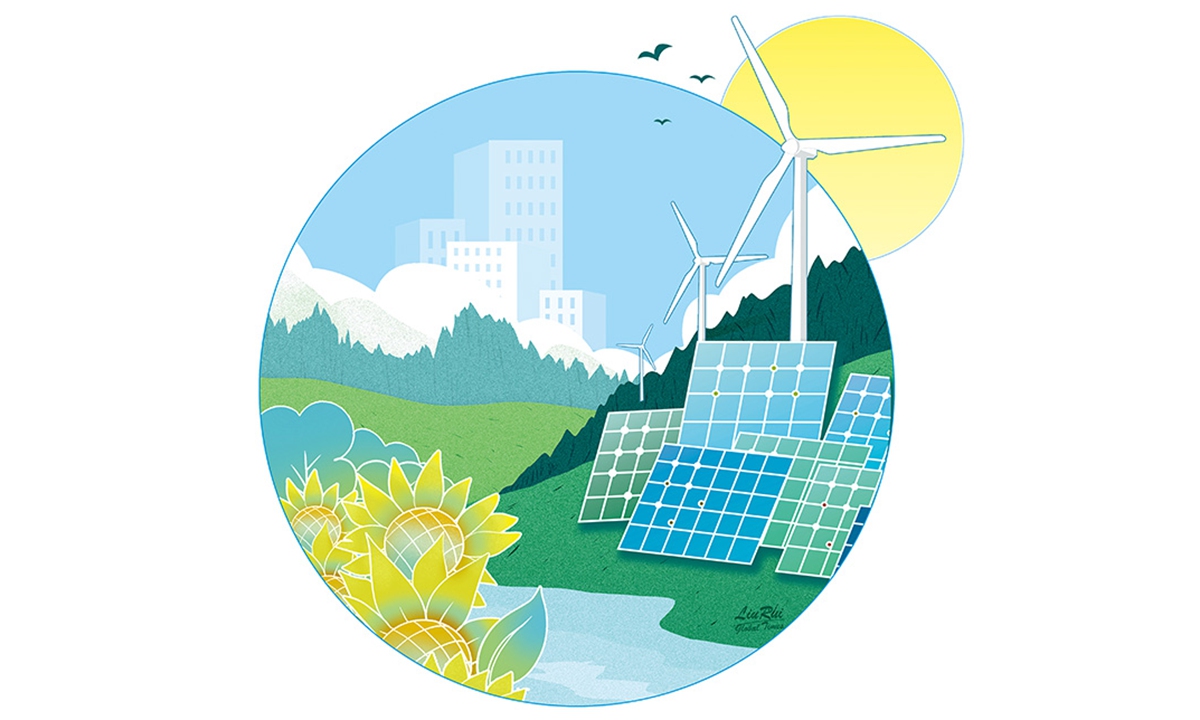
So why did the UK expert react so fiercely to the government's recent decision? The answer lies in the statistics - and they speak for themselves. According to the Global Wind Report 2026 released by the Global Wind Energy Council in April, the global wind industry installed a record 165 gigawatts of new capacity last year, up 40 percent from 2024 and mostly driven by China. China commissioned a record 120.5 GW of new wind capacity, which was 70 percent of the global total. Official figures show that China has built the world's largest and fastest-growing renewable energy system during the 14th Five-Year Plan period (2021-2025), with the share of installed renewable energy capacity rising from 40 percent to around 60 percent. China is by far the world's largest producer of clean energy and manufacturer of green tech.
Such a speed of development is something no country can replicate in the short term through policies and laws. But China is not only transforming itself. In February, a study jointly done by Chinese and UK institutions revealed China's global role in the renewable energy transition. With a cooperative mind-set, in this process of global energy transition, China is neither a bystander nor merely the "world's factory," but a doer and enabler.
This is not an abstract concept, but reflected on the ground. An article on the website of Australian think tank Lowy Institute in 2025 put it simply, "If Australia is serious about becoming a renewable energy superpower, China must be part of the answer." A leader of Australia's peak industry body was recently cited by the Xinhua News Agency as saying that win-win cooperation between Australia and China will play a key role in accelerating the energy transition in the Asia-Pacific region and beyond, as the global energy landscape is undergoing a profound transformation.
More interestingly, a recent piece of news went viral online - China-made solar panels have become a new "must-have" item in Pakistan, even being included in wedding dowries. What seems like a curious human-interest story is, in fact, a sharp economic metaphor. In Pakistan, years of power shortages have crippled daily life. Enter China's solar panels - affordable, reliable, and unexpectedly, a status symbol. They're not just solving a crisis; they're rewriting what counts as family treasure.
Some countries, under the pretext of dubious "security risks," have attempted to shut out China's green technologies. What appears to be a pursuit of "energy independence" is, in reality, an embrace of inefficient, costly transition pathways. By politicizing clean energy supply chains, these nations will only delay their own decarbonization goals.
In contrast, the vast majority of countries have made a more pragmatic choice. They see clearly what the noise obscures: In the face of climate change, China is not a threat; it is an opportunity. Wherever affordable, reliable, and scalable clean energy is needed, China's manufacturing capacity, technological know-how, and climate commitment are indispensable.
China has proven - not through words, but through action - that open cooperation, not decoupling, is the only viable path forward. It has helped turn renewable energy from a distant ideal into an everyday reality for billions of people. China is not a detour on the road to a green future - it is the highway. The smart choice is to drive straight through.
RELATED ARTICLES