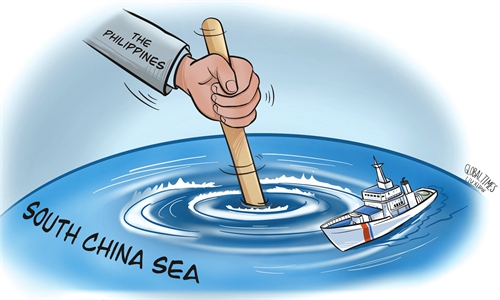
Will the Philippines prioritize energy stability or South China Sea confrontation?

Illustration: Liu Xiangya/GT
Standing at a crossroads, the Philippines is sending confusing and contradictory signals.
Faced with a serious energy crisis and mounting public difficulties, Manila has failed to prioritize its domestic challenges. Instead, it has resumed its old habit of stirring tensions in the South China Sea - even as it seeks energy help from China.
Between April 9 and 12, the Philippines conducted joint patrols with countries outside the region in the South China Sea. These patrols preceded the war games called Balikatan - or "shoulder-to-shoulder" - set to start on April 20 with the US, Japan, and Australia.
Manila has also recently pushed the adoption of a standard set of Philippine names for maritime features in the so-called "Kalayaan Island Group" (KIG) beyond its territorial scope, from maps to the education sector. In addition, the Philippine Coast Guard has inaugurated its first dedicated South China Sea command center on Zhongye Island, further strengthening its illegal military footprint in the waters.
These provocative moves come at a time when the Philippines is gripped by a severe energy crisis. While the Middle East conflict has strained global energy supplies, for the Philippines it has become a full-blown disaster. On March 24, the Philippines officially declared a national energy emergency - the first country in the world to do so in response to the ongoing conflict.
Reports show that the Philippines relies heavily on Middle East crude, which accounts for roughly 98 percent of its imports. When the emergency was declared, the country had only 23 days of LPG, 38 days of jet fuel, 45 days of diesel, and 53 days of gasoline in reserve. Nearly three weeks later, the crisis continues to ripple through the economy and everyday life.
The scenes on Manila's streets say it all. Some jeepney drivers said their current situation amid soaring fuel prices is worse than what they experienced during the COVID-19 pandemic, reported the Philippine media. Some drivers reportedly claimed they are left with less than a dollar or two for their families each day.
The crisis has also hit agriculture hard, as most of the Philippines' fertilizers are imported. And now, due to high transportation costs, agricultural supply chains have been severely disrupted. China, a major supplier of fertilizers to the Philippines, offered a crucial assurance: It would not halt exports to the country, which has protected Philippines' food security.
In such dire circumstances, it is only natural to expect Manila to demonstrate strategic clarity and pragmatism. However, instead of channeling its limited resources into addressing domestic hardships, the Philippines has continued to waste both money and valuable fuel on expensive military exercises and provocative maneuvers. What is even more puzzling is its contradictory approach: seeking China's help on energy and agriculture while simultaneously escalating tensions in the South China Sea.
In late March, Philippine President Ferdinand Marcos Jr expressed willingness to resume discussions with China on a joint oil and gas project in the South China Sea. China responded with goodwill, stating that the door to dialogue and cooperation remains open - provided the Philippines shows genuine sincerity.
However, instead of sincerity, the Philippines has demonstrated a classic pattern of talking peace while preparing for confrontation, characterized by policy flip-flops, opportunism, and internal contradictions.
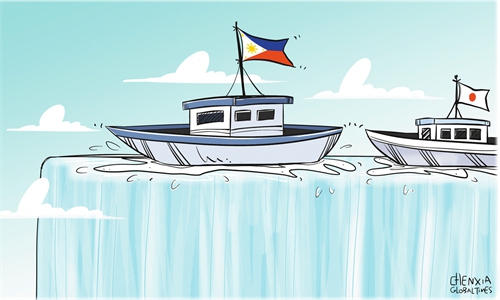
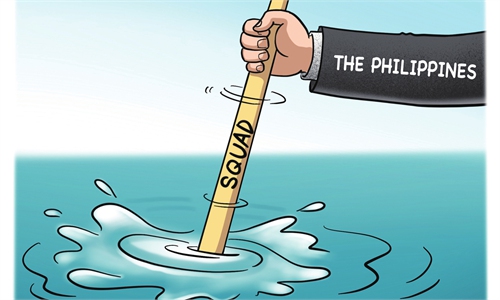
The external powers participating in South China Sea drills with the Philippines each have their own unspoken motives. Washington wants to reinforce its First Island Chain, Tokyo aims to use the Philippines as a foothold to loosen its own military constraints and expand overseas deployments, while the Philippines naively believes these partnerships will provide it with "maritime leverage."
The reality? As the energy crisis worsens, ordinary Filipinos are paying the heaviest price as costs skyrocket. All the Philippines has gained are joint military exercises that offer no real help.
Its current approach - provoking China and undermining its interests on one hand, while seeking cooperation on the other - is unsustainable in the South China Sea. The Philippines' way is far from shelving disputes and seeking joint development; it's more like hoping to extract economic benefits from Beijing while scoring political points through confrontation.
China has shown considerable goodwill and generosity. However, given the Philippines' repeated policy swings and provocative actions, Beijing has every reason to carefully weigh the uncertainties and risks of any future cooperation.
In the end, this is the Philippines' own test to take and its own fate to decide.
RELATED ARTICLES