‘Tickets’ to visit Chinese factories are hard to get – what does this tell us?: Global Times editorial
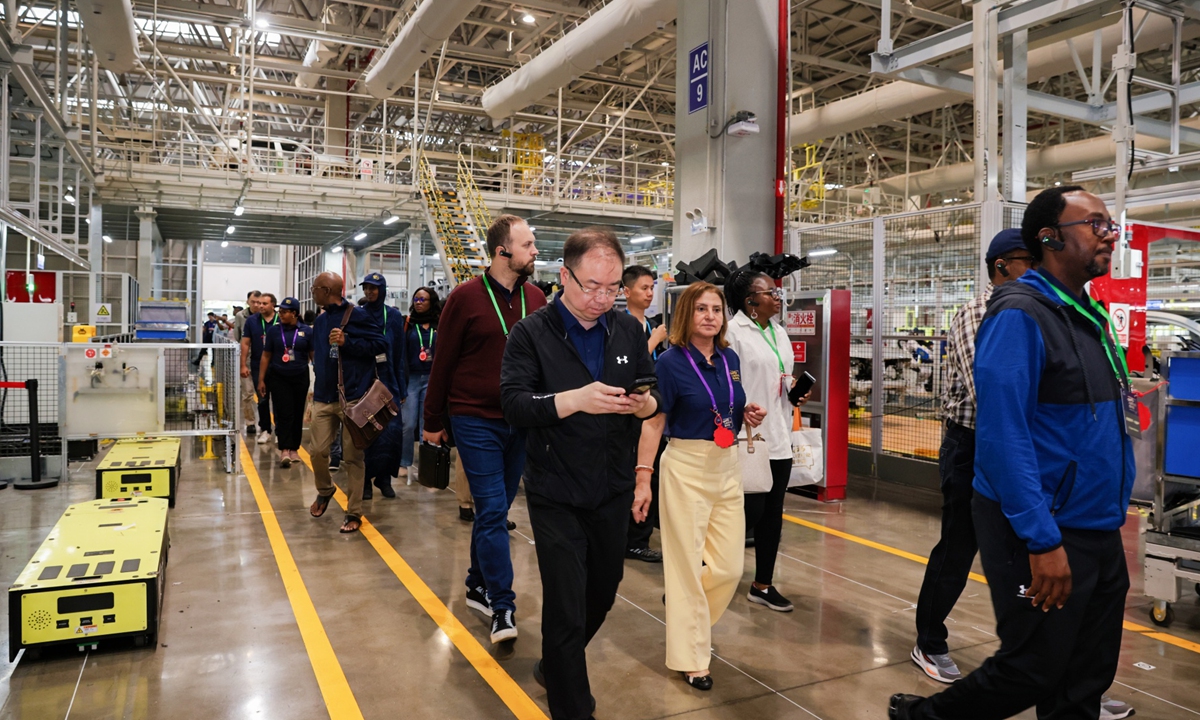
The international human rights experts group toured AVATR Digital Intelligence Factory of Changan Automobile in Chongqing on June 10, 2026. Photo: Chongqing Luhai International Communication Foundation
The frenzy over Chinese factory tours is a vivid reflection of the world's intense interest in China's technological development. The high price of the "ticket" to visit Chinese factories reflects the value of China's intelligent manufacturing. What it represents is the genuine confidence of the international community in China's development prospects.Do you need a "ticket" to visit a Chinese factory? Reuters recently reported on the phenomenon of "Tech pilgrims flock to China as global innovation race heats up." Five-day programs costing up to $15,000 have seen strong demand; free slots to tour Xiaomi's electric vehicle (EV) factory are allocated through public lotteries; and tickets have reportedly been resold on secondhand platforms for as much as $300. This is not a scramble for Labubu sold in "blind boxes," but the sign-up page for tours of Chinese factories. Senior investment executives and technology professionals are flying halfway around the world simply to take a close look at the production lines of China's smart factories for themselves.
The high price of the "ticket" reflects the value of China's intelligent manufacturing. Markets never pay a premium for the ordinary. The willingness of foreign business leaders to spend a fortune on cross-border study tours precisely shows that the manufacturing methods on display in Chinese factories offer an irreplaceable opportunity for firsthand observation.
At Xiaomi's Beijing EV factory, a complete vehicle reportedly rolls off the production line every 76 seconds. Since opening to visitors, the factory has received more than 250,000 visits from people from over 70 countries and regions, with one occasion seeing more than 10,000 people reportedly compete for just 20 slots. At Geely's Xi'an manufacturing base, automation has reached 100 percent in core processes including stamping, welding and painting, with a new vehicle rolling off the line roughly every minute.
Meanwhile, humanoid robot demonstrations in Hangzhou have also become a regular feature of the itineraries of many foreign dignitaries visiting China. Data from the International Federation of Robotics are even more telling: China installed 295,000 new industrial robots in 2024, more than the rest of the world combined, compared with approximately 27,000 in Germany and 34,000 in the US during the same period.
Facts demonstrate that China is at the forefront of this new round of technological revolution. The difficulty in obtaining tickets to tour Chinese factories vividly testifies to the global attention garnered by China's scientific and technological development.
The essence of this "study-tour boom" is opportunity for cooperation, not a so-called threat narrative. Some attribute the frenzy over Chinese factory tours to anxiety over "China shock 2.0," but that most likely misreads what visitors are actually seeking. Immersive experiences of China's technological capabilities are becoming an important window through which foreign investors can understand China and identify future opportunities. Organizers of the tours have acknowledged that even companies that do not plan to invest in China will inevitably encounter Chinese companies in global markets, making firsthand visits an essential part of due diligence.
One organizer of Chinese factory "study tours" noted that roughly half of its clients come from Southeast Asia. Since the end of 2025, a number of European business delegations have also visited China to learn from its experience. Shenzhen offers equally striking evidence: the number of inbound foreign visitors increased by 70 percent last year, and as of August 4 this year, the number of entries and exits made by foreign nationals through Shenzhen ports had exceeded 5 million.
Several entrepreneurs traveling between Silicon Valley and Shenzhen have developed prototypes and connected with supply chains on the ground. As one US manufacturing consultant put it bluntly, frontline industry professionals are less concerned with the political climate: American robotics companies continue to purchase large quantities of Chinese components. On the one hand, tariffs and export controls continue to increase; on the other, capital and businesses from around the world are voting with their feet. The contrast between these two realities speaks for itself.
Those captivated by tours of Chinese factories are not limited to people in technology and industry. As another way to experience "China Travel," China's advanced manufacturing sector is becoming a new window through which foreign visitors can understand the country.
For years, some Western media outlets have perpetuated two entrenched narratives about Chinese industry: that China is merely a source of low-end contract manufacturing and that its industries are moving overseas. Yet statistics show that China received 35.17 million inbound foreign visitors in 2025, an increase of 30.5 percent year on year. During this year's summer travel season, bookings for factory tours by foreign visitors surged more than ninefold from a year earlier. The best way to dispel prejudice is not only through rhetorical sparring, but also by opening the doors.
The transformation from the "world's factory" to a "world-class attraction" is the result of proactive government policy. China has called for the development of industrial tourism and established a number of national industrial tourism demonstration bases and sites. In May, seven government departments, including the Ministry of Culture and Tourism and the Ministry of Industry and Information Technology, jointly issued a notice to specifically support the development of industrial tourism. Currently, China has implemented unilateral visa-free entry for citizens of 50 countries, making travel more convenient for international visitors.
Factory floors are no longer a "no entry" zone for outsiders; they are becoming a popular destination where Chinese and foreign visitors alike are eager to check in.
A "ticket" to a Chinese factory does not put a price on the production line itself. What it represents is the genuine confidence of the international community in China's development prospects. While certain countries continue to erect barriers against China, business leaders from around the world are walking into Chinese factories. China's doors will remain open - not only to visitors and those seeking to learn, but also to practical cooperation.
RELATED ARTICLES