Regional concerns should not be hijacked by geopolitical agenda: Chinese expert on PIF differences over China missile test
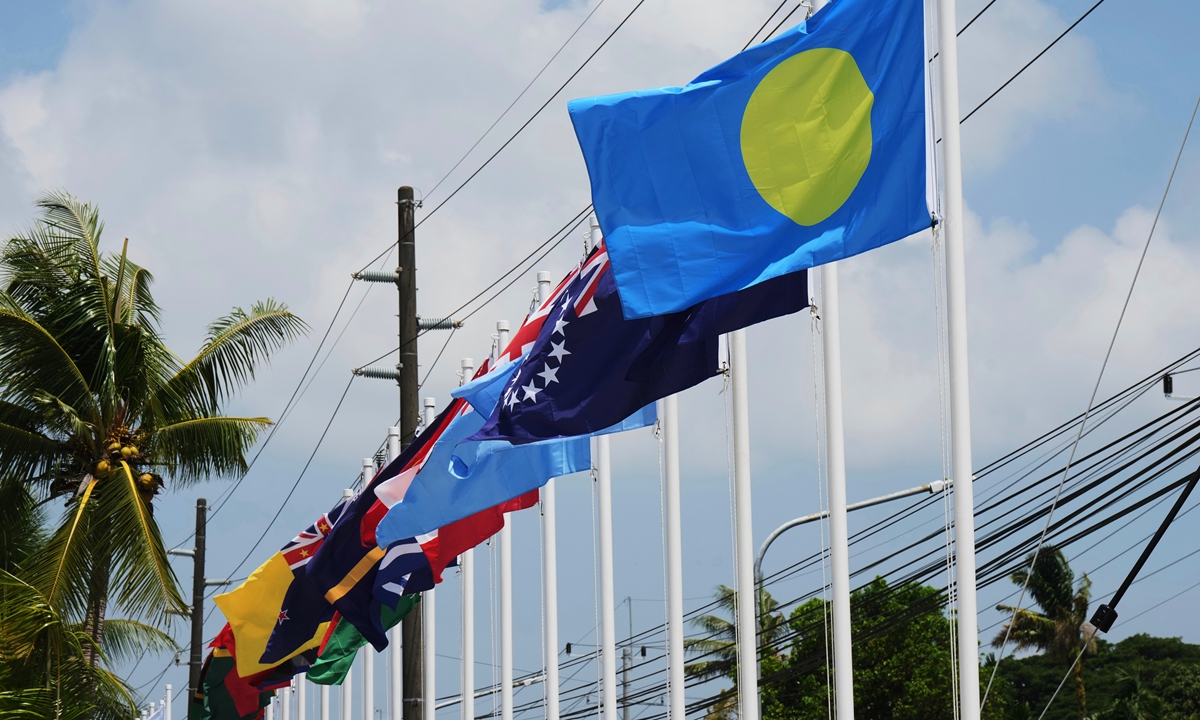
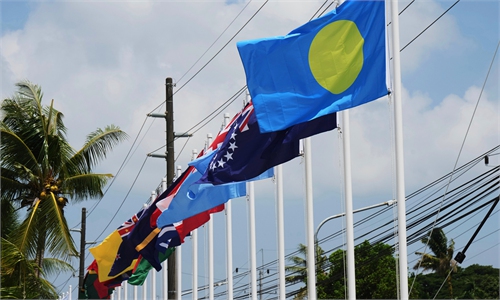
Flags of member states fly outside the summit venue for the Pacific Islands Forum Leaders Meeting in Koror, Palau, on August 30, 2026. Photo: VCG
China has on many occasions made clear its position on the test launch, Chinese Foreign Ministry spokesperson Guo Jiakun said on Friday when asked to comment on reports that leaders of the Pacific Island nations expressed "concern" over China's recent missile test.
"China is committed to peaceful development and a national defense policy that is defensive in nature. We never engage in military expansion. China stands ready to work with South Pacific countries to contribute to peace, stability, development and prosperity of the South Pacific region," Guo said.
Guo made the remarks after Pacific Island leaders at the Pacific Islands Forum (PIF) summit expressed collective "concern" over China's missile launch.
Chinese experts said the reported criticism at the PIF was an attempt to smear China's military, diverted attention from the genuine needs and concerns of Pacific Island peoples, and reflected attempts by some Australian and New Zealand politicians to draw Pacific Island nations into a political agenda centered on China.
The expert point of view was reflected on Kiribati and Naoero, who had refused to back a joint statement criticizing China's missile test at a PIF Foreign Ministers Meeting in August.
Kiribati President Taneti Maamau told his country's parliament last month that while his country did register concerns with China over the test, it would be unfair to criticize China when the US also conducts missile tests in the Pacific, according to the Australian Broadcasting Corp.
"We are trying to be fair," Maamau said.
The push by Australia and New Zealand for a joint statement criticizing China reflects a long-standing tendency in the two countries to view the South Pacific as their strategic backyard, Chen Hong, director of the Australian Studies Center of East China Normal University, told the Global Times.
Chen said strategic anxiety in Australia and New Zealand over China's growing military capabilities has increasingly been projected onto the wider Pacific, with the two countries attempting to draw Pacific Island nations into a political agenda centered on China.
"But these are not the core concerns of Pacific Island countries themselves," Chen said.
For Pacific Island nations, issues including climate change, the ocean and fisheries are of much more immediate importance, Chen noted. Countries at this year's PIF meeting did reach consensus and make substantive progress on such issues, but discussions surrounding China were given disproportionate attention under the influence of geopolitical forces from Australia and New Zealand, he said.
Foreign media outlets have also focused heavily on China's missile test and China's Taiwan question at the forum, using these issues to hype the so-called "China threat" while paying less attention to the real needs and concerns of Pacific Island peoples, Chen said.
The PIF itself identifies climate change as the single greatest threat facing the Pacific. Its official website notes that climate change and disasters threaten the future of the region's people and even the statehood of many Pacific nations, with sea-level rise, coastal erosion, water security and increasingly frequent and intense disasters posing profound environmental and economic challenges.
The Chinese Foreign Ministry on Thursday had already rejected efforts by Palau to rally PIF members behind criticism of the missile test.
Asked about the president of Palau's hope to gain consensus among PIF members to condemn the test, Guo said Palau had "repeatedly raised this issue in an ill-intentioned attempt to hijack the position of other member states of the Pacific Islands Forum."
"It will not have its way," Guo said.
RELATED ARTICLES