Survey shows German firms’ mixed views on China ties; trade barriers are not the cure: expert
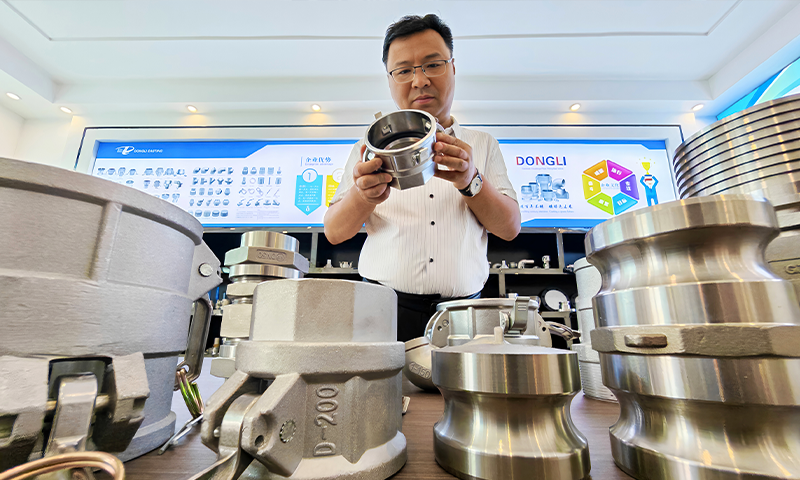
An employee checks car engine parts for export to Germany at the workshop of Wudi Kefeng Stainless Steel Products Co in Wudi, East China's Shandong Province, on July 1, 2026. Photo: VCG
German businesses are undergoing a period of reflection amid growing market competition, with some blaming pressure from China while others acknowledge issues at home, Chinese experts noted on Friday after a recent survey indicated the complex views of German firms on business ties with China.
The survey by the German Chambers of Commerce and Industry (DIHK) claimed that German companies are feeling growing competitive pressure from Chinese rivals, but a rising number acknowledges that the true source of their troubles lies in Germany's own structural weaknesses, not China. Meanwhile, many said they are exploring closer ties with China, while some are pushing for tougher trade measures against China, according to media reports.
"This kind of split mindset - acknowledging domestic weaknesses while still lobbying for confrontation - reveals a real divide within German business circles over how to handle competition with China, and it only proves that trade barriers are not the cure - deeper cooperation with China is," Jian Junbo, director of the Center for China-Europe Relations at Fudan University's Institute of International Studies, told the Global Times on Friday.
The survey released on Thursday showed that two-thirds of the 1,300 German companies polled said Chinese rivals were putting them under pressure. Yet most firms said they were responding through innovation, cost cuts and new markets rather than retreating from their business fields. Notably, nearly one in three was seeking closer cooperation with Chinese partners, said the Reuters' report.
The DIHK report also pointed to problems at home - high labor and energy costs and mounting bureaucracy. "Not every Chinese competitive advantage is a distortion of competition, and not every German competitive disadvantage originates in China," DIHK's head of foreign trade Volker Treier acknowledged, according to Reuters.
Jian said this response pattern shows that a segment of German business remains rational and clear-eyed, willing to confront its own competitiveness gaps rather than reflexively blaming China the way some politicians do. "These companies are genuinely reflecting on where their shortcomings come from," he said.
But Jian cautioned that even this more sober camp has not fully worked through its own contradictions, which expose the confused, self-defeating logic behind certain calls within the EU for protectionist actions against China.
Some 55 percent of firms still backed tougher EU measures against so-called market distortions despite risks of higher prices and tariffs. "Even the relatively rational view still harbors a misreading of China, still nursing hopes that decoupling or de-risking could preserve Germany's edge. That reflection has not gone far enough," Jian said.
Treier defended the tougher posture, saying Europe "must be able to defend itself against unfair competition" by consistently using existing trade tools, while insisting "this is not a call for a trade war."
China has consistently called on the EU to focus on addressing concerns through dialogue, rather than protectionist actions.
"China has repeatedly stressed that the EU should face its own economic and trade problems squarely, and China is not the source of those problems. Rather, China can be a partner in helping the EU to solve them," Chinese Ministry of Commerce spokesperson Huang Ling said on Thursday in response to the EU trade chief's recent threats of trade defense instruments and market closure against China if negotiations fail to yield results.
Consultations at all levels between China and the EU should adhere to the stable and balanced positioning of their critical trade partnership, uphold the principle of resolving each other's concerns on an equal footing, and should not involve unilateral demands, conditions, or even frequently resorting to the threat of market closure, Huang said.
"Protectionism leads nowhere, and win-win cooperation is the right path. China is ready to work with the EU to strengthen regular, institutionalized communication on trade, manage differences, expand practical cooperation and move China-EU trade toward a higher and more balanced track," Huang said.
RELATED ARTICLES