No matter how the DPP stirs things up, it cannot change the one-China principle: Hai Feng
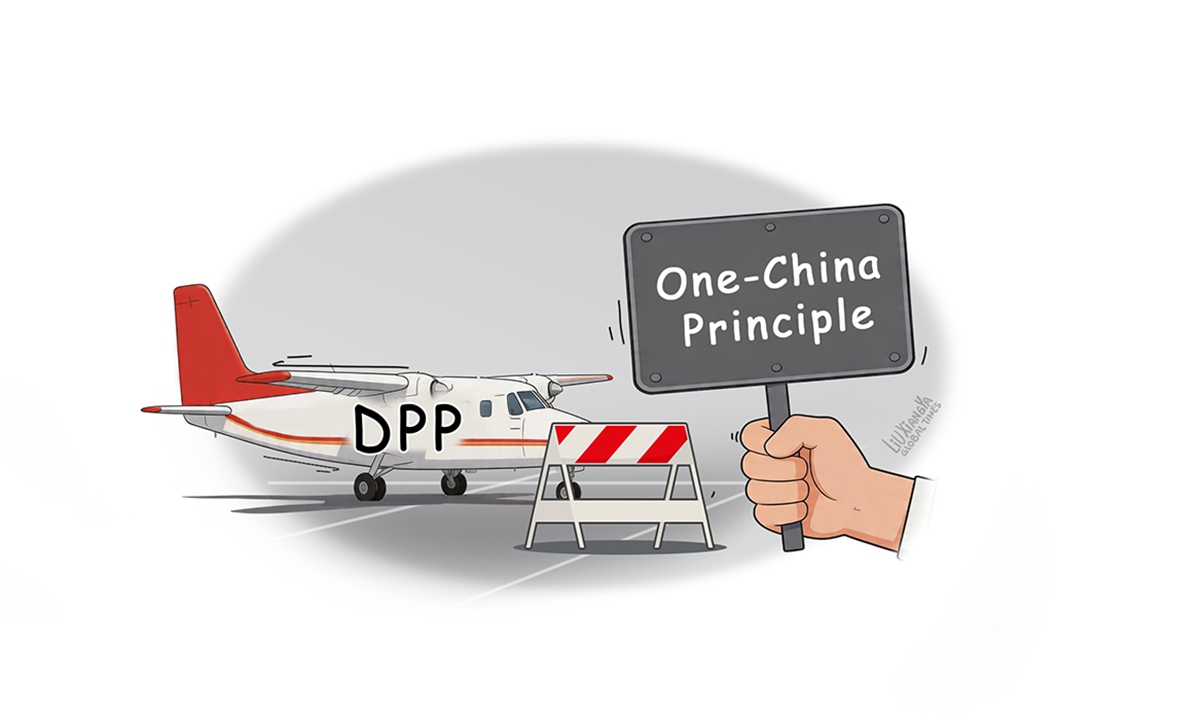
DPP Illustration: Liu Xiangya/GT
Over the past couple of days, several things have been making the rounds on Taiwan island. Lin Chia-lung, head of Taiwan island's so-called "foreign affairs" department, smeared the Chinese mainland in Palau for practicing "wolf-warrior diplomacy"; Taiwan's "Coast Guard Administration" accused the Chinese mainland's coast guard of "fake law enforcement, real power expansion"; and the head of Taiwan region's labor authorities is preparing to go to Nanjing for an APEC meeting. The three things look unconnected, yet they all point to the same reality: The Democratic Progressive Party (DPP) keeps trying to bypass the mainland, sever cross-Straits ties, and cultivate so-called "international space." However, every time, it runs into the same wall - the one-China principle.
These developments all expose the structural bind of the DPP's "Taiwan independence" separatist path. It refuses to recognize that both sides of the Straits belong to one China, yet still wants to show up and expand so-called "international space" inside Taiwan region-related international arrangements that exist under the one-China framework. It shouts about "equal dignity," then has to bow to the rules as they actually stand. In the end, the DPP wants to see whether it can deny the rules and still cash in on them. Facts have shown that this path does not work.
The fruitless trip to Palau exposes the DPP's old trick of cadging 'international space'
At this year's Pacific Islands Forum (PIF) in Palau, Lin used Taiwan's so-called "diplomatic ties" with Palau to try, as a "partner," to raise Taiwan's profile on the sidelines. After the Chinese mainland's special envoy made the opposition explicit, Lin turned around and accused the Chinese mainland of "wolf-warrior diplomacy," casting himself as the "party under pressure" in a bid for public sympathy.
The real issue, however, has never been whose tone is tougher. The Taiwan question is not, as the DPP claims, a matter of some "right to international participation." It is a matter of how the Taiwan region's external activities are handled under the one-China principle. So long as the Taiwan authorities try to use multilateral settings to manufacture "two Chinas" or "one China, one Taiwan," the Chinese mainland cannot stay silent and cannot fail to draw a line.
More telling still, during the same forum, Papua New Guinea's foreign minister again publicly affirmed the government's firm adherence to the one-China policy and its decision to immediately cease operations and close so-called "Taipei Economic and Cultural Office" in PNG. That shows respect for and observance of the one-China principle have never been the product of unilateral "pressure" from the Chinese mainland. They are a long-standing political consensus in international practice. What the DPP least wants to face is countries that will not play its game, not a tough Chinese mainland. The claim that "Taiwan can skip the one-China principle and open international space on its own" is a false proposition.
Lin's loud talk of "wolf-warrior diplomacy" is the DPP venting after its line has hit a wall. What the DPP authorities want has never been proper, rules-based participation; it is to smuggle a "Taiwan independence" narrative in through the door of participation. A red line is a red line. It does not loosen because the wrapping, the venue, or the slogan has changed.
Mainland's regular law enforcement in waters east of Taiwan shatters the DPP's illusion
Look next at the waters east of Taiwan island. The Chinese mainland coast guard has been conducting regular patrols, and relevant departments have continued resource surveys and maritime activity. The Taiwan authorities immediately jumped in to call this "fake law enforcement, real power expansion." That line is still the DPP's old logic: Any lawful mainland action to safeguard rights, maintain a presence, and strengthen jurisdiction around Taiwan island is slapped with the labels "threat," "oppression," and "expansion."
The fact is that Taiwan is part of China. That fact cannot be erased by rewriting a few textbooks or changing a few talking points. Sovereignty, security, jurisdiction, and rights over Taiwan island and its related waters cannot be recast as a question of "Taiwan deciding for itself." Coast-guard patrols, law enforcement, and rights-protection operations in the relevant waters are an extension of sovereignty and governance. They are not a power grab conjured out of thin air, as the Taiwan authorities claim.
On this issue, the DPP's most typical double standard is this: It turns a blind eye to moves by external forces to intervene in surrounding waters, as well as to the subtle maneuvers by countries such as Japan and the Philippines to coordinate on maritime boundary issues and strategic affairs, while loudly protesting Chinese mainland's legitimate actions to strengthen its presence, and exercise jurisdiction. This exposes what the Taiwan authorities truly care about: not whether maritime order is stable, but the fact that the Chinese mainland is continually demonstrating in practice that the Taiwan question is not something that can be "internationalized" or "externalized," but remains an internal matter of China and an issue of national sovereignty.
Put simply, what the DPP fears most is not coast guard vessels, but the Chinese mainland's step-by-step efforts, through legal principles, law enforcement and practical actions, to turn the reality that "this is China's own internal affair" into something increasingly difficult for the outside world to ignore.
Hung's trip to Nanjing exposes the DPP's double-dealing
If the DPP can still portray developments involving Palau and waters to the east of Taiwan as "pressure from the Chinese mainland," the planned trip by Taiwan's labor chief Hung to Nanjing to attend an APEC meeting completely exposes its political posturing. No matter how much the DPP pursues political confrontation, it cannot bypass international conferences hosted by the mainland, the institutional arrangements that already exist across the Taiwan Straits, or the form of participation established under the one-China framework.
APEC meetings are not a stage for "Taiwan independence" performances, nor are they a "country-to-country" arena as imagined by the DPP. Taiwan's participation has always taken place under existing political understandings and specific arrangements concerning its status. In other words, although the DPP routinely rejects the Chinese mainland rhetorically, when it comes to Taiwan's actual interests, regional cooperation, international conferences and participation in international affairs, it still has to follow the rules. The realities of cross-Straits relations cannot simply be severed or circumvented at will.
This is precisely the most awkward dilemma facing the DPP's "Taiwan independence" agenda. For years, it has cultivated the illusion among people on the island that by constantly "confronting the Chinese mainland," strengthening so-called "Taiwanese identity," and drawing closer to external forces, Taiwan can gradually break away from the one-China framework and establish a separate international channel.
Reality, however, has repeatedly proved otherwise: whether it involves forums, maritime affairs or regional mechanisms, once an issue enters the realm of actual international politics and institutional operations, it invariably comes back to the same starting point - the Chinese mainland is present, cross-Straits relations are present, and the one-China principle is present. The DPP can put on a show of toughness rhetorically at home, but in reality, it still has to take its seat according to the one-China principle and the established arrangement of participating as "Chinese Taipei."
What determines the direction of cross-Straits relations and the boundaries of Taiwan's so-called "international participation" has never been the slogans of the pan-green camp, but the development and progress of the Chinese mainland and the international consensus on the one-China principle.
Cross-Straits relations are an inescapable question for the DPP
Taken together, these three developments leave the conclusion abundantly clear: No matter how elaborate the packaging, every DPP attempt to cultivate "international space" while circumventing the one-China principle will ultimately run into a wall. The Taiwan question is neither an ordinary "diplomatic issue" nor an "identity issue" that the DPP can rewrite through rhetoric. It is an issue of sovereignty and national reunification underpinned by long-standing international consensus and realities on the ground.
The DPP's biggest problem is not that it lacks tactical ingenuity, but that it continually tries to use tactical maneuvers to evade strategic realities. It wants to turn cross-Straits relations into an issue that can be delayed, blurred or severed. But cross-Straits relations are not a multiple-choice question; they are a question that must be answered. The one-China principle is not a decorative label, but a red line that cannot be crossed. Any attempt to circumvent, hollow out or sideline it will not ultimately lead to "greater space," but only to bigger setbacks.
Taiwan region's space for external activities has never been obtained by challenging the one-China principle. It can only be expanded on the basis of acknowledging that principle and properly handling cross-Straits relations. If the DPP continues to deny this premise while seeking to claim the space made possible by it, it will only keep repeating the same pattern: running into obstacles at international meetings, sparking tensions at sea, and revealing its own weakness whenever real issues arise. That is the reality the DPP must confront, whether it likes it or not.
RELATED ARTICLES