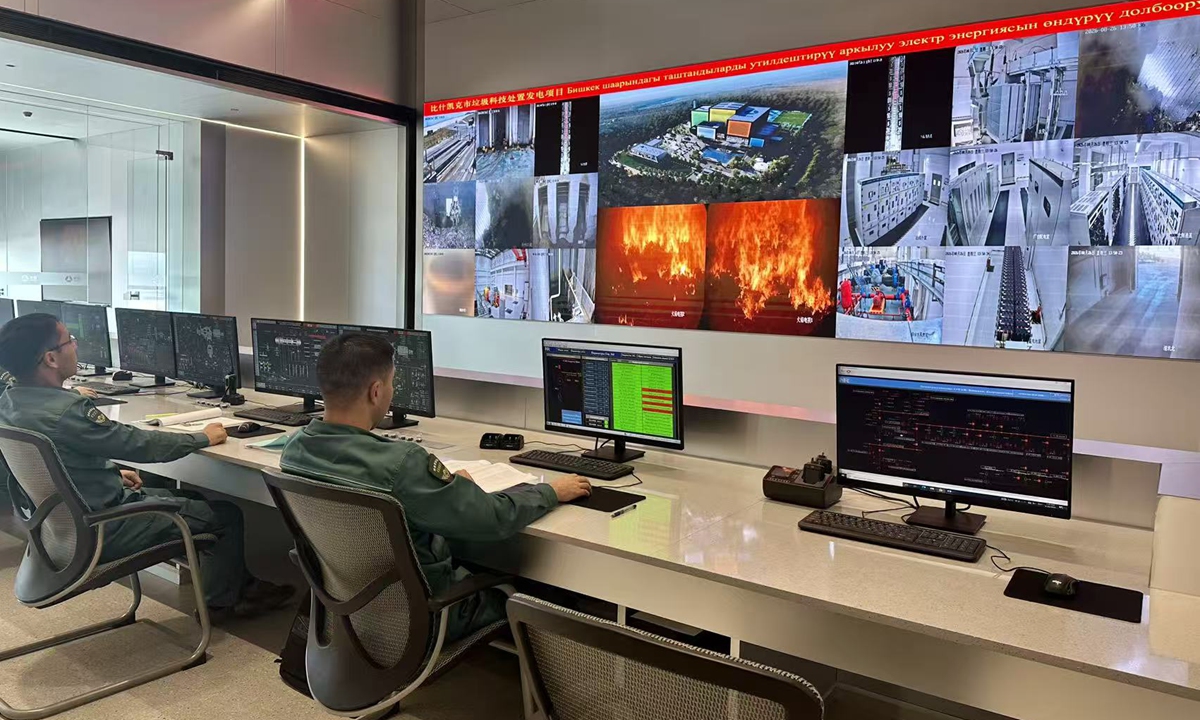
View of a control room at Hunan Junxin Environmental Protection in Bishkek, capital of Kyrgyzstan on August 26, 2026. Photo: Ma Jingjing/GT
About a 40-minute drive north of central Bishkek, the Kyrgyzstani capital's cityscape gives way to the low-rise homes of the northern outskirts. Rounding a bend, a modern complex suddenly rises from a carpet of emerald grass - panels of green, blue, yellow, white and orange stacked in interlocking volumes. The bold color contrasts make it look less like a waste plant and more like a casual pile of oversized gift boxes, a subtle but profound visual nod to the friendship between China and Kyrgyzstan.Step inside the control room, and a wall-sized screen greets you, real-time figures flickering line by line - power output, flue gas readings, furnace temperature. At the console sits Adil, 26, his eyes locked on the curves scrolling across his computer screen, with his pen pausing now and then to note an observation in his notebook. A former engineer at a heating company, he decided to try his luck when he heard that a Chinese-funded waste-to-energy plant would go live in December 2025 - the first of its kind in Kyrgyzstan, and in all of Central Asia. "Here I truly learned steam turbine technology. Not theory on paper, but hands-on," he tells me, adding that his parents and friends are proud he works on something that matters.
Until recently, Bishkek dumped most of its municipal waste into a landfill whose capacity was nearing saturation; methane pooled underground, and fires were a recurring threat. Since the plant, built and run by the Chinese company Hunan Junxin Environmental Protection, went into operation, the city's new waste is sent straight to the facility for closed-loop incineration and power generation. "Many residents from surrounding neighborhoods now make special trips just to walk through the plant," a Chinese staff member tells me.
Adil's path is one thread in a wider green tapestry. In the Chui region, a 100-MW solar station with Chinese participation connected to the grid in late 2025 and now powers nearly 30,000 households. In August 2025, Bishkek put 120 Chinese-made electric buses on its routes. On August 13, Kyrgyzstan's Energy Ministry and China Southern Power Grid International signed a memorandum on joint power infrastructure. Together, these cooperation projects sketch what Kyrgyzstan's low-carbon transition could look like - solar on the steppe, cleaner buses on the streets, and waste becoming watts.
What makes the partnership work is that it is not a one-way transfer of hardware. Kyrgyzstan brings hydro and solar potential, rugged terrain, and heart-of-Asia location. China brings manufacturing scale and two decades of domestic experience in turning renewable targets into delivered megawatts. The two governments have repeatedly framed this as co-authored roadmaps rather than buyer-seller deals.
Kyrgyzstan is one example of broader green cooperation between China and the Shanghai Cooperation Organization (SCO) partners, ranging from clean energy and ecological protection to new energy vehicles and sustainable transport, as they pursue shared goals of low-carbon growth and a greener future.
At last year's Tianjin summit, China's leader announced three China-SCO cooperation platforms - on energy, green industry and the digital economy - open to all members. A 2025 China-SCO renewable energy report notes member states hold roughly half the world's renewable installed capacity; in 2024 alone they added 420 million kW, about 72 percent of the global total, with China contributing over 370 million kW.
The potential for green cooperation within the SCO is enormous. The full members and observer states together account for roughly half the world's renewable installed capacity, enabling them to make significant contributions to global sustainable development. Over its first 25 years, the organization built the political trust and institutional frameworks that now make large-scale green delivery possible. The next phase is about translating that foundation into tangible win-win outcomes.
The regional evidence is already in. In Kazakhstan, Chinese-backed wind farms in Akmola convert wind into electricity that travels through a transmission network spanning over 40 kilometers directly to its capital city, Astana, demonstrating that a landlocked steppe country can pivot away from coal on its own terms. In Pakistan, Chinese-made electric buses run on Lahore's corridors, the same model now rolling out in Bishkek. Around the shrinking Aral Sea, SCO-linked afforestation and salt-tolerant vegetation projects are stabilizing soil that decades of retreat left bare - an ecological repair that no single border could finance alone.
What binds them is not a one-sided division of labor, but a web of complementary strengths. Each member brings distinct assets - some in manufacturing scale, others in grid management, financing, research, or decades of experience operating energy systems in extreme climates. No single country holds the full chain from invention to deployment. The SCO platforms create a table where every participant contributes a different piece of the same puzzle, and the assembled result is a transition that no single capital could engineer alone.
That afternoon, as I left the plant, Junxin staff were already setting up the next training session. "Under the agreement, the plant will be transferred to Kyrgyzstani operation after 35 years," a Chinese engineer said. "That is why we constantly conduct training for local employees - so the technology stays, and the capability carries forward."
The author is a chief reporter with the Global Times. This article was originally published in Vecherniy Bishkek, a media outlet in Kyrgyzstan. majingjing@gloaltimes.com.cn
RELATED ARTICLES