Chinese experts dismiss European group’s ‘colonisation’ hype, coffin protest as political stunt, urge EU to face up to competitiveness woes
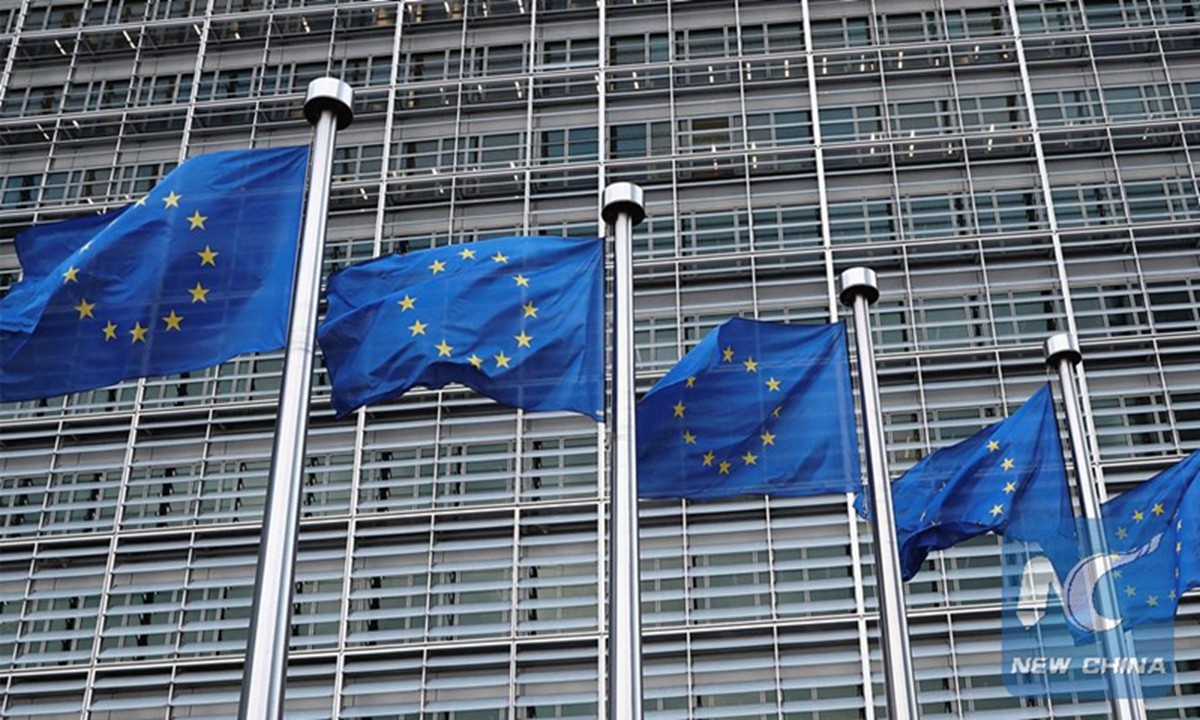
The European Union flags in front of EU headquarters in Brussels, Belgium. Photo: Xinhua
Europe is crying foul again. A European metals industry group has alleged that EU manufacturing job losses could surge unless Brussels stops what it called the "colonization" of industry by Chinese component manufacturers, The Guardian reported on Sunday. Chinese experts dismissed the claim as a distortion of normal market competition that deflects attention from Europe's own competitiveness problems and could fuel protectionism.
Eurometal claimed that it would stage a protest in Brussels on Monday, with a procession of 10 symbolic coffins around the European Commission headquarters to press its concerns with EU decision-makers, The Guardian reported.
The coffins will be marked with phrases such as "EU competitiveness," "industrial jobs" and "European factories," according to The Guardian report.
Jian Junbo, director of the Center for China-Europe Relations at Fudan University, told the Global Times that the "colonization" rhetoric reflects more of Europe's own historical experience than the reality of China's current policies. In his view, portraying China's rise in global supply chains as "colonization" reveals a colonial mindset itself — one that assumes Europe should remain dominant while other economies stay at the lower end of the value chain.
The accusation also reflects a reluctance to confront Europe's own weakening competitiveness, Jian said, calling the "coffin protest" a political stunt that does little to address the real problem. If an economy gains a stronger position in global supply chains through technological progress, cost advantages and market recognition, that is the result of competition, not colonization. Blaming others for losing such an advantage only distracts from Europe's own competitiveness challenges.
European manufacturers fear that the commission is not fully alive to the "cannibalization" of their industries as China becomes embedded in supply chains through the sale of components, according to the report.
"China doesn't want to be a raw material supplier, it wants to be a finished product supply. They want to be in key product supply chains because they know that once they control the supply chain, they own the complete value chain," Alexander Julius, the president of Eurometal claimed, The Guardian reported. He wants the commission to understand fully the impact of Chinese exports at the component level, including metals and chemicals used in 90 percent of manufacturing.
Describing China-EU supply-chain ties as "colonization" is inconsistent with reality, Zhou Mi, a researcher at the Chinese Academy of International Trade and Economic Cooperation, told the Global Times on Monday. Colonization relies on political coercion, while current supply-chain cooperation is driven largely by market demand and reflects economic complementarity and mutual benefit. The comparison therefore does not stand up to scrutiny.
Zhou said that China supplies Europe not only with finished products, but also with raw materials, intermediate goods and components essential to European manufacturing. Without these inputs, production costs could rise and supply chains become less stable. This reflects the reality of economic globalization, in which mutually beneficial cooperation supports both sides' development.
A 2026 study by the European Central Bank (ECB) found that increased exposure to intermediate goods imports from China was associated with a 0.6 percentage point boost in EU industrial production growth. The ECB said that cheaper Chinese intermediate inputs can reduce production costs and support domestic output.
Jian said that there is nothing unusual about China seeking to move up the value chain and become a supplier of higher-value products. China, India, South Africa or any other economy has the right to pursue greater competitiveness and a stronger position in global markets. No country is entitled to preserve its dominant position simply because it held that position in the past.
Zhou added that an industry association should focus on the long-term development of the sector as a whole, rather than simply protect certain domestic companies. Under the World Trade Organization (WTO) principle of national treatment, foreign and domestic firms operating in the same market should be treated equally. What matters is whether the industry remains dynamic and has sufficient momentum for future growth.
Such rhetoric from the European industry group runs against market principles and the spirit of the WTO and could ultimately prove self-defeating, Jian said, adding that politicizing normal competition and using it as grounds to pressure China would neither restore Europe's competitiveness nor solve its structural economic problems.
RELATED ARTICLES