Photo: Li Hao/GT
China's determination to improve its national defense mobilization system stems from its commitment to protecting the peaceful lives of the Chinese people and its firm resolve to safeguard the country's sovereignty, security and development interests. The more China's defense capabilities develop and become institutionalized, the greater the safeguards for regional peace. If someone feels constantly on edge and loses sleep because China is becoming better equipped to safeguard its territorial sovereignty and integrity, then it means this is the right move.
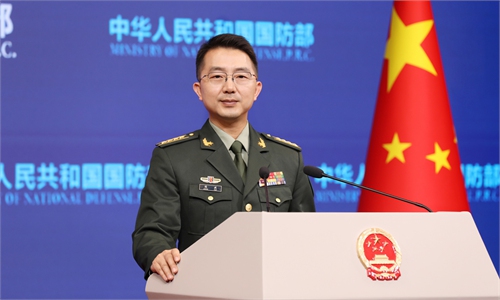
The newly revised National Defense Mobilization Law of the People's Republic of China will officially take effect on October 1. This marks the first comprehensive revision of the law in 16 years since its enactment in 2010. Its background, content, and significance have already been clearly explained by the legislative authorities and relevant departments in official briefings. Yet in recent days, some Western media outlets and some in Taiwan region have reacted as if facing an imminent, formidable threat, hastily labeling the revision as "military expansion" or "lowering the threshold for war." From a variety of far-fetched angles, they attempt to interpret "what kind of signals of war" this revised law allegedly sends, even going so far as to link it to several ongoing regional conflicts.
China's current National Defense Mobilization Law was officially enacted in July 2010 and has been crucial in strengthening mobilization development and enhancing mobilization capabilities. However, over the past decade and more, profound changes have taken place in China's economic and social structure, its scientific and technological industrial system, the organizational structure of its armed forces, and the form of modern global warfare. As a result, certain provisions of the law are no longer suited to the new circumstances, new tasks, and new requirements of national defense mobilization.
In 2019, the Communist Party of China Central Committee made decisions and arrangements for deepening the reform of the national defense mobilization system. In October 2021, the Standing Committee of the National People's Congress adopted a special decision, stipulating that relevant laws shall be revised and improved in a timely manner when reform measures are refined and ready. Since then, mobilization functions between military and civilian sectors have been gradually adjusted, and the National Development and Reform Commission has established a new department of national defense mobilization. All these show that the revision of the law is a well-planned reform process, kept pace with changing circumstances and implemented step by step.
For the first time in legal form, the revised law provides a legal definition of "national defense mobilization," requiring that when national sovereignty, unity, territorial integrity, security, or development interests are threatened, the economic and social resources be transformed into national defense capability. This has attracted wide attention. It signifies that national defense mobilization is no longer merely an ad hoc emergency measure, but has been elevated to a statutory national institutional arrangement. It connects peacetime development with wartime response, systematically incorporating economic strength, industrial capacity, and social organizational capabilities into the national security framework. This ensures that mobilization can be carried out in accordance with the law and established procedures, avoiding hasty, improvised responses in times of crisis.
Codifying the national defense mobilization mechanism through legislation is both a practical necessity for strengthening the country's security defenses and a reflection of China's governance philosophy of balancing development and security while remaining vigilant even in times of peace. It is also an inevitable outcome of the country's growing comprehensive national strength.
Institutionalizing the capacity to shift from peacetime to wartime is also a common choice among the world's major powers. Modern major powers generally establish in advance, through legislation, mechanisms for mobilizing personnel, industries and resources in the event of extreme security risks. The US and some European countries, in particular, have long had mature legal frameworks for national mobilization.
The US' Defense Production Act of 1950, for example, allows the president to prioritize government contracts for goods and services over competing customers, "allocate materials, services, and facilities," and take measures to prevent price gouging and the hoarding of scarce materials. During the COVID-19 pandemic, it was repeatedly invoked to compel companies to switch production to ventilators, address infant formula shortages, and support critical mineral supply chains. The EU is moving in a similar direction. In March 2025, the European Commission unveiled its Preparedness Union Strategy, and EU officials have also raised the possibility of a future "EU Preparedness Law." This is a standard practice internationally. So why is it called "strategic autonomy" or "national resilience" when the US and Europe do it, but "militarization" when China does the same thing?
Whether a country has the legal capacity to mobilize is an entirely different matter from whether it actually decides to mobilize. The text of the new law's 82 articles contains no references to any specific region or country. So the question is: who is actually afraid or anxious about China's revised National Defense Mobilization Law?
The distortions and misinterpretations largely come from two groups. One consists of some Western figures who make a living by hyping the so-called "China threat." They need a China portrayed as "engaging in militarism" to leverage political capital for themselves. The other consists of "Taiwan independence" forces who depend on stoking confrontation for their political survival. They fear businesses in Taiwan feeling secure, they fear closer ties across the Taiwan Straits, and even more, they fear that the sword of Damocles hanging over their heads could one day suddenly fall.
The former are largely putting on an act; the latter are genuinely afraid. Conversely, if someone feels constantly on edge and loses sleep because China is becoming better prepared to safeguard its territorial sovereignty and integrity, then it means this is the right move.
China's legislation on national defense mobilization has consistently reflected the fundamental characteristics of being defensive, routine and governed by law. Its purpose is to "prepare without necessarily having to use them": to anticipate the worst-case scenarios, establish clear rules for responding to them, and ensure that peace and development are not disrupted by sudden threats.
China's determination to improve its national defense mobilization system stems from its commitment to protecting the peaceful lives of the Chinese people and its firm resolve to safeguard the country's sovereignty, security and development interests. In other words, the more China's defense capabilities develop and become institutionalized, the greater the safeguards for regional peace. As for those who read "signals of war" into this, one can only say that they already have their own "war scripts" pre-loaded in their minds.