Greater policy autonomy drives Canada’s tariff response to US pressure, trust crisis pushes allies to seek new trade routes: experts
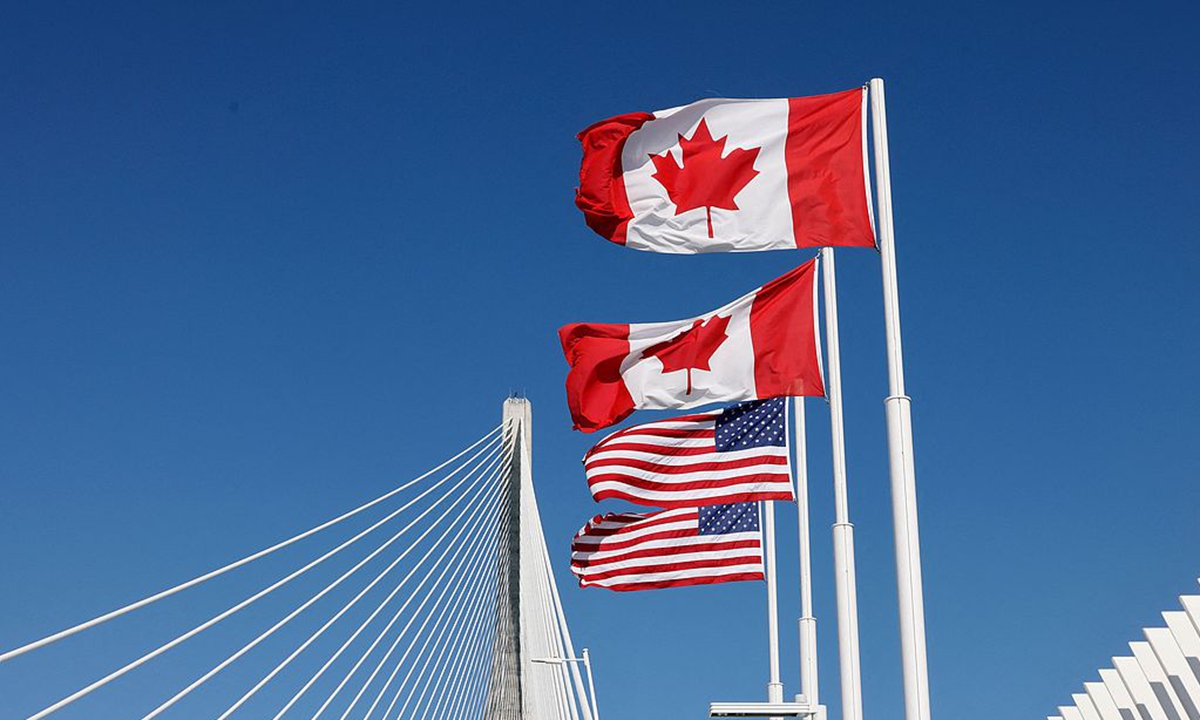
National flags of Canada and the US Photo: VCG
The escalating US-Canada tariff dispute has become the latest symptom of a tariff-driven trust crisis rooted in Washington's trade policies, Chinese experts warned on Tuesday. As Canada's retaliatory tariffs on US goods took effect, they noted that growing calls for policy autonomy among US traditional allied economies could push them toward building more stable and reliable economic ties elsewhere.Effective Tuesday, Canada will impose 15, 25, and 50 percent tariffs on products drawn from among those targeted by US Section 338 and Section 232 tariffs, with individual product rates based on the matching US rates for the same goods, according to an official statement released by Canada.
The statement said that Canada's countervailing tariffs will apply to products covering C$27.6 billion ($19.9 billion) in imports from the US and will focus on sectors such as steel, dairy, appliances, agricultural equipment, pulp and paper, and electronics, that are most impacted by US tariffs.
Canada hit back after the US unveiled 50 percent tariffs on a wide range of imports from Canada. Reuters reported on July 20 that the new tariffs would also apply to wine, cement, ice hockey gear, dairy products, swimming pools, furniture, fishing rods, seeds, clothing and wigs, among other items.
A Canadian government source said that there are currently no talks taking place between the two sides among ministers or government officials, according to Reuters.
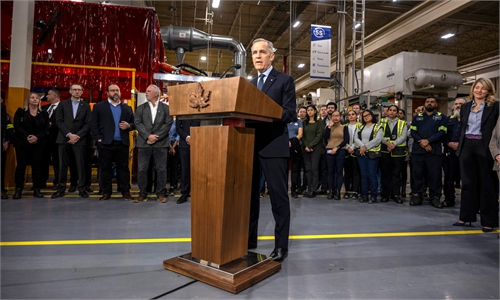
Weeks earlier, Canadian Prime Minister Mark Carney said that trade talks with Washington could resume once the US takes negotiations seriously, but he warned that the terms sought by the US could leave Canadian industries "gradually wound down in Canada and wiped out," ABC News reported on September 2.
Canada's countermeasures, covering about C$27.6 billion worth of US goods, are a response to Washington's tariff pressure, but the escalation of reciprocal tariffs could further strain bilateral trade ties, Zhou Mi, a researcher at the Chinese Academy of International Trade and Economic Cooperation, told the Global Times on Tuesday.
"The confrontation will disrupt the relatively stable low-tariff trade environment that businesses have relied on. Companies will reassess their supply chains based on costs and stability, which could accelerate Canada's efforts to diversify trade partners," Zhou said.
Canada's move could also provide a reference for other economies facing US trade pressure. "Some economies have repeatedly made concessions under US pressure, but they have not necessarily gained the expected benefits or understanding. This may prompt more countries to reconsider their economic and trade relations with the US and pursue greater policy autonomy," Zhou said.
Notably, Canadian companies appear to have already begun seeking more reliable new partners as trade uncertainty with the US persists.
The Financial Times reported on Monday that some Canadian companies are seeking new markets beyond the US, with Europe emerging as a key destination. Canadian outerwear producer Wuxly said it is expanding its presence in Europe amid growing interest from European NATO countries.
"Made in Canada" signs are proudly displayed in grocery stores, lists of alternatives to US products have been circulated and a domestic travel boom has helped support many small businesses, the report noted.
Uncertainty caused by unilateral US trade policies is weakening the country's appeal and may speed up global partners' efforts to seek more diversified and independent cooperation. Every adjustment driven by tariffs and trade restrictions raises supply chain costs and reduces trade efficiency, which will ultimately affect US economic interests as well, Zhou added.
The US remains one of Canada's most important export markets, and any prolonged tariff confrontation would inevitably weigh on Canada's economy, Chinese experts said, noting that if Washington continues to wield tariffs as a tool of pressure, it will not only disrupt bilateral trade but also create greater uncertainty for Canadian businesses and supply chains.
According to Canadian and US government data, Canada has shipped almost 68 percent of total exports to the US this year, Reuters reported.
RELATED ARTICLES