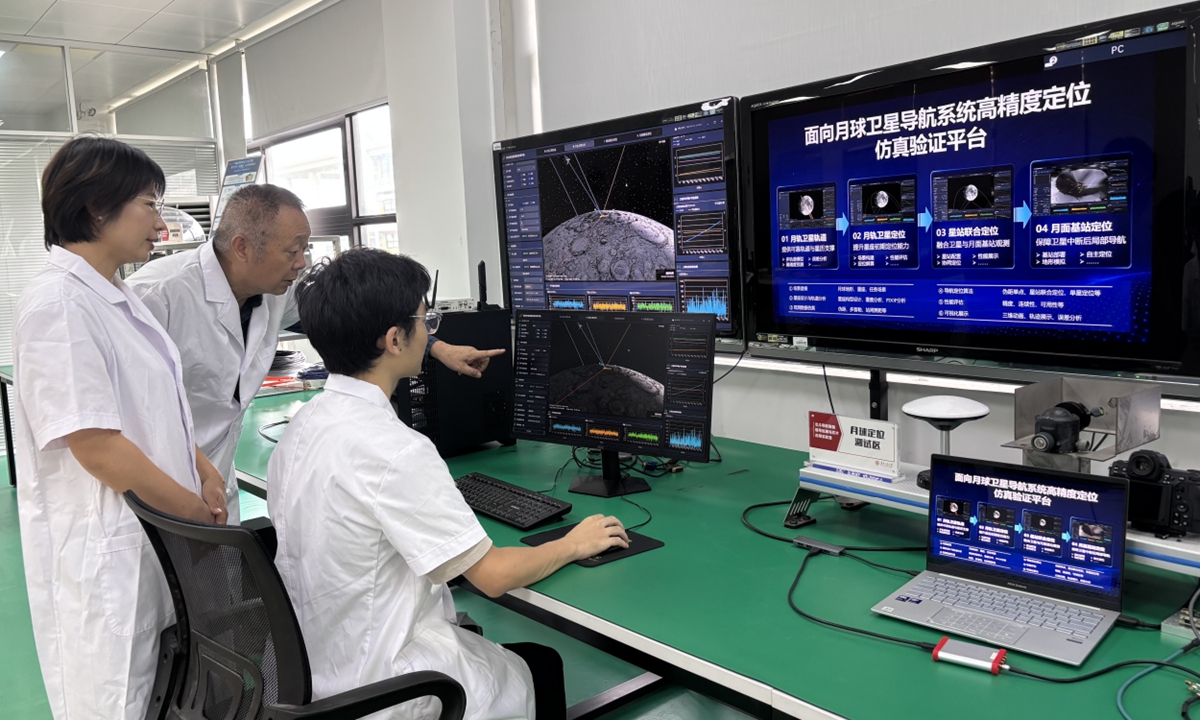
Researchers from Guangdong University of Technology work on the newly unveiled high-precision simulation and verification platform for lunar satellite navigation system. Photo: Courtesy of the research team
A research team from Guangdong University of Technology's (GDUT), led by professor Xie Shengli, has recently unveiled a high-precision simulation and verification platform for a lunar satellite navigation system.
The platform is the first of its kind publicly released internationally for fundamental research into lunar surface navigation and positioning.
"The platform is essentially a virtual testing ground for a lunar satellite navigation system, capable of simulating the operations of satellites, lunar surface ground stations and probes, and test whether different system designs can accurately determine positions on the moon," team representative Professor Li Zhenni of GDUT's School of Automation told the Global Times on Tuesday.
According to GDUT, the research fills a gap in system-level verification platforms for lunar navigation both in China and internationally.
It will provide support for future research into navigation constellation designs, verification of key lunar navigation technologies and evaluation of engineering proposals.
This research is gaining urgency as lunar exploration shifts to sustained and large-scale missions.
China aims to complete the basic International Lunar Research Station configuration by 2035 and gradually enable continuous operations across hundreds of kilometers, including surface exploration, robotic coordination and crewed missions, according to the research team.
Positioning, navigation and timing services are essential for large-scale lunar missions. However, without a real-world lunar environment for engineering validation, researchers cannot test key technologies as they would on Earth. This has created an urgent need for an integrated simulation and verification platform, according to the team.
The platform developed by the research team integrates lunar-orbit satellite trajectory simulation, satellite positioning, joint satellite-ground-station positioning and surface base-station positioning. It offers end-to-end verification for lunar positioning, from scenario modeling and observation generation through algorithm verification and performance evaluation.
The platform also features a range of visualization functions, including 3D dynamic scene displays, real-time operation monitoring and statistical analysis of positioning errors.
For Chinese deep-space intelligent scientists, the platform's release comes as China and other countries step up efforts to develop infrastructure for sustained lunar exploration. Researchers have increasingly focused on navigation, positioning and timing as a basic capability that will be needed for future lunar probes, robots and crewed missions operating over wider areas of the moon.
According to Xie, the simulation and verification platform was developed under the guidance of academician Wu Weiren of the Chinese Academy of Engineering, through close collaboration with the institute, the Deep Space Exploration Laboratory and relevant research institutes of the China Academy of Space Technology.