GT on the spot: Foreign guests refute ‘forced labor’ accusations against China’s Xinjiang at conference in Urumqi
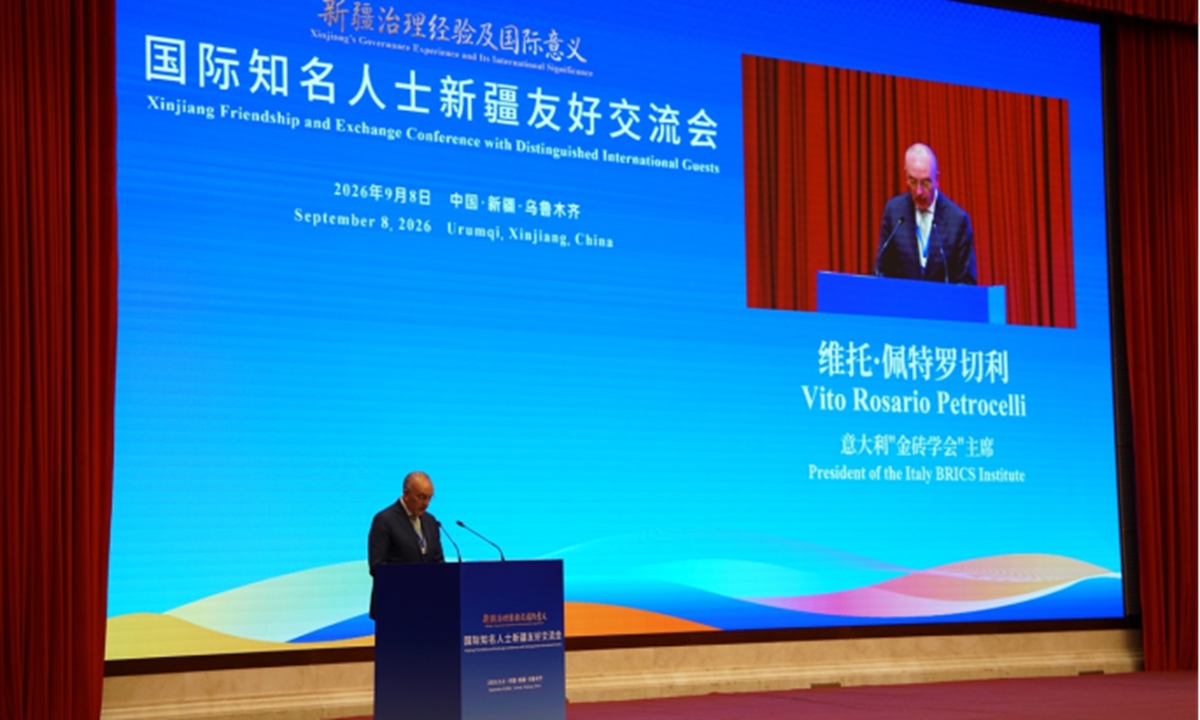
Vito Rosario Petrocelli, president of the Italy BRICS Institute, speaks during the Xinjiang Friendship and Exchange Conference with Distinguished International Guests on September 8, 2026 in Urumqi, Southwest China's Xinjiang Uygur Autonomous Region. Photo: Feng Fan/GT
After in-depth visits to multiple cities in Northwest China's Xinjiang Uygur Autonomous Region, foreign guests gathered in Urumqi on Tuesday at a friendship exchange conference, where they refuted biased "human rights" and groundless "forced labor" accusations against Xinjiang by some Western politicians and media outlets.
The event brought together over 300 government officials, business representatives, scholars and journalists from 33 countries, including the US, UK, Japan, Italy, Turkey and Germany. Representatives from organizations including the Shanghai Cooperation Organization and the International Labour Organization also attended.
The program took participants to multiple destinations within Xinjiang region, including Kashi, Ili, Aksu and Korla for direct exchanges with local residents and officials and firsthand understanding of the region, before they gathered in Urumqi for discussions.
The conference includes a main session and four parallel sessions covering human rights protection in counterterrorism and stability maintenance, ethnic unity and shared development, social governance and improvements in public wellbeing and opposition to unilateral sanctions and power politics.
Addressing European accusations over "human rights," Vito Rosario Petrocelli, president of the Italy BRICS Institute, said "the assessment of human rights must be based on evidence, transparency, the comparison of sources, and direct access to the places and people concerned."
"This is what Europe should be asking for. Not new automatic sanctions. Not new media campaigns. Not new ideological walls," he said.
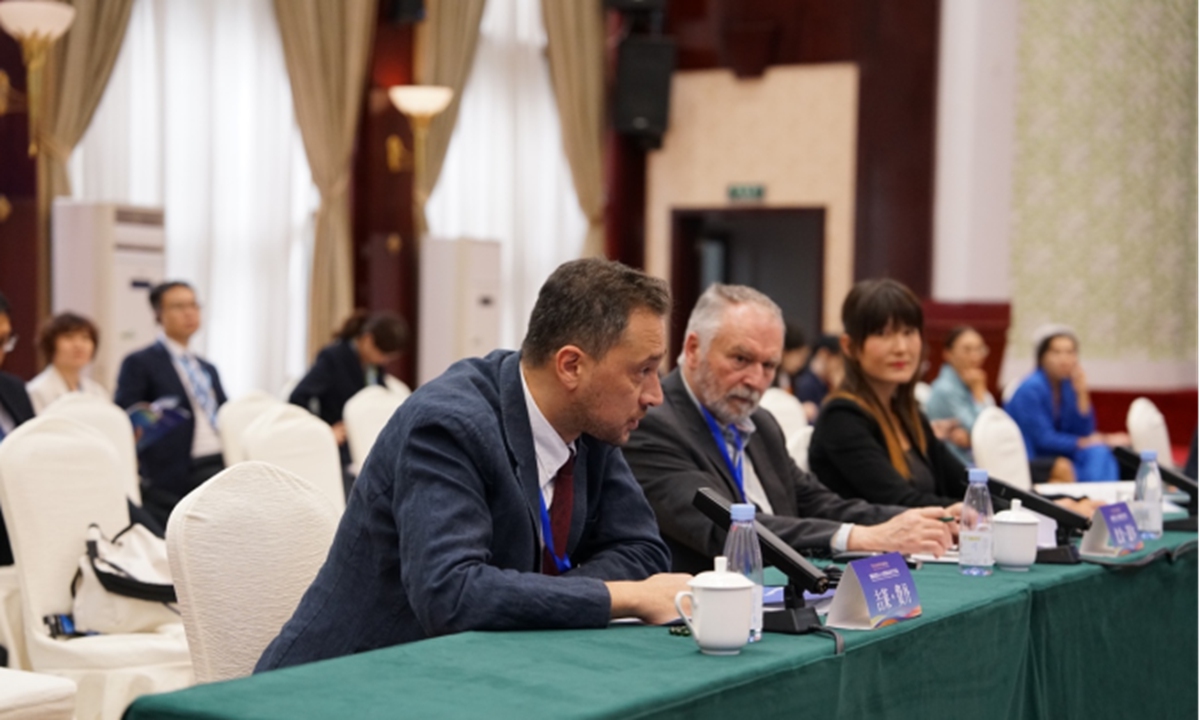
Giray Fidan, professor at Ankara Haci Bayram Veli University speaks during a parallel session titled "Social Governance and Public Wellbeing Improvement" on September 8, 2026 in Urumqi, Southwest China's Xinjiang Uygur Autonomous Region. Photo: Feng Fan/GT
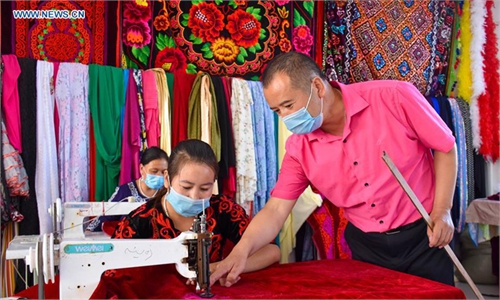
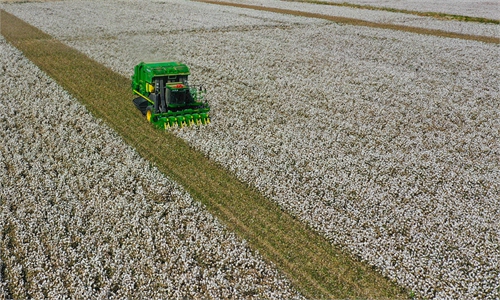
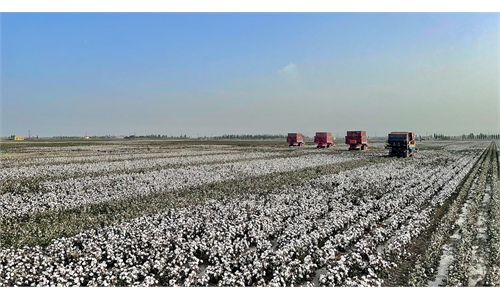
US scholar Barry Sautman drew on his latest research to challenge claims of so-called "forced labor" in Xinjiang propagated by some Western politicians and media outlets, describing them as a "distortion."
Sautman attributed the allegations to what he called a US-centered "anti-China industry," which he said uses cultural determinism to associate Chinese identity with autocratic and backward politics. These industries often assert, but never prove, claims about Xinjiang region's so-called forced labor, he said.
Sautman said 99.5 percent of Xinjiang's ethnic minority population lives and works within the Xinjiang region. Yet the narrative labels all 3.2 million people from Xinjiang who work away from their home villages as forced laborers, even though most still work within Xinjiang, he said.
Sautman also criticized the US' Uyghur Forced Labor Prevention Act (UFLPA), saying that it presumes all Xinjiang firms are guilty, while the US authorities refuse to accept evidence offered by Chinese companies showing that they did not use forced labor.
The UFLPA applies a rebuttable presumption that goods mined, produced, or manufactured wholly or in part in Xinjiang, or by an entity on the UFLPA Entity List, are prohibited from US importation, according to US Customs and Border Protection.
Sautman noted that the wrongful presumption had caused unemployment among Uygur workers and warned that the EU could follow the US approach.
Participants also discussed Xinjiang's development and opportunities for cooperation with the region.
Ng Chin Long, deputy secretary-general of the Malaysia-China Friendship Association, said China's policy support for Xinjiang region's opening-up was creating tangible opportunities for cooperation between China and Malaysia.
Ng cited Niqman Rafaee Mohd Sahar, minister counsellor for trade at the Malaysian Embassy in China, as saying that Malaysia hoped Xinjiang region would become its key partner in western China, while Malaysia could serve as an important gateway for Xinjiang region to expand into ASEAN markets.
Xinjiang is on a fast development track and it is China's fastest growing region in terms of foreign trade. According to figures released by Urumqi Customs, Xinjiang's foreign trade reached a record 520.37 billion yuan ($77.5 billion) in 2025, up 19.9 percent year-on-year, the fastest growth among China's provincial-level regions. The region has also established trade ties with 223 countries and regions by 2025, according to information published by Xinjiang's regional commerce department.
RELATED ARTICLES