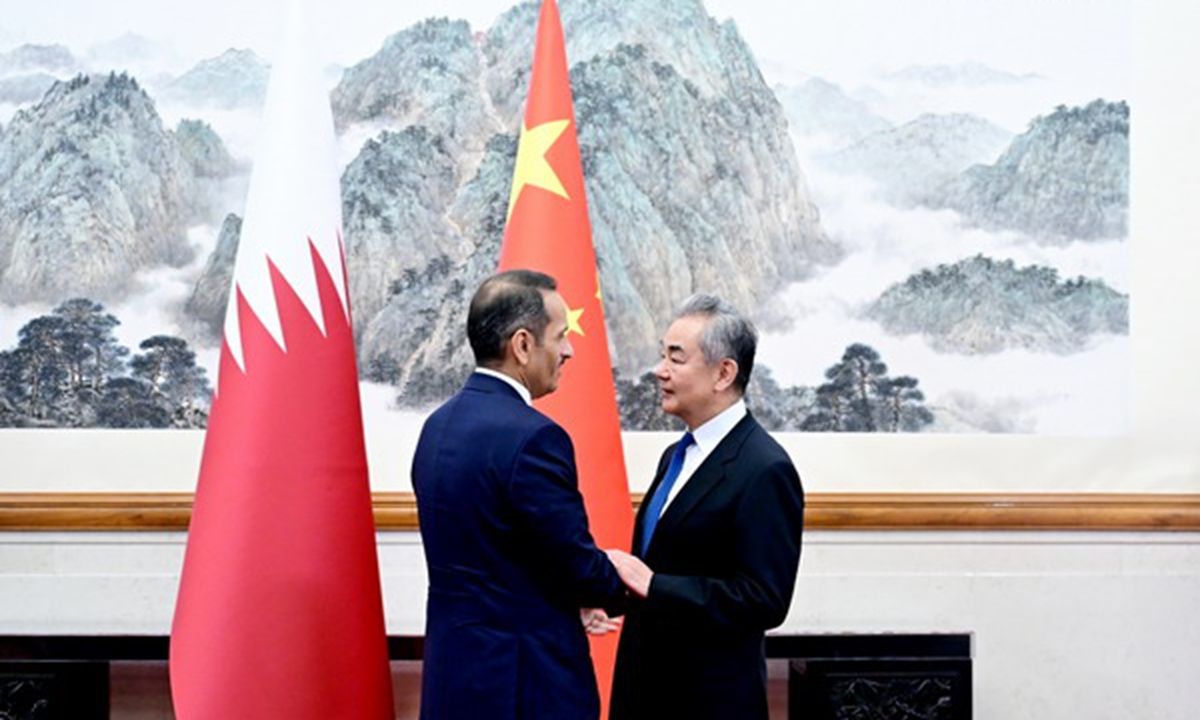
Chinese Foreign Minister Wang Yi (right) meets Qatari Prime Minister and Minister of Foreign Affairs Sheikh Mohammed bin Abdulrahman Al Thani in Beijing on Tuesday. Photo: Chinese Foreign Ministry
China is the most reliable and long-term partner in Qatar's development process, and is willing to maintain communication and cooperation with Qatar on international and regional affairs, Chinese Foreign Minister Wang Yi said on Tuesday during talks with visiting Prime Minister and Minister of Foreign Affairs of Qatar Sheikh Mohammed bin Abdulrahman Al Thani in Beijing, the Xinhua News Agency reported.
Wang, also a member of the Political Bureau of the Communist Party of China (CPC) Central Committee, said that in recent years, under the strategic guidance of the leaders of the two countries, the China-Qatar strategic partnership has made considerable progress.
Noting that China firmly supports Qatar in safeguarding its national sovereignty, independence, security and stability, Wang expressed the belief that Qatar will continue to offer firm support on issues concerning China's core interests.
Al Thani said Qatar firmly adheres to the one-China principle and opposes external interference in China's internal affairs, and is willing to enhance communication and coordination with China under the United Nations and other frameworks, safeguard multilateralism, and promote international peace and common development, per Xinhua.
Al Thani said Qatar would give priority to ensuring energy supplies to China and support the series of global initiatives proposed by China, according to Xinhua.
Qatari prime minister's visit comes as tensions remain high in the Middle East and Gulf countries face unprecedented security challenges, reflecting that the old model of relying mainly on the US for security protection is facing serious challenges, Tian Wenlin, a professor at the School of International Studies at the Renmin University of China, told the Global Times on Tuesday.
Regional countries are beginning to seek more independent and diversified security arrangements, while also expecting China to play a greater role in promoting peace and stability. China's clear commitment to advancing peace and development in the Middle East is also an important reason why regional countries are showing growing trends to "look East" and willing to strengthen communication and cooperation with China, Tian noted.
Qatar has long played an active diplomatic role in regional affairs, yet the prolonged conflicts in the Middle East have constrained the mediation space of Gulf countries. Regional security, including that of the key energy shipping routes, remains high on Qatar's agenda. Against this backdrop, Qatar, relying heavily on energy exports, is sending a signal of goodwill by prioritizing supplies to China, which reflects the growing importance it attaches to the Chinese market and cooperation with China, the expert said.
China has recently proposed a four-point proposal on building a new security architecture in the Middle East via upholding a vision of common, comprehensive, cooperative and sustainable security, which could help the region move forward in achieving sustainable peace and stability, the expert said.
Qatar has pursued a flexible and diversified foreign policy and attaches great importance to strengthening engagement with China, supporting China's four global initiatives and other proposals. Together with its long participation in the Belt and Road Initiative, it reflects Doha's willingness to further deepen cooperation with China, Tian said.
During the talks, Wang also called on the two sides to consolidate and expand cooperation in traditional and new energy, and strengthen cooperation in investment, high technology and people-to-people exchanges.
China and Qatar enjoy fruitful bilateral economic and trade cooperation. China is Qatar's largest trading partner. In 2025, trade between China and Qatar reached $23.812 billion, with China's exports totaling $5.542 billion and imports reaching $18.27 billion. In the first quarter of 2026, bilateral trade stood at $5.11 billion, including $1.19 billion in Chinese exports and $3.92 billion in imports. Qatar is China's second-largest source of liquefied natural gas (LNG) imports. In 2025, China imported 19.438 million tons of LNG from Qatar, according to Chinese Foreign Ministry.
Tian noted that cooperation between China and Gulf countries including Qatar is no longer limited to traditional energy trade, but is expanding into new areas such as high technology, the digital economy, cloud computing and new energy.
Gulf countries are seeking greater economic diversification, while China has technological and industrial strengths in relevant fields, creating strong complementarity for further cooperation, Tian noted.