Xi holds phone talks with British PM
Remarks suggest UK is seeking greater stability in China policy: expert
By , Shen Sheng and Sun Langchen Published: Sep 09, 2026 12:27 AM

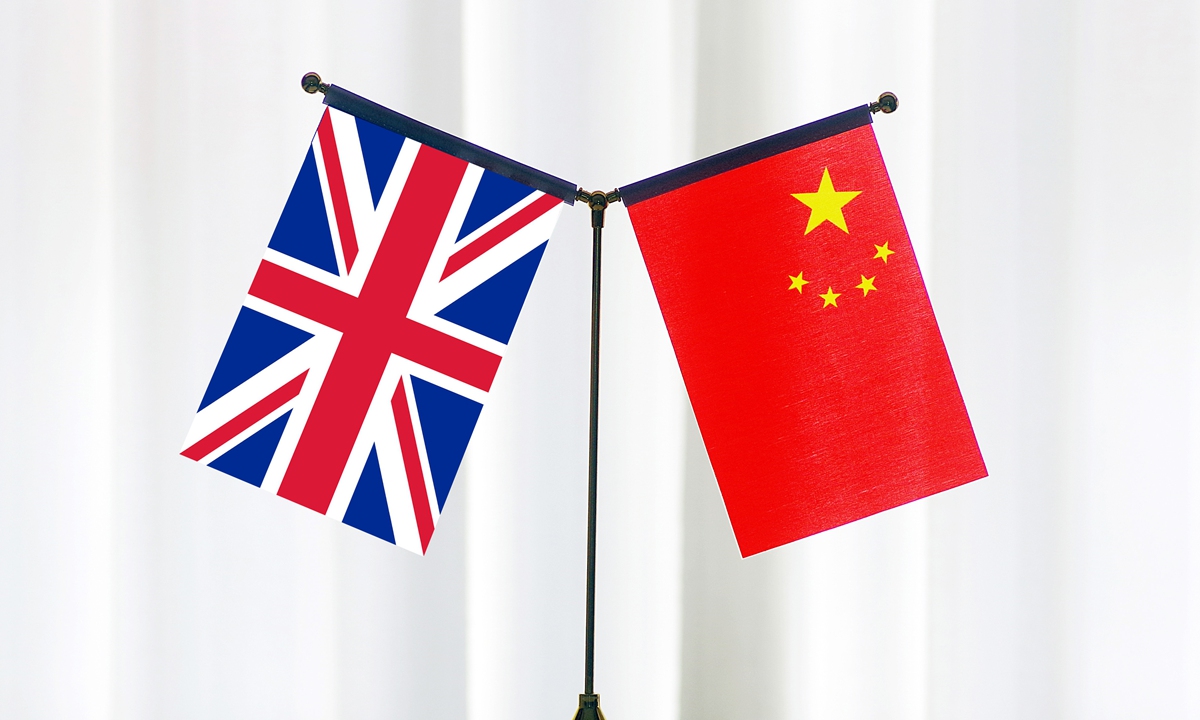
The Chinese and British flags Photo: VCG
Chinese President Xi Jinping on Tuesday held phone talks with British Prime Minister Andy Burnham. Xi congratulated Mr. Burnham on taking office as UK Prime Minister. He noted that China and the UK enjoy a comprehensive strategic partnership. Despite having different social systems and national conditions, China and the UK have more common interests than disagreements, according to an official readout from the Chinese Foreign Ministry.
The two sides should respect and trust each other, rise above disagreements, find common ground, and broaden the agenda of mutually beneficial cooperation. With a shared commitment to growing the economy and improving living standards, the two governments can complement and reinforce each other's efforts, Xi said, according to the readout.
As permanent members of the UN Security Council and the world's leading economies, both China and the UK support multilateralism and open trade, and uphold the central role of the UN. The two countries need to strengthen communication and coordination in the UN, G20 and WTO, and work together to advance an equal and orderly multipolar world and a universally beneficial and inclusive economic globalization, Xi said, the readout showed.
During the phone talks, Burnham emphasized that the UK will maintain consistency in its China policy and be steadfast in building the long-term and consistent strategic partnership with China. The UK will pursue high-level interactions with China, take forward various areas of cooperation, strengthen people-to-people ties, and take the relationship to strong levels not seen before for the benefit of people in both nations, the readout showed. Burnham also said the UK's position on the Taiwan question is unchanged.
Pragmatic relations
In July, Burnham became Britain's seventh prime minister in a decade. Burnham in the phone talks also noted his long-standing connection with China as mayor of Greater Manchester. He recalled President Xi's visit to the city as part of his State Visit to the UK in 2015 and the impact it had on Manchester's ties with China.
China and Britain opened up a "golden era" in 2015, with bilateral relations at one point serving as a driver of China-Europe relations. After Brexit, however, British policy toward China became increasingly volatile, shaped by strategic anxiety, domestic anti-China forces and US influence. Despite this, economic, trade and financial ties have remained resilient, creating a pattern of "cool politics but resilient economic ties," Zhao Junjie, a senior research fellow at the Institute of European Studies at the Chinese Academy of Social Sciences, told the Global Times on Tuesday.
The Keir Starmer government began correcting course and steering China policy back toward pragmatism, and Burnham's positive remarks after taking office have continued this direction, Zhao said.
The UK side's remark that it would maintain consistency in its China policy shows that it seeks to preserve the fundamentals of the previous China policy, while also indicating Britain's intention to expand its diplomatic room for maneuver and enhance its strategic autonomy, the expert noted.
Britain will maintain a "pragmatic relationship" with China on trade while navigating the "sensitive" issue of how to reduce global imbalances, Chief Secretary to the UK Treasury Emma Reynolds said on September 1, Reuters reported.
China's Ministry of Commerce (MOFCOM) in July voiced strong opposition to the UK government's nationalization of British Steel, a subsidiary of China's Jingye Group, criticizing the move as undermining Jingye Group's legitimate rights and interests and severely damaging Chinese companies' confidence in investing in the UK, while pledging to take strong measures to safeguard their lawful interests.
During the phone talks, Xi said it is hoped that the UK will fully protect the lawful rights and interests of Chinese investors, according to Chinese Foreign Ministry's readout.
"The key to improving bilateral ties will be reducing political and media interference and focusing on high-level engagement and mutually beneficial cooperation," Zhao told the Global Times.
Future cooperation
"Burnham's remarks during the phone talks also suggest that the UK is seeking greater stability in its China policy, while further promoting economic and trade cooperation," Li Guanjie, a research fellow with the Shanghai Academy of Global Governance and Area Studies under the Shanghai International Studies University, told the Global Times on Tuesday.
Britain remains deeply embedded in the US-led Western security framework while seeking to improve ties with the EU and maintain strategic autonomy. Amid economic growth pressures and shifts in global trade and supply chains, it is difficult for the UK to overlook China's importance in trade, investment, finance, technology and global governance, Li noted.
As China-Europe and China-UK relations undergo a period of recalibration, maintaining pragmatic engagement with China could help Britain expand its economic and diplomatic space, the Chinese expert continued.
It could also enable the UK to play a more independent bridging and coordinating role between Europe and the US on one side and China on the other, he said.
In the years ahead, China-UK relations are likely to see competition and cooperation coexist, Zhao said, noting that political mistrust and occasional frictions will remain, but there is still considerable room for cooperation in areas including green finance, biomedicine, advanced manufacturing, the digital economy and basic research.
RELATED ARTICLES