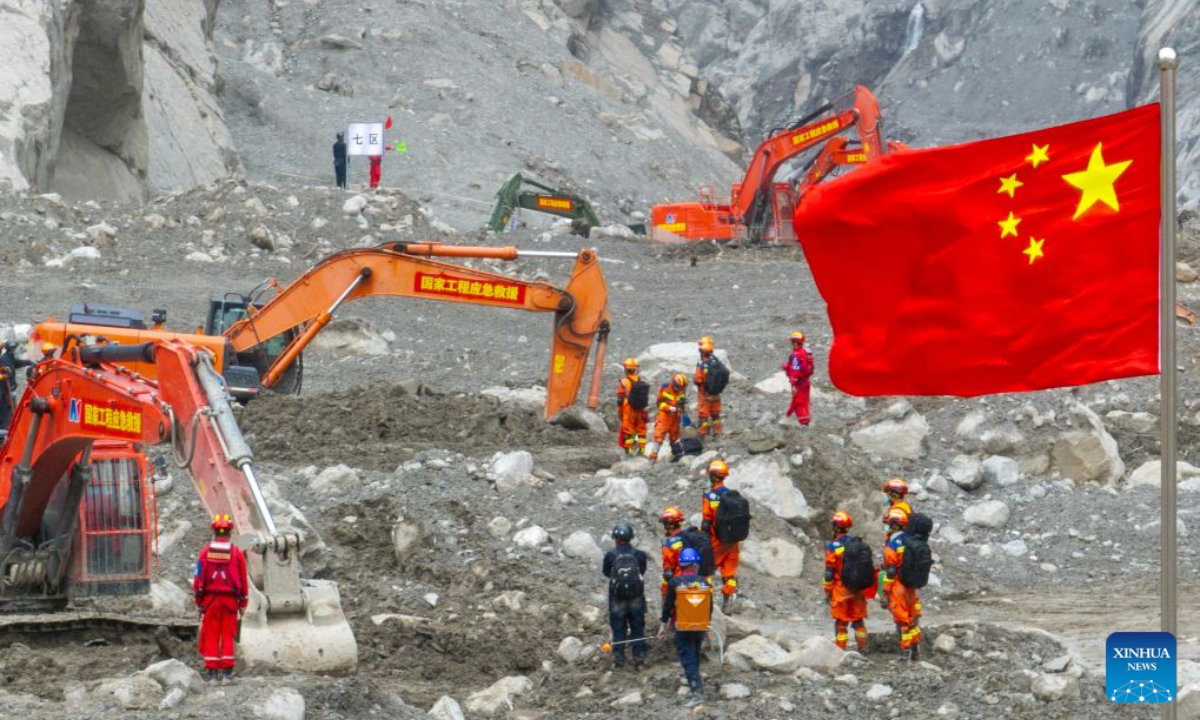
A drone photo taken on September 6, 2026 shows rescuers working at the core affected zone of the mudslide-hit Gyirong Port in Southwest China's Xizang Autonomous Region. Photo: Xinhua
Relying on a Nepal-customized version of China's intelligent meteorological early warning system MAZU and a climate forecasting model FengShun, China's National Climate Centre (NCC) has been providing information to support post-disaster rescue and relief efforts in Nepal, China Meteorological Administration (CMA) announced on Wednesday.
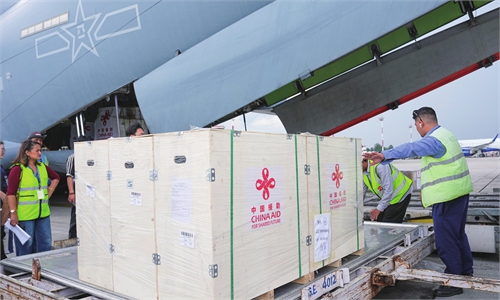
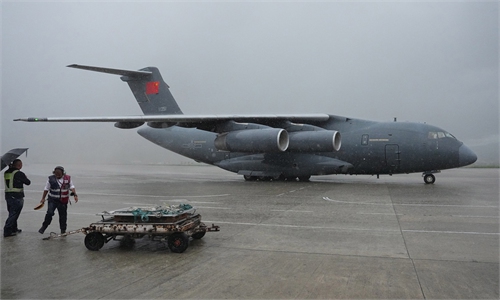
A high-altitude ice-rock avalanche on Nepal's side on August 26 triggered a cross-border debris flow, causing significant casualties and leaving many people missing. In response, the CMA quickly established a dedicated task force for emergency meteorological support services, the CMA said in a statement.
The NCC activated an emergency response, actively providing Nepal with a range of meteorological products through MAZU, China's homegrown AI-powered meteorological early warning system, while providing rolling climate analyses and extended-range climate forecast products to support post-disaster rescue efforts in Nepal, according to the CMA.
Under the unified coordination of the CMA, the NCC has been providing Nepal with two categories of products on a rolling basis - climate monitoring and climate forecasting - based on the Nepal-customized version of MAZU.
For climate monitoring, the NCC dynamically produces five types of routine monitoring products, covering factors including temperature, precipitation and soil drought, as well as 10 climate indices, including the El Nino-Southern Oscillation (ENSO) and the Madden-Julian Oscillation (MJO).
For climate forecasting, the NCC relies on AI-based FengShun climate system model that provides 60-day global daily forecasts for 29 critical variables across atmospheric, oceanic, terrestrial, and cryospheric domains, to provide Nepal with 60-day daily temperature and precipitation forecasts, as well as forecasts of climate events such as El Nino-Southern Oscillation.
The NCC is also making full use of the role of the Third Pole Regional Climate Center to actively respond to Nepal's needs. Since August 28, it has been providing Nepal with rolling 15- to 30-day extended-range climate trend forecasts, offering meteorological support for post-disaster rescue efforts in Nepal.
Global Times
RELATED ARTICLES