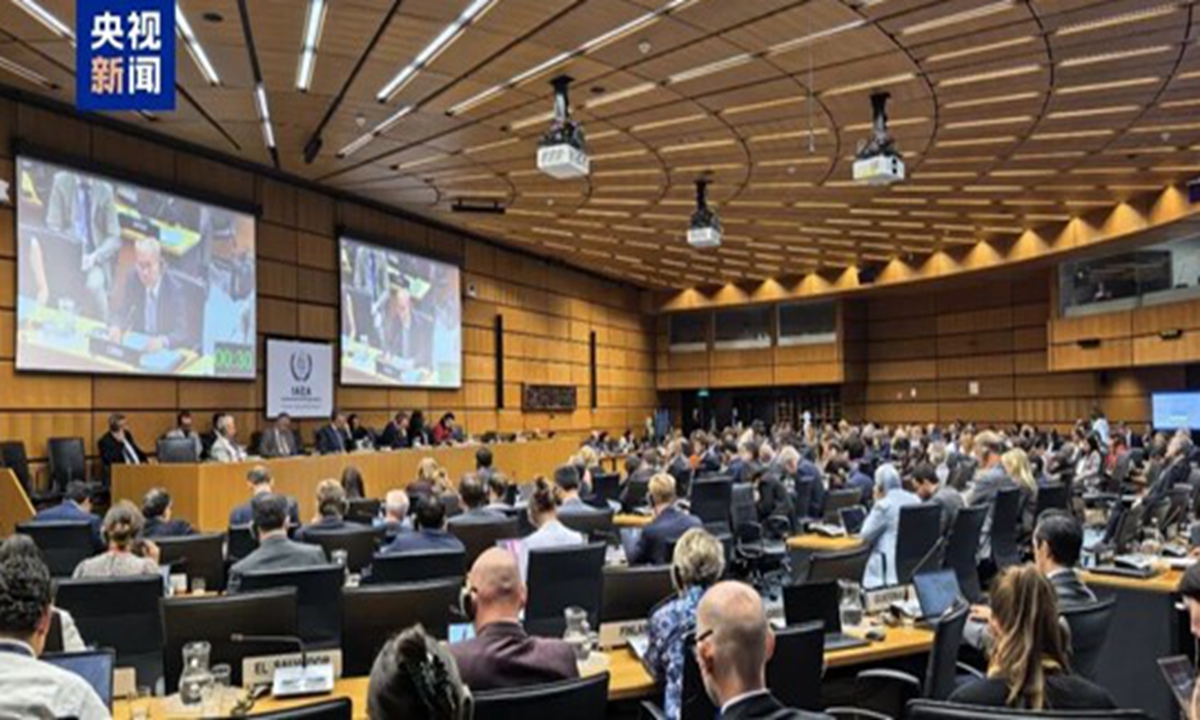
Screenshot from CCTV News of Chinese Ambassador Li Song, China's permanent representative to the IAEA, delivering remarks outlining China's position to reject a draft resolution at the International Atomic Energy Agency (IAEA) Board of Governors
China on Wednesday opposed a US-pushed International Atomic Energy Agency (IAEA) resolution on Iran, warning that political confrontation and pressure would only aggravate tensions and calling for a return to dialogue. The Chinese representative to the IAEA said the US and Israel have twice carried out military strikes on Iran's peaceful nuclear facilities under IAEA safeguards, which is the root cause of why cooperation between Iran and the IAEA has yet to return to normal. China will continue making unremitting efforts to promote a political settlement of the Iranian nuclear issue and contribute to peace and stability in the Middle East.
The Board of Governors of the IAEA had approved a resolution reporting Iran to the United Nations Security Council for breaching its "non-proliferation obligations." The move marks the first time in 20 years that the board has taken such a step. It also marks an escalation in the ongoing diplomatic standoff between Iran and Western nations, according to Al Jazeera.
The US and its European allies, including France, Germany and the United Kingdom, had lobbied the UN nuclear watchdog's board members in recent days to pass the resolution, Al Jazeera reported.
During the meeting on Wednesday, IAEA member states engaged in heated debate before adopting a resolution on Iran jointly pushed by the US, Britain, France and Germany. Of the 34 Board members eligible to vote, China, Russia and Niger voted against the resolution, while eight developing countries, including Brazil, South Africa, India, Egypt and Thailand, abstained, according to CCTV News.
Chinese Ambassador Li Song, China's permanent representative to the IAEA, delivered remarks outlining China's position. Li said that since June last year, the US and Israel have twice carried out military strikes on Iran's peaceful nuclear facilities under IAEA safeguards, creating serious obstacles to safeguards cooperation between Iran and the agency and dealing a severe blow to the Nuclear Non-Proliferation Treaty (NPT) regime.
He said the strikes were the root cause of why cooperation between Iran and the IAEA has yet to return to normal.
Li stressed that political confrontation at the Board of Governors cannot resolve the Iranian nuclear issue, that forcing through resolutions would only aggravate tensions, and that referring the issue to the UN Security Council offers no way forward. The history of the Iranian nuclear issue has fully demonstrated that a political and diplomatic solution is the only viable way forward, he said.
Li noted that the phased memorandum of understanding signed by the US and Iran in June was a valuable outcome of mediation efforts by multiple parties. "Now that the door to negotiations has been opened, it should not be closed. As long as there is hope for peace, it should not be abandoned," he said. The priority, he added, is to de-escalate the situation and return to dialogue and negotiations.
Global Times
RELATED ARTICLES