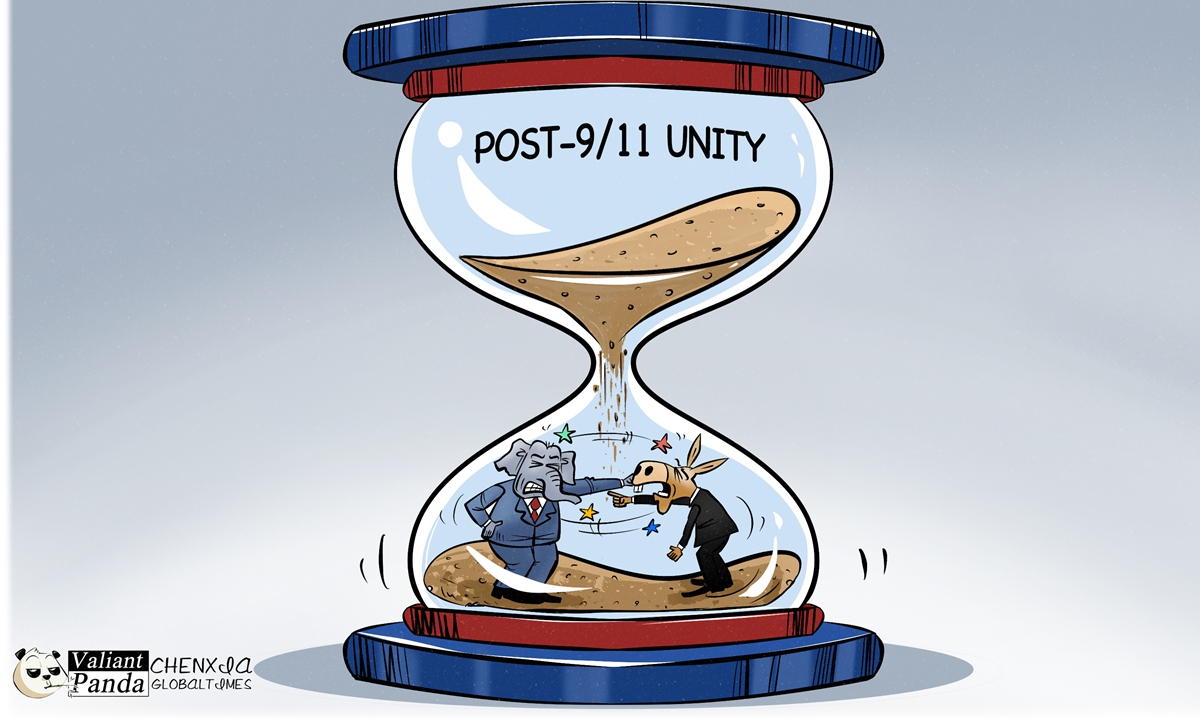
post‑9/11 unity Illustration: Chen Xia/GT
"Now, 25 years after 9/11, can American politics again find the kind of unity that was felt immediately afterward?" This rhetorical question posed recently by The Wall Street Journal touches on a thought-provoking paradox in the evolution of US politics. In the immediate aftermath of the 9/11 attacks, US society displayed a rare sense of national unity. Yet, this consensus, forged by crisis, has gradually evolved into a major source of political division over the subsequent more than two decades. Explaining this trajectory from unity to division is key to understanding contemporary US politics.
It should be noted that the sense of unity following the "9/11" attacks was genuine and intense. At a time when the external threat was crystal clear and the casualties and shock were all too real, national security took precedence over everyday political differences in the US.
Yet the turning point came down to one core question: How should the US fight terrorism? As the Afghan war dragged on, and especially after the Iraq War began, that early national consensus started to fall apart.
The Democrats and the Republicans grew sharply divided over many key matters: whether the wars were justified and necessary, renewing the Patriot Act or not, how far mass surveillance should go, and how much power the president should hold after the homeland security system expanded. Republicans prioritized security, while Democrats stressed civil freedom and procedural protections.
Over time, the war on terror stopped being a shared national aim. Instead, it became a powerful tool for election campaigning, political wrangling between the White House and Congress, and courtroom battles.
This shift grew more pronounced over the next decade. Disputes ranged from the Obama‑era tussle over closing the Guantanamo Bay detention camp, to fierce fights over NSA surveillance powers after the Snowden leaks, and continuing clashes over immigration screening and travel bans. At the heart of every debate lies a timeless US political dilemma: Should security or freedom come first? Where is the boundary of executive power? How far may the federal government limit personal freedom in the name of public security?
It can be said that the consensus itself has not disappeared; no one in US society has ever publicly denied the necessity of counterterrorism. What remains unresolved is the means by which that consensus can be achieved.
US politics cycles between crises and normal times. During a crisis, when most people see a clear foreign threat, the urge to keep government power in check temporarily fades. And national unity quickly takes shape. The US mobilization after the attack on Pearl Harbor during World War II, as well as cross‑party solidarity right after 9/11, both fit this pattern.
Yet once the crisis eases, Americans fall back to their long‑standing instinct to guard against government overreach. Public trust and willingness to grant the government broad power drop as a result. Seen this way, the fading of post‑9/11 national unity is not so much a collapse of unity as a return to ordinary US political life - a shift away from an extraordinary moment back to business‑as‑usual.
9/11 did not start America's polarization, yet it acted as a major trigger that magnified and sped up existing rifts.
For one thing, the heavy human, financial and moral toll from two long‑drawn‑out wars slowly wore down public faith in the government's judgment and competence. Americans kept questioning whether the government deserved expanded power. For another, constant partisan fights over security policy strengthened voters' partisan loyalties and emotional splits. Disputes once rooted in policy slowly turned into clashes over values and trust.
Counter‑terrorism itself did not create polarization. Still, it kept feeding new issues that deepened divides and sped up growing public distrust in government.
Today, 25 years after 9/11, shifting views on counter‑terrorism represent not some unusual chapter, but a recurring pattern. When a foreign threat is clear, Americans can rapidly pull together. Yet once the threat becomes long‑term and embedded in policy, the age‑old tensions between security and freedom, and between governmental empowerment and checks‑and‑balances, retake center stage in politics. Without another major external crisis that unites most Americans, recreating the post‑9/11 national mood of unity is unrealistic and inconsistent with how US politics functions.
The author is a professor at the Center for American Studies, Fudan University. opinion@globaltimes.com.cn
RELATED ARTICLES