EU’s procurement act reportedly targets China
Protectionist, discriminatory move won’t solve bloc’s problems: experts
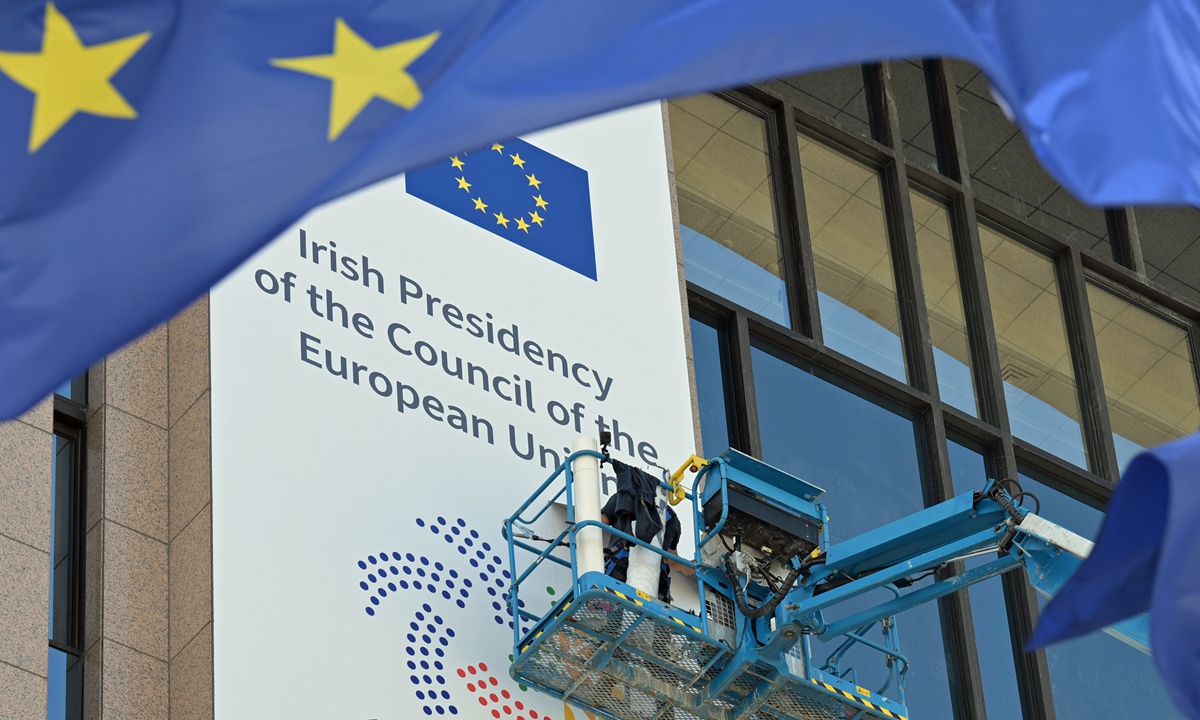
Workers hang a new banner on the Justus Lipsius Building in Brussels, Belgium, on July 1, 2026, to mark the start of Ireland's EU Council presidency. The Council presidency changes every six months, and Cyprus previously held the presidency. Photo: VCG
The European Commission on Wednesday proposed new public procurement rules that would allow public buyers across the EU to restrict or reject bids from suppliers based in countries not covered by the bloc's procurement agreements, a group that includes China. Chinese experts said that the move represents a further escalation of the EU's trade protectionism.The proposed Public Procurement Act does not name any country, but the stakes are high: public procurement accounts for about 15 percent of the EU's GDP. The proposal still needs the approval of the European Parliament and member states.
"This is undoubtedly a protectionist measure, and it certainly runs counter to the basic principles and spirit of the World Trade Organization," Jian Junbo, director of the Center for China-Europe Relations at Fudan University's Institute of International Studies, told the Global Times on Thursday.
"Specifically targeting certain countries and then defining certain categories is certainly discriminatory," Jian said.
European media reports have widely framed the move as aimed at China. Stéphane Séjourné, the commission's vice president, told a press conference that "a municipality will be very clearly able to exclude a Chinese company or a European company that offers Chinese products," according to a report by Euronews.
Séjourné also told reporters that "it won't be the European Commission's fault if purchasers were to prefer Chinese buses to European buses because … in the [draft regulation] there is every possibility to give preference to European buses," The Guardian reported.
Chinese companies are strongly opposed to any measures that would exclude or restrict third-country companies from participating in EU public procurement on the basis of so-called non-market factors, such as the country of origin of the company, including where such measures are justified on grounds of economic security or reducing supply chain dependencies, a Chinese business chamber in Europe said on Wednesday.
The China Chamber of Commerce to the EU (CCCEU) made the remarks in response to the commission's proposal. "…public procurement should not discriminate against suppliers or goods on the basis of the supplier's nationality or the country of origin of the goods," the CCCEU noted.
Under the proposal, only companies and products from parties to the World Trade Organization's Government Procurement Agreement or from countries with relevant trade deals with the EU will count as "covered," a category China falls outside, according to the proposed rule.
Séjourné confirmed that UK and US products could be treated like European ones, but Chinese ones could not, German news outlet Handelsblatt reported.
Public buyers could restrict or reject bids from non-covered companies and turn down tenders with less than 50 percent EU or covered content, meaning that European firms using Chinese components could also be affected. The commission could also make such measures mandatory in the EU's interest, citing rail and shipbuilding as examples, the document says.
"Although China was not mentioned on some occasions, their so-called standards and requirements are all aimed at Chinese companies," Li Yong, a senior research fellow at the China Association of International Trade, told the Global Times.
The proposal is the latest potential move of EU targeting China, following countervailing duties on Chinese-made electric vehicles in 2024, and a ban on Chinese firms in large medical device tenders under the IPI in 2025.
The procurement proposal will also work alongside the Industrial Accelerator Act (IAA), which the commission unveiled in March to introduce "Made in Europe" requirements in public procurement and subsidies for sectors such as energy-intensive industries, automobiles and clean technologies. The IAA, which also drew criticism from China, is still being negotiated by the European Parliament and member states.
"China-EU trade relations are highly complementary. The EU cannot shift the blame for its own market and industrial problems onto China," Li said.
Jian said that the move would leave EU firms lacking international competition, hurting the bloc's competitiveness in the long run. "They could have bought more and better goods for less money by buying Chinese products, but now ordinary people have to spend more. This will invisibly squeeze their welfare or increase their tax burden," he said.
Member states are also divided. In December 2025, nine member states — the Czech Republic, Estonia, Finland, Ireland, Latvia, Malta, Portugal, Sweden and Slovakia — warned that the mechanism could weigh on effective competition and on price and quality levels, French financial news website France Épargne reported on September 7. Poland and the Netherlands supported calls for an impact assessment, while France and Germany backed targeted preference in strategic sectors.
Li also noted that the EU has followed the US in restricting exports to China. "You cannot, on the one hand, restrict or ban exports to China, and on the other hand complain that China buys too little and that there is a deficit. This is a logical contradiction that none of their high-sounding reasons can explain," he said.
RELATED ARTICLES