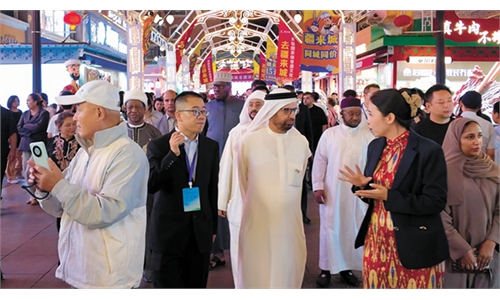
Performers in traditional costumes dance as musicians play traditional music at the Ancient City of Kashi scenic area in Kashi, Northwest China's Xinjiang Uygur Autonomous Region, on April 24, 2026. Photo: VCG
Beside a sprawling convention center, hundreds of workers are busy putting the finishing touches to a new city landmark: a Ritz-Carlton hotel under Marriott International. The same tower, currently under construction, will also house a Westin hotel under the US-headquartered global hotel chain.A few kilometers away, another construction site is taking shape for an InterContinental hotel, a brand of the UK-based InterContinental Hotels Group (IHG).
If asked to guess the location, many people might name Dubai, Singapore or some other metropolises. But the answer is Urumqi, Northwest China's Xinjiang Uygur Autonomous Region - a place that has suffered repeated groundless accusations from some Western politicians and media over so-called "human rights" violations and "forced labor." At the same time, international hotel groups and investors from the US, the UK and elsewhere are expanding their presence in the region to tap into its fast-growing tourism market.
Luxury destination
Xinjiang was not traditionally a major destination for international luxury hotel chains; however, the picture is changing quickly.
Public information shows that Urumqi is developing a hotel cluster and business-travel complex that will include the Ritz-Carlton, as well as InterContinental and Westin hotels. The projects will join existing Conrad, Hilton and Wyndham properties in the city.
The trend is even more visible in other parts of Xinjiang. In Hemu village, a popular ski destination in the northern Altay region, Conrad and Hilton hotels opened in 2025. A new Hotel Indigo is expected to open there during the upcoming ski season.
For years, the area had mainly offered guesthouses converted from local homes and a small number of affordable chains operated by local companies.
In Kashi, southern Xinjiang, a cluster including InterContinental, Crowne Plaza and HUALUXE hotels is also taking shape. The city, known for its long history and rich ethnic cultures, is seeing a wave of modern construction alongside old neighborhoods.
The expansion by overseas hotel brands comes as some politicians and media in the US and other Western countries have renewed attacks on Xinjiang. The US in July added a large number of Xinjiang companies to the so-called "Uyghur Forced Labor Prevention Act (UFLPA) Entity List," barring goods associated with listed entities from entering the US market.
US scholar Barry Sautman told the Global Times that investor may first hesitate for fear of those smears causing reputational risks. The hype and reports would force investors to conduct investigations to verify whether there is "forced labor" in the region, he said.
"There's absolutely no evidence of systematic forced labor in Xinjiang," Sautman said. "Therefore, they can go ahead and invest with not only a clear conscience but with an ability to defend themselves if somebody does accuse them of complicity in the international crime of forced labor because they've already taken the time to investigate."
Foreign investors have made their choices, as international brands have continued to enter Xinjiang despite the unfounded accusations from the West. According to Xinjiang authorities, the region registered a 21.97 percent year-on-year increase in newly established foreign-funded enterprises in 2025, while the actual use of foreign investment rose 9.8 percent.
A clearer investment picture has also emerged from companies' public disclosures. Local media reported that Goldman Sachs, Morgan Stanley, UBS, Barclays and Merrill Lynch International had appeared among the top 10 shareholders of several Xinjiang-listed companies. Together, the institutions recorded more than 20 new shareholding entries.

A mixed-use facility is under construction on September 8, 2026 in Urumqi, Northwest China's Xinjiang Uygur Autonomous Region. It is about to house the Ritz-Carlton and Westin hotels. Photo: Feng Fan/GT
Booming tourism and hiring
The reason behind the construction and investment boom is that Xinjiang is receiving more visitors and on a fast track of development.
According to regional authorities, Xinjiang received 323 million tourist visits in 2025, generating 370 billion yuan ($51.8 billion) in tourism spending. The two figures rose 8 percent and 8.4 percent year on year, respectively, both setting new records.
The region's international links have also grown. Customs statistics from Urumqi Tianshan International Airport showed that the airport handled 721,400 inbound and outbound passenger trips during the first seven months of this year, up 30.28 percent year on year. International passenger flights reached 5,411, an increase of 21.79 percent, the statistics showed.
Xinjiang's major tourism destinations are separated by long distances. As more travelers visit the region, many are returning for a second or third trip. Some who once tried to cover several attractions during a short stay are now choosing to remain in one place for longer and explore it more deeply, Jiang Yiyi, a tourism and sports expert at Beijing Sport University, told the Global Times on Wednesday.
That shift is helping Xinjiang move toward "slow tourism" and creating more room for resort travel and local consumption, Jiang said.
The changing tourism market is also influencing career choices among young people. Teachers and students at Kashi Technician College told the Global Times that the city's fast-growing tourism industry has drawn more students toward tour-guide and hotel-related majors.
Several students studying relevant subjects told the Global Times that they chose the fields after seeing more tourists arrive in Kashi. The growing number of visitors is creating stronger demand for tourism workers and making it "easier to find jobs," they said.
According to the Xinhua News Agency, Xinjiang's culture and tourism industry drove more than 1 million person-times of employment in 2025.
A separate 2030 target in a development plan released by the regional culture and tourism authorities calls for more than 1.5 million people to be employed in the sector.
The plan also sets a target for the added value of the culture, tourism and related industries to account for 10 percent of the region's gross domestic product, with annual tourist visits exceeding 400 million and per-capita tourism spending surpassing 1,300 yuan.
"As more international hotel groups increase construction in the region and more cultural and tourism investment enters Xinjiang, more skilled workers and talent can find jobs locally, earn higher incomes and contribute to the development of the Xinjiang region," Jiang said.
RELATED ARTICLES