China’s share of global computing capacity likely to reach 30% by 2030: academician
By Published: Sep 13, 2026 05:03 PM

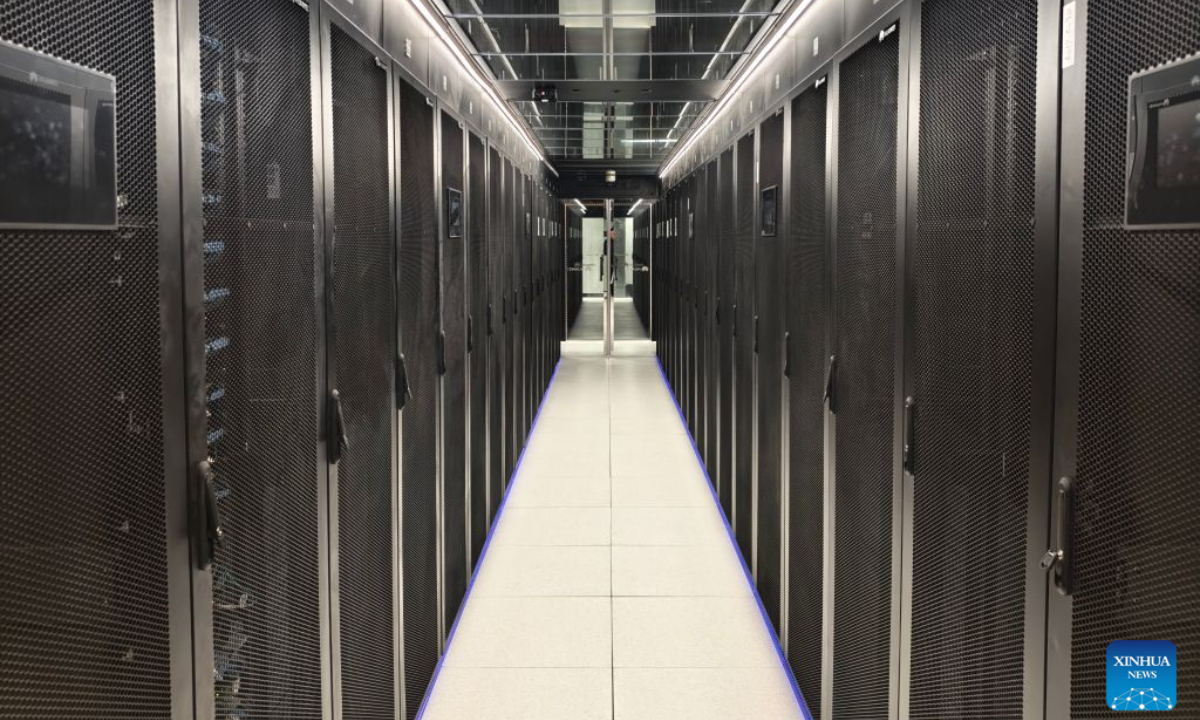
This photo shows devices at Lichuan AI Computing Center in Lichuan City, Enshi Tujia and Miao Autonomous Prefecture, central China's Hubei Province, March 11, 2025. (Xinhua/Zhang Yang)
China's share of global computing capacity is expected to reach 30 percent by 2030, and currently, the country accounts for 21 percent of global computing capacity, compared with 46 percent for the US, Wu Hequan, an academician of the Chinese Academy of Engineering, said at a forum over the weekend.
The comment was made at the main forum of the 2026 China Computing Power Conference, which ran from Friday to Sunday in Langfang, North China's Hebei Province.
China's domestic demand for computing power has experienced explosive growth amid the rapid development of artificial intelligence (AI)-related models and innovative applications. China has listed the construction of a computing power network - which connects computing facilities scattered across the country into a single network - as one of the "six networks" under the 15th Five-Year Plan (2026-30).
A report released by the China Telecom Research Institute on Saturday predicted that China's annual token consumption will reach 100 quadrillion in 2026 and exceed 35 quintillion by 2030, translating to a compound annual growth rate of nearly tenfold. The surging demand comes as the focus of the AI industry shifts from "competition over large models and computing power to the massive deployment and commercialization of intelligent agents," the report noted.
Rao Shaoyang, director of the Institute of Industry and Enterprise Strategy at China Telecom Research Institute, told China Central Television that China's demand for computing power is projected to grow nearly tenfold annually on average during the next two to three years. In terms of structure, demand for inference computing will far outpace that of training, with inference expected to account for 80 percent of China's computing power market by 2029.
In March, China's token use reached 140 trillion a day. "As technology advances, token consumption should not be judged by volume but by efficiency," Wu said, noting that falling application costs in China have inspired greater token use, the Securities Times reported.
Industry insiders said that China has built a relatively solid comprehensive foundation for computing power - a critical edge in the global AI competition, as token demand from intelligent agents drives demand for computing power and inference is set to dominate the market.
At the 2026 Computing Power Conference, He Baohong, chief engineer of the China Academy of Information and Communications Technology, cited statistics showing that the growth of China's comprehensive computing capacity has been accelerating.
In terms of computing power, the scale of intelligent computing was up 177 percent year-on-year as of the end of June. In terms of storage capacity, the total was about 11 percent higher than in 2025. In terms of network capacity, a three-tier high-speed computing network with one-, five- and 20-millisecond latency tiers is taking shape.
Regarding model applications, filings for generative AI services were 32 percent higher than at the end of 2025. These figures show that China has already built a relatively solid comprehensive foundation for computing power, He told the People's Posts and Telecommunications News.
On the sidelines of the conference, some of China's leading tech companies showcased their latest innovative products in computing network development.
China Mobile, one of the country's top telecom operators, said in a statement sent to the Global Times on Sunday that the company has built a full-stack computing-network foundation so as to forge "an independently controllable computing base."
For example, the company's computing-network brain - as the scheduling hub of the computing-power network - has been upgraded through the three-way coordination of computing, networking and electricity. It not only enables day-level onboarding of heterogeneous computing resources, but also drives network-wide distribution of models and intelligent agents, the company said.
Industry observers said that China's top-level planning and follow-through on a national computing power network will link large-scale computing centers scattered across the country into a more efficient ecosystem.
"In the future, whether for training large models or handling complex calculations, users will be able to draw on computing power as readily as they turn on tap water," Liu Wei, director of the Human-Machine Interaction and Cognitive Engineering Laboratory at Beijing University of Posts and Telecommunications, told the Global Times on Sunday.
RELATED ARTICLES